What should you check first?
Start with what you want the Fairtrade claim to cover, then compare the treat’s format and its food label. The Fairtrade Foundation says its two marks have different ingredient scopes, so the distinction matters even when both packs mention Fairtrade.
| Priority |
What to check |
Your needs |
| Fairtrade scope |
Look for the mark on the exact pack. According to the Fairtrade Foundation, the classic black-background Mark covers all ingredients that can be Fairtrade certified; the white-background Fairtrade Sourced Ingredient Mark identifies a named Fairtrade-sourced ingredient. |
I want to know whether the claim applies across eligible ingredients or only to one, such as cocoa. |
| Fudge or chocolate |
Read the product name and ingredients to distinguish fudge from a chocolate bar with fudge-flavoured pieces. Check the Fairtrade claim on whichever item you actually choose. |
If I am after fudge’s texture, a chocolate bar is a different treat. If the sourcing claim matters more, I may prefer clearly labelled chocolate. |
| Separate pairing |
Check the chocolate or hot drink’s own label. A Fairtrade claim on that item does not certify the fudge served with it. |
I can keep the fudge I want and make a separate Fairtrade-labelled choice for the accompanying treat or drink. |
| Portion and sugars |
Use the pack’s portion information and nutrition panel. Total sugars on a label are not necessarily the same as free sugars; the NHS advises keeping the amount and frequency of sugary foods and drinks as low as possible. |
For a small elevenses treat, I want to see what a serving contains rather than assuming a sourcing claim changes its nutrition. |
| Ingredients and allergens |
Read the current ingredients and allergen information for the exact variant, including any relevant precautionary wording. Do not use the flavour name as a substitute for the label. |
Before sharing, I need to check whether this particular product suits the person who will eat it. |
Relevant brand and retailer ranges
These ranges show why the label on the chosen item matters: a retailer can offer fudge and Fairtrade-labelled chocolate without making the same claim for both.
Waitrose
Waitrose & Partners lists clotted-cream fudge and dark-chocolate-and-caramel fudge in its confectionery range. Its separate No.1 chocolate range lists Fairtrade-labelled bars.
- The separately labelled chocolate bars give shoppers a Fairtrade chocolate option.
- A Fairtrade claim on a chocolate bar does not establish the claim on a Waitrose fudge pack.
M&S
M&S lists chocolate fudge in its fudge and toffee range and says its separate ChocMarks chocolate range uses Fairtrade cocoa.
- The ChocMarks statement is relevant if Fairtrade cocoa in chocolate meets your aim.
- That statement does not automatically apply to an M&S fudge product; check the fudge’s own pack.
Tesco
Tesco lists own-label fudge in its toffee and fudge category. A separately listed Ben & Jerry’s Chocolate Fudge Brownie ice cream states that it contains Fairtrade-certified cocoa, sugar and vanilla.
- The ice-cream listing illustrates a product-specific ingredient claim.
- Frozen ice cream is not shelf-stable fudge, and its claim cannot be applied to Tesco’s fudge listings.
Thorntons
Thorntons describes vanilla, chocolate-covered and assorted fudge, including an assorted 300 g carton.
- The range offers different fudge formats when flavour or sharing is the main consideration.
- Choose a particular carton on Fairtrade grounds only if its current pack carries a product-specific claim.
Joybuy chocolate options for elevenses
These two Joybuy options are chocolate bars, not traditional fudge. One contains fudge brownie pieces; for either bar, check the exact pack if the type and scope of its Fairtrade claim determine your choice.
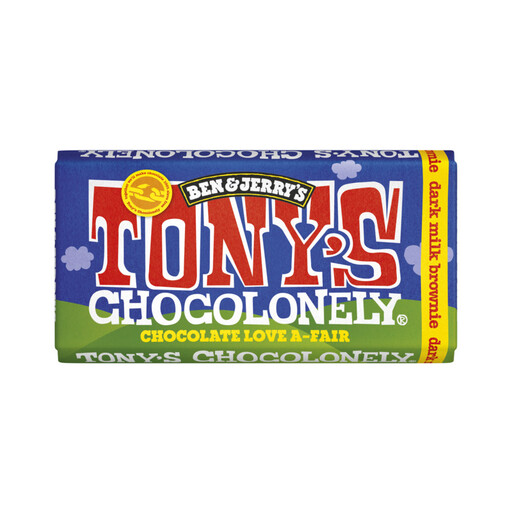 Image unavailable
Tony's Chocolonely Ben & Jerry's Dark Milk Chocolate Fudge Brownie 180 g
A chocolate-bar alternative for elevenses if you want fudge brownie pieces rather than traditional fudge. The product description says its cocoa beans are Fairtrade; check the pack for the applicable mark and its scope, along with current ingredients and allergen information.
View on Joybuy
 Image unavailable
Tony's Chocolonely Fairtrade Milk Chocolate Caramel Sea Salt 180 g
A milk-chocolate alternative with caramel and sea salt, rather than a fudge product. The listing identifies sugar, cocoa butter and cocoa mass as Fairtrade ingredients; check the exact pack for its mark and claim scope. Use the pack’s portion, ingredients and allergen information when deciding whether to share it.
View on Joybuy
Questions about Fairtrade fudge
Does chocolate fudge automatically count as Fairtrade?
No. Chocolate flavour or coating does not establish a Fairtrade claim. Check the exact pack for a mark or product-specific statement, then read which ingredients the claim covers.
What do the two Fairtrade Marks mean?
According to the Fairtrade Foundation, the classic black-background Mark means all ingredients that can be Fairtrade certified are Fairtrade-certified. The white-background Fairtrade Sourced Ingredient Mark identifies one named Fairtrade-sourced ingredient, such as cocoa; it does not automatically cover sugar.
What if I cannot confirm a Fairtrade claim on the fudge?
Decide which matters more for this treat: fudge itself or a clearly identified Fairtrade-sourced item. You can choose explicitly labelled chocolate instead, or serve the fudge you want with a separately labelled Fairtrade drink. In the latter case, the drink’s claim does not apply to the fudge.
Does a Fairtrade claim change what I should check on the nutrition label?
No. Fairtrade labelling addresses sourcing rather than sugar content. Check the serving and nutrition information on the exact pack; the NHS advises keeping the amount and frequency of sugary foods and drinks as low as possible.
What should I check before sharing fudge or chocolate?
Read the current ingredients and allergen information for the exact product and flavour, including relevant precautionary wording. Do not assume that two products with similar names have the same recipe.


