Breakfast drinkers avoiding black tea
If you want a herbal drink with a cooked breakfast, Clipper describes its Fairtrade Organic Peppermint Infusion as naturally caffeine-free. Its Fairtrade Organic English Breakfast product is black tea.


Choose an explicitly Fairtrade herbal infusion if you want a naturally caffeine-free drink with a Full English breakfast: Clipper describes its Fairtrade Organic Peppermint Infusion this way. If you want black tea instead, a Fairtrade English Breakfast tea is a different choice. Check the exact pack for its certification and ingredients, since another ethical-sourcing label is not necessarily the Fairtrade Mark.
If you want a herbal drink with a cooked breakfast, Clipper describes its Fairtrade Organic Peppermint Infusion as naturally caffeine-free. Its Fairtrade Organic English Breakfast product is black tea.
If Fairtrade certification is your requirement, check the mark and wording on the particular pack. The Fairtrade Foundation distinguishes its marks from other sourcing claims; Pukka identifies its own tea certification as Fair for Life.
Blend ingredients matter if you need to avoid a particular botanical. NHS pregnancy guidance says to avoid teas containing liquorice root, which Tesco lists in some blends in Pukka’s Herbal Collection.
Decide whether you want a herbal infusion or black tea, then check the certification and ingredients of the exact product.
| Priority | What to check | Your needs |
|---|---|---|
| Fairtrade certification | Look for the Fairtrade Mark on the pack and read its wording. The Fairtrade Foundation explains that its classic mark and mass-balance mark have different implications for how ingredients are sourced and processed. | I want the product to meet a Fairtrade requirement, rather than relying on an organic label or a different ethical certification. |
| Tea type | Check whether the product is labelled as a herbal infusion or black tea, and whether it states that it is caffeine-free. Clipper calls its Fairtrade Organic Peppermint Infusion naturally caffeine-free; its Fairtrade Organic English Breakfast is black tea. | For breakfast, I would rather have an infusion than a black-tea drink. |
| Flavour | Read the blend name and ingredients. Clipper describes its peppermint infusion as crisp and cool, while its English Breakfast black tea contains Assam and Ceylon teas. | Do I want peppermint with my meal, or am I looking for the familiar style of English Breakfast tea? |
| Botanicals | Read the full ingredient list, particularly on blends. NHS pregnancy guidance says to avoid teas containing liquorice root and to drink no more than four cups of herbal tea a day during pregnancy. | I need to check each blend against ingredients I avoid, rather than assuming all herbal teas contain the same plants. |
Pukka describes its teas as Fair for Life certified. That is not the same certification as the Fairtrade Marks explained by the Fairtrade Foundation.
If Fairtrade is a firm requirement, check the mark and wording on the exact product before choosing it.
Clipper’s Fairtrade Organic English Breakfast is black tea, whereas its Fairtrade Organic Peppermint Infusion is described as naturally caffeine-free. The breakfast occasion alone does not make them the same type of drink.
Choose the tea type you want first, then check certification within that choice.
Some blends in Pukka’s Herbal Collection list liquorice root. NHS pregnancy guidance says to avoid teas containing it.
Read the ingredients of each blend, especially if pregnancy guidance or advice about particular botanicals applies to you.
These brand examples show why the certification and tea type need checking at product level.
Clipper Tea Shop lists Fairtrade Organic herbal infusions as well as a Fairtrade Organic English Breakfast black tea.
Pukka says its teas are certified Fair for Life and its products are certified organic.
Twinings presents an Organic & Fairtrade tea collection and a separate herbal-infusion collection.
This Clipper option is black tea for someone who wants that style with breakfast, rather than a herbal infusion. Check the pack if you specifically want an English Breakfast blend.
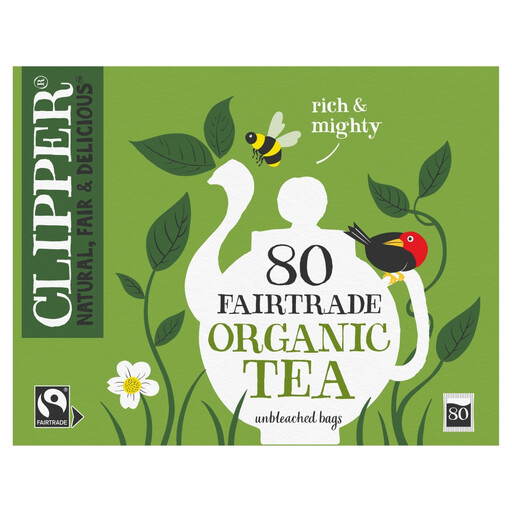 Image unavailable
Consider this black tea if you prefer it to a herbal infusion with breakfast. The product name states 80 tea bags and 232g, and identifies the tea as Organic Fairtrade. If you specifically want an English Breakfast blend, check the precise blend on the pack.
Look for the Fairtrade Mark and its wording on the exact pack or product listing. The Fairtrade Foundation says its classic black-background mark indicates that ingredients which can be Fairtrade-certified are Fairtrade-certified; a different ethical-sourcing logo does not mean the same thing.
No. The Fairtrade Foundation explains that, under mass balance, Fairtrade and non-Fairtrade commodities may be mixed during processing while an equivalent quantity is bought on Fairtrade terms. Check which mark and wording appear on the pack if physical traceability matters to you.
Choose according to the drink you want, rather than the meal alone. Clipper describes its Fairtrade Organic Peppermint Infusion as naturally caffeine-free; its Fairtrade Organic English Breakfast is an Assam and Ceylon black-tea blend.
No; certification and ingredients answer different questions. NHS pregnancy guidance says to avoid teas containing liquorice root and to drink no more than four cups of herbal tea a day, so check the ingredients of the particular blend.