For a brunch that specifically calls for Fairtrade-certified herbal tea, check the claim on each blend’s own pack or product page; organic or Fair for Life labelling is not interchangeable with Fairtrade certification. If friends have different flavour preferences, offer a few clearly labelled blends, checking the ingredients and caffeine-free claim on each one.
Who is this choice for?
Hosts with a specific Fairtrade requirement
If the tea served at brunch must be Fairtrade-certified, check the claim on the exact blend. An organic label, a brand’s wider Fairtrade range or a different fair-trade standard does not establish that claim for an individual herbal tea.
Hosts offering an alternative to coffee or breakfast tea
A choice of herbal flavours gives guests another option. Twinings describes its fruit-and-herbal range as caffeine-free, and Clipper says the same of its herbal infusions; check the individual product when caffeine avoidance matters.
Hosts who want several flavours on the table
When guests’ preferences are unknown, an assortment lets them choose their own blend. Pukka describes its Herbal Collection as four organic blends and says its teas are Fair for Life certified, which is a different requirement from Fairtrade certification.
What should you check before buying?
Settle the certification requirement first, then choose flavours and serving formats that work for the people coming to brunch.
| Priority |
What to check |
Your needs |
| Fairtrade claim |
Look for a FAIRTRADE Mark or explicit Fairtrade claim on the exact blend, and check what the claim covers. The Fairtrade Foundation says the classic mark indicates that ingredients eligible for Fairtrade certification are Fairtrade-certified. |
I need the herbal tea I serve to meet a specific Fairtrade requirement, rather than relying on an organic label or a brand-wide sourcing statement. |
| Flavour choice |
Compare the blend names and ingredient lists. Consider a selection pack or a few distinct flavours rather than several boxes of one blend. |
My friends may not all want the same flavour; a choice of mint, ginger, chamomile or fruit blends gives them room to choose. |
| Caffeine claim |
Check the selected product’s caffeine-free claim and ingredients, especially if it combines herbs with other tea ingredients. A range description is not a substitute for checking the box you will serve. |
Alongside coffee or breakfast tea, I want an option for guests who are avoiding caffeine. |
| Serving information |
Read the full ingredient list, preparation directions and pack quantity before deciding how many boxes or teapots to use. |
If someone asks what is in their cup, I want to be able to show them the blend’s ingredients and prepare it as directed. |
Common mistakes when choosing
-
Treating a brand’s reputation as certification for every blend
Clipper describes itself as a Fairtrade tea company, but its Fairtrade collection and herbal-infusion range are distinct. A claim about the brand does not establish certification for a particular herbal box.
For a strict Fairtrade brunch selection, check the exact herbal product’s packaging or product page for its own Fairtrade claim.
-
Assuming organic and Fairtrade mean the same thing
Pukka describes its Herbal Collection as organic and says its teas are Fair for Life certified. Neither description is a claim that the collection carries the FAIRTRADE Mark.
Decide whether Fair for Life meets your requirement; if it does not, check separately for Fairtrade certification on the product you choose.
-
Serving just one herbal flavour to everyone
Herbal ranges include distinct ingredients and flavours, from mint and ginger to chamomile and fruit blends. One blend gives guests less choice.
Put out a small selection with the blend names and ingredients visible, so guests can choose for themselves.
Brands and their herbal ranges
These brand ranges can help narrow down flavours, but a brand’s sourcing position does not establish Fairtrade certification for every herbal product it sells.
Pukka
Pukka offers organic herbal blends and describes its Herbal Collection as a four-blend assortment.
- The collection provides several flavours in one selection for guests to choose from.
- Pukka says its teas are Fair for Life certified. Check the exact collection if the requirement is specifically Fairtrade certification.
Twinings
Twinings lists fruit-and-herbal infusions including peppermint, camomile, lemon and ginger, and fruit flavours.
- Twinings describes this range as caffeine-free and suitable for serving hot or cold.
- Its responsible-sourcing programme is not, by itself, a Fairtrade claim for an individual herbal infusion.
Clipper
Clipper offers herbal infusions and separately describes itself as a Fairtrade tea company.
- Its herbal range includes flavours such as chamomile, peppermint, and lemon and ginger; Clipper describes the infusions as caffeine-free.
- The Fairtrade collection shown by Clipper includes black and green teas. Check the chosen herbal pack for its own certification claim.
teapigs
The teapigs herbal range lists peppermint, liquorice and peppermint, honeybush and rooibos, lemon and ginger, chamomile, and fruit blends.
- The listed flavours offer different options for a brunch table.
- Check a selected product’s packaging for a Fairtrade claim before using it to meet a strict certification requirement.
Tesco
Tesco’s herbal-tea catalogue includes own-label and branded products.
- Its listings can help compare blend names and pack formats.
- A catalogue listing alone does not establish Fairtrade certification for a particular herbal tea; check the individual product.
A Joybuy herbal tea option
This single-blend option is relevant if you want a herbal tea whose listing makes a product-specific Fairtrade claim. For a strict requirement, check that claim on the exact pack before buying; it is not a mixed-flavour selection.
 No image available
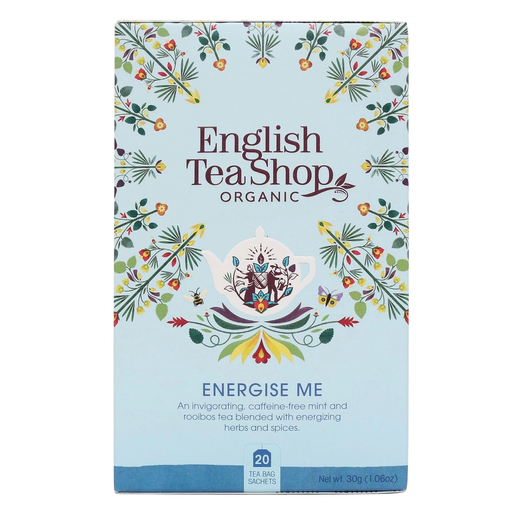
English Tea Shop Organic Wellness Energize Me 30g
A single blend to consider for guests who want a herbal option at brunch. The product listing describes it as caffeine-free and claims Fairtrade International certification. Check the exact pack for the certification claim, ingredients, number of tea bags and preparation directions when planning what to serve.
View on Joybuy
Questions about herbal tea for brunch
Is Fair for Life the same as Fairtrade?
No. They are separately named standards. Pukka says its teas are Fair for Life certified; if your brunch requires Fairtrade-certified tea, check the exact product for a Fairtrade claim or FAIRTRADE Mark instead of treating the two labels as interchangeable.
Does a FAIRTRADE Mark always mean ingredients were physically kept separate?
Not necessarily. The Fairtrade Foundation explains that its mass-balance model can allow certified and non-certified commodities to mix during processing, provided the amount sold as Fairtrade matches the amount purchased on Fairtrade terms. Check how a certification claim applies to the ingredients in the particular blend.
How can I serve herbal tea to guests with different tastes?
Offer a few clearly labelled blends rather than relying on one shared flavour, and keep their ingredient lists available. Pukka describes its Herbal Collection as four organic blends; check each tea’s certification if Fairtrade status is part of your choice.
Can I assume every herbal tea is caffeine-free?
Check the product you intend to serve. Twinings describes its fruit-and-herbal range as caffeine-free, and Clipper says its herbal infusions are caffeine-free, but those range descriptions do not replace checking an individual blend when caffeine avoidance matters.


