Shoppers who require Fairtrade ingredients
If certification matters more than a handheld snack, an ice cream in another format may be worth considering. Check the exact product’s Fairtrade Mark and ingredient scope before choosing it.


If Fairtrade certification is essential, choose a packaged cone only after checking the exact pack’s Fairtrade Mark and what it covers; a familiar brand or a different cocoa certification is not a substitute. If the cone matters less, Ben & Jerry’s describes Fairtrade sourcing for ingredients in its ice cream, but that does not make it a verified ready-made cone. For food supplied to pupils in England’s state-funded schools, chocolate-coated products must also be considered under the school-food confectionery rule, rather than a blanket UK-wide HFSS assumption.
If certification matters more than a handheld snack, an ice cream in another format may be worth considering. Check the exact product’s Fairtrade Mark and ingredient scope before choosing it.
A ready-made cone or multipack can suit an informal gaming session. Tesco Groceries lists several Cornetto cone variants, but a retailer category listing does not establish their Fairtrade status.
If the snack would be supplied to pupils in a state-funded school, check the applicable school-food rules before considering it. England’s confectionery restriction is relevant to products wholly or partially coated with chocolate.
Decide whether Fairtrade certification or a ready-made cone is the firmer requirement, then check the exact pack rather than relying on the brand or freezer category.
| Priority | What to check | Your needs |
|---|---|---|
| Fairtrade scope | Look for the Fairtrade Mark on the exact pack and read which ingredients it covers. The Fairtrade Foundation says its classic Mark means all ingredients that can be Fairtrade-certified are certified. | I want the certification claim to cover the ingredients that matter to me, rather than relying on a general sustainability message. |
| Snack format | Check whether the product is a ready-made cone or ice cream to serve separately. For a multipack, compare the stated number and size of portions. | A handheld cone might be easier for my gaming session; if Fairtrade ingredients come first, I can consider a different format. |
| Certification scheme | Read the named scheme, not just the cocoa-sourcing claim. Magnum describes Rainforest Alliance-certified cocoa and vanilla; this is distinct from Fairtrade certification. | If I specifically require Fairtrade, another ethical-sourcing claim will not answer that requirement. |
| School setting | Identify the nation, setting and product coating. Under England’s school-food regulations, confectionery must not be provided to pupils, and the definition includes products wholly or partly coated with chocolate. | For a school snack, I need to check the rules that apply where and how it will be supplied—not assume a generic HFSS label settles the question. |
Magnum’s Rainforest Alliance sourcing statement and the Fairtrade Mark refer to different schemes. One does not establish certification under the other.
If Fairtrade is your requirement, use the exact pack’s Fairtrade Mark and stated ingredient scope as the check.
Tesco Groceries’ cone listing helps identify formats and pack sizes, but a category listing alone does not establish Fairtrade certification for a Cornetto variant.
Inspect the exact pack or manufacturer’s product information before describing a cone as Fairtrade.
England’s school-food rules are a separate question from a food’s nutrient-profile classification. The England confectionery restriction matters when a chocolate-coated product is supplied to pupils in the covered school setting.
For a school purchase, establish the relevant nation, setting and product characteristics before making a compliance decision.
A packaged-cone option when the ready-made format matters.
An ice-cream alternative when Fairtrade ingredient claims matter more than a ready-made cone.
A reference for comparing named cocoa-sourcing schemes, not a Fairtrade cone recommendation.
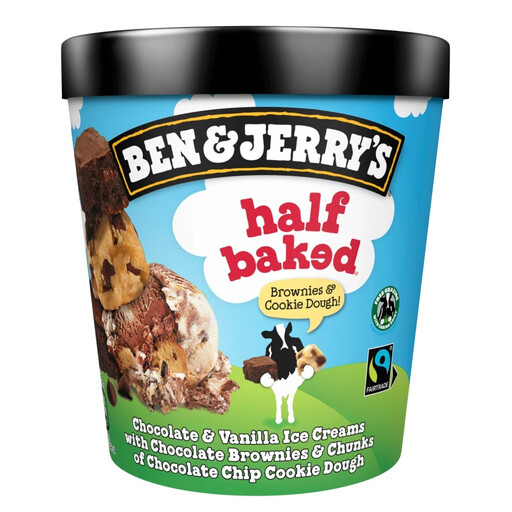
This ice cream is a tub option for a gaming snack when Fairtrade ingredients matter more than having a ready-made cone. Check its exact pack for the Fairtrade Mark and the ingredients covered.
 No image available
A 465 ml tub to consider when a ready-made cone is not essential. Ben & Jerry’s describes Fairtrade sourcing across its ice-cream flavours; check this pack’s Mark and ingredient scope if certification is decisive. It is not a packaged cone, and school-food suitability requires a separate check for the applicable setting.
Look for a Fairtrade Mark on the exact retail pack and check what it covers. The Fairtrade Foundation says its classic Mark indicates that all ingredients capable of Fairtrade certification are certified. A general sustainability claim does not establish the same thing.
No. Magnum describes Rainforest Alliance-certified cocoa and vanilla, while Fairtrade has its own Mark and certification scope. If your requirement is specifically Fairtrade, check for that claim on the product you intend to buy.
No: its Fairtrade ingredient statements concern its ice cream, not a named ready-made cone. Ben & Jerry’s UK identifies the sugar and vanilla in its Vanilla ice cream as 100% Fairtrade; check the exact flavour and pack you choose rather than transferring that product statement to another format.
Under England’s school-food regulations, confectionery must not be provided to pupils, and the definition includes products wholly or partially coated with chocolate. This conclusion concerns food supplied in the covered England school setting; it is not a rule for every private setting or every UK nation.
No. The GOV.UK nutrient profiling model classifies foods using their nutritional composition, while England’s school-food requirements are separate rules. For a chocolate-coated product supplied to pupils in the covered setting, check the confectionery restriction rather than assuming an unspecified product has an HFSS classification.