Hosts looking for Fairtrade tea
If Fairtrade is part of the buying decision, check the claim on the exact tea-bag pack rather than relying on a brand name or a general sourcing statement.


For a brunch where Fairtrade tea is the priority, check that the claim applies to the tea in the exact pack, then choose a style your guests will drink. A Fairtrade black tea gives guests who take milk a familiar option; a separately labelled Fairtrade green tea adds a different choice. Organic or Rainforest Alliance wording alone does not establish a Fairtrade claim.
The right tea selection depends on whether Fairtrade is a firm requirement and which drinks you need to offer alongside brunch.
If Fairtrade is part of the buying decision, check the claim on the exact tea-bag pack rather than relying on a brand name or a general sourcing statement.
Clipper lists Fairtrade everyday black tea, an English Breakfast blend and green tea. A black and a green option can give guests a choice without treating the two styles as interchangeable.
Keep the packaging available so guests can check the current ingredients and allergen information, particularly for flavoured or blended tea. If someone requests decaf or has a strict caffeine limit, check the exact product rather than assuming all teas in a range meet that need.
Start with the certification claim, then decide which tea styles and pack details matter for the people coming to brunch.
| Priority | What to check | Your needs |
|---|---|---|
| Fairtrade claim | Read the exact pack or listing. The Fairtrade Foundation says the classic Fairtrade Mark covers ingredients capable of Fairtrade certification; for an ingredient-specific claim, check that tea is named. | I want to know what the sourcing claim covers before serving the tea. In Kantar research reported by Fairtrade International in September 2025, 86% of UK adults said brands should be upfront about sourcing; that figure measures transparency, not a preference for Fairtrade tea. |
| Tea style | Compare the named black- and green-tea varieties. Clipper describes its Fairtrade English Breakfast tea as an Assam and Ceylon black-tea blend; its Everyday and Green Tea product pages make Fairtrade claims for the tea in those specific packs. | Some guests will want black tea they can take with milk, while others would rather have a green-tea option. |
| Certification type | Check whether the label says Fairtrade or Rainforest Alliance; one claim does not establish the other. Fairtrade International describes a minimum price and Fairtrade Premium for tea sourced on Fairtrade terms. | If Fairtrade is my requirement, a different sourcing certification will not answer it. If I am open to either approach, I can compare the claims on the packs separately. |
| Caffeine preference | Identify any pack labelled decaf, and check its product information if a guest has a strict caffeine limit. Do not treat green tea as a decaf option. | I need an option for a guest who asks for decaf, without assuming the label tells me a precise residual caffeine amount. |
| Serving details | Read each tea’s brewing instructions and the current ingredients and allergen statement. Check pack size against the number of cups you expect to serve. | I would like guests to choose how they take their tea, and I need the packaging to hand if someone asks about ingredients. |
A brand’s name or general sourcing information does not establish the certification of every tea bag it sells. Yorkshire Tea, for example, describes its suppliers’ Rainforest Alliance certification in its explanation of why Yorkshire Tea is not Fairtrade.
Check the current pack or product listing for a Fairtrade Mark or a specific statement covering the tea.
Guests who would choose green tea may not want the same cup as those taking black tea with milk.
If the guest mix calls for both, choose separately labelled Fairtrade black and green teas and follow each pack’s brewing instructions.
Organic, Rainforest Alliance and Fairtrade claims describe different things. A pack carrying one of them does not necessarily carry the others.
Confirm the Fairtrade claim first if that is your requirement; assess other labels and tea styles on their own terms.
A tea’s name alone may not give a guest enough information about its ingredients, particularly if it is flavoured or blended.
Keep the exact pack available so you can check its current ingredient and allergen information when asked.
These brand references help distinguish specific Fairtrade tea options from other sourcing claims; they do not mean every product in a brand’s range has the same certification.
Clipper lists Fairtrade black- and green-tea options that could provide different styles for a brunch table.
Twinings has an Organic & Fairtrade collection as well as other tea ranges.
A black-tea reference for shoppers considering Rainforest Alliance sourcing rather than requiring Fairtrade.
A tea brand to consider separately if Rainforest Alliance certification meets your sourcing preference.
Another option to assess when the requirement is not specifically Fairtrade.
These Clipper packs offer an everyday tea and a decaf-labelled alternative for a brunch table. Check each pack’s Fairtrade claim and serving information when choosing between them.
 No image available
A decaf-labelled choice for guests who request it, in an 80-bag, 277g pack. If a strict caffeine limit matters, check the exact pack for the information the guest needs.
 No image available
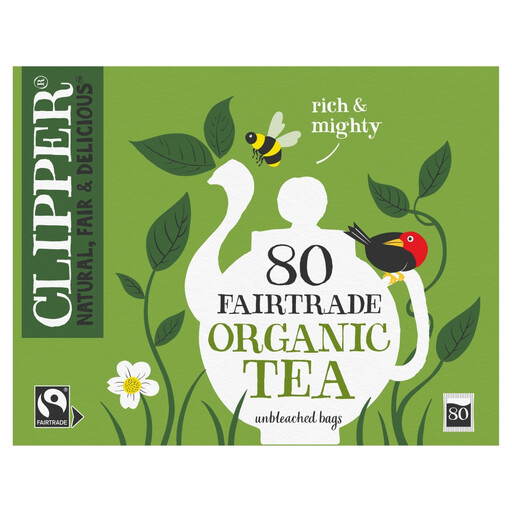
An 80-bag, 232g pack for guests who want a black-tea option; the product information identifies organically grown black tea. Check the pack for its brewing directions before serving.
Check the exact pack or listing and read what its Fairtrade claim covers. The Fairtrade Foundation says its classic black-background Mark indicates that ingredients capable of Fairtrade certification are Fairtrade-certified; an ingredient-specific mark requires you to check that tea is the named ingredient. Some Clipper product pages instead state explicitly that the tea is traded in compliance with Fairtrade standards.
No: a Rainforest Alliance claim does not establish a Fairtrade claim on the same tea. Rainforest Alliance sourcing is identified for PG Tips, Tetley, Typhoo and Yorkshire Tea in their respective sourcing information; if Fairtrade is your requirement, check the exact product for that claim separately.
If guests have different preferences, a specifically labelled Fairtrade black tea and a Fairtrade green tea give them two distinct choices. Clipper’s Everyday and Green Tea 40-bag product pages each make a Fairtrade statement about the tea; check the directions on whichever packs you serve and offer milk separately for guests taking black tea.
Follow each pack’s own brewing instructions rather than using one method for both. When guests want different strengths, individual bags also let them decide when to remove the tea.
Read the current ingredient and allergen information on the exact pack, especially for flavoured or blended teas, and keep it available while serving. Do not assume another variety or an older pack has the same ingredients.