What should you check before buying?
Start with the certification on the exact product, then choose the tea style and bag format that fit your break. Check disposal instructions separately from claims about the tea itself.
| Priority |
What to check |
Your needs |
| Fairtrade status |
Read the Fairtrade wording or look for the FAIRTRADE Mark on the exact pack. Check that the claim applies to the tea, not just another product in the range. |
Fairtrade is essential to my choice, so a general statement about the brand is not enough. Clipper’s Everyday and English Breakfast pages specify tea traded in compliance with Fairtrade standards, total 100%. |
| Certification type |
Identify which scheme is named on the product. Yorkshire Tea describes its tea as Rainforest Alliance Certified; the Rainforest Alliance also lists PG Tips and Tetley tea for the UK. |
I can consider a different certified-sourcing approach if Fairtrade itself is not required. If it is required, I need a Fairtrade claim on the tea I buy. |
| Tea style |
Check whether the particular product is black tea, decaffeinated or another blend. Read its stated flavour description and brewing directions rather than applying those of a different variant. |
For a short afternoon break, I want a cup that matches my taste and preparation routine. Clipper describes its Organic & Fairtrade Everyday tea as a rich, complex black-tea blend. |
| Bag disposal |
Follow the pack’s disposal directions and check what your local food or garden-waste service accepts. Do not assume a plant-based seal means the whole bag will break down in a home compost bin. |
I need a disposal route that works where I live. Recycle Now says plant-based-plastic-sealed tea bags need industrial processing to break down completely. |
Brand ranges and certification
A brand can offer differently labelled blends. Use these references to narrow your search, then check the particular tea bags before buying.
Clipper
Clipper’s Organic & Fairtrade Everyday and English Breakfast product pages identify organically grown black tea and state that the tea is traded in compliance with Fairtrade standards, total 100%.
- Product-specific Fairtrade wording is available for the cited Everyday and English Breakfast packs.
- Check the particular blend and bag count: a claim for one Clipper product does not establish the details of another.
Twinings
Twinings has an Organic & Fairtrade tea collection for shoppers who want to browse beyond a standard black-tea blend.
- The collection provides a starting point for finding individually labelled teas.
- Check each product’s tea type and certification; the collection does not make every Twinings tea Fairtrade.
Yorkshire Tea
Yorkshire Tea describes its tea as Rainforest Alliance Certified.
- Its named certification gives shoppers a distinct sourcing criterion to consider.
- Rainforest Alliance certification should not be used as proof of Fairtrade status.
Tetley
Tetley describes Rainforest Alliance sourcing for its tea, and the Rainforest Alliance lists Tetley tea among products available in the UK.
- The UK listing identifies the certified ingredient as tea.
- For a Fairtrade-specific purchase, check the exact pack for a separate Fairtrade claim.
PG Tips
The Rainforest Alliance lists PG Tips tea and identifies tea as the certified ingredient for products available in the UK.
- The listing provides a product-category reference for Rainforest Alliance certification.
- It does not establish that PG Tips tea bags are Fairtrade.
Typhoo
Typhoo describes its 240 Premium Tea Bags product as Rainforest Alliance Certified and states 3.125 g of tea per bag for that pack.
- The stated bag content helps identify the cited 240-bag product.
- Its Rainforest Alliance claim is not a Fairtrade claim; check other Typhoo variants separately.
Joybuy tea-bag options
These Clipper listings are black-tea bag options for an afternoon break, including a decaffeinated variant. Their titles make Fairtrade claims; if that certification is essential to your choice, check the wording or mark on the exact pack.
 No image available
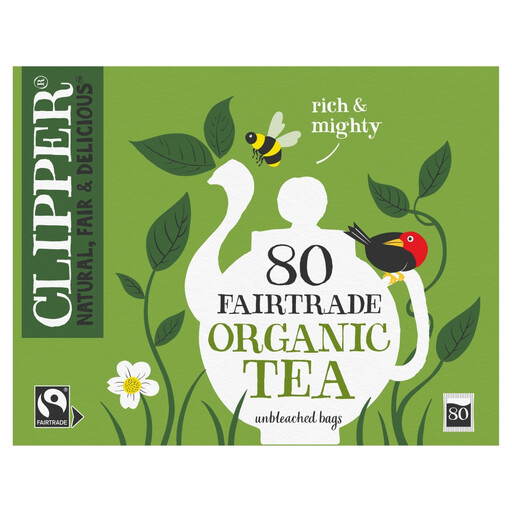
Clipper Organic Fairtrade 80 Tea Bags 232g
An 80-bag black-tea option for repeated afternoon breaks. The listing names organically grown black tea and calls the product Fairtrade; check the exact pack’s certification wording, brewing directions and disposal instructions before relying on those details.
View on Joybuy
 No image available
Clipper Organic Fairtrade Decaf Everyday 80 Tea Bags 277g
This 80-bag decaffeinated black-tea listing is an option if you prefer decaf during your afternoon break. Its product description makes a Fairtrade claim for the tea; confirm the wording on this decaffeinated pack, along with its brewing and disposal instructions.
View on Joybuy
Questions about Fairtrade tea bags
How can I tell whether tea bags are Fairtrade?
Check the exact pack or product page for Fairtrade wording or the FAIRTRADE Mark. Clipper’s cited Everyday and English Breakfast pages state that the tea is traded in compliance with Fairtrade standards, total 100%; a claim about another blend from the same brand is not a substitute.
Is Rainforest Alliance certification the same as Fairtrade?
No. They are different certification schemes, so a Rainforest Alliance claim alone does not confirm that tea bags meet a Fairtrade-specific preference. If Fairtrade is essential, look for evidence on the particular pack.
Which Clipper black tea suits an afternoon break?
Clipper describes its Organic & Fairtrade Everyday tea as a rich, complex black-tea blend; its Organic & Fairtrade English Breakfast is another black-tea option if you prefer that style. The cited product pages for both state that the tea is traded in compliance with Fairtrade standards, total 100%. Choose by the particular blend and pack you want, rather than assuming their flavour or preparation directions are identical.
How long should I brew the tea bags?
Follow the directions on the pack you buy. Brewing guidance can differ between products and pack formats, so use that pack’s stated range when adjusting the cup to your taste.
Can used tea bags go in food waste or home compost?
Check the bag and your local collection instructions before choosing a disposal route. Recycle Now says tea bags sealed with plant-based plastic need industrial processing to break down completely; that does not establish that they are suitable for home composting.


