Buyers with a Fairtrade purchasing requirement
Check the Fairtrade wording on the exact tea product rather than relying on a general statement about the brand’s sourcing.


If Fairtrade is a workplace canteen purchasing requirement, check the exact tea product for an explicit Fairtrade statement before choosing a pack size. A catering carton may suit frequent lunch service, while smaller Fairtrade-labelled packs can add choice; Rainforest Alliance certification is a different option and does not, by itself, meet a Fairtrade-specific requirement.
Check the Fairtrade wording on the exact tea product rather than relying on a general statement about the brand’s sourcing.
Compare bag count with expected use, available dry storage and the way staff or customers will prepare each cup.
Check each decaffeinated or speciality tea separately for Fairtrade wording, and keep ingredient and allergen information current for everything served with it.
Decide whether Fairtrade is required, then choose the tea types and pack quantities that fit lunch service. Certification, carton size and menu variety are separate checks.
Consider when: Many customers want a standard black tea and the purchasing requirement specifies Fairtrade; Clipper Tea Shop lists a 1120-bag catering product with an explicit Fairtrade tea statement.
Allow for: A large carton needs suitable storage and a replenishment plan, and black tea alone will not provide a decaffeinated choice.
Consider when: The canteen wants options alongside its regular tea, such as decaffeinated or organic varieties.
Allow for: Check the certification and pack format of each variant; a brand’s Fairtrade collection does not establish the status of every tea it sells.
Consider when: The purchasing brief accepts a sustainability certification other than Fairtrade, such as Rainforest Alliance certification.
Keep distinct: Yorkshire Tea identifies its tea bags as Rainforest Alliance Certified and explains that its regular tea is not Fairtrade. Do not record the two schemes as interchangeable.
| Priority | What to check | Your needs |
|---|---|---|
| Fairtrade status | Read the exact pack or product specification for a Fairtrade statement. If the purchasing brief requires all the tea in a product to be Fairtrade, check its specific ingredient and certification wording. | “I need to document that the tea we order meets a Fairtrade requirement, rather than a different sourcing standard.” Clipper Tea Shop describes its Fairtrade Everyday One Cup catering product as tea traded in compliance with Fairtrade standards, total 100%. |
| Service quantity | Compare bags per pack with lunch-period use, dry storage space and the supplier’s instructions for the exact tea. Clipper Tea Shop lists 1120 one-cup catering bags; Coffee Masters and Discount Cream each list a different 1100-bag Fairtrade catering product. | “Our team needs enough bags for regular service without ordering more than we can store and use.” |
| Menu choice | Check Fairtrade wording separately for each tea type, then compare whether bulk or smaller packs suit self-service and replenishment. | “Some colleagues prefer a decaffeinated or different tea alongside regular black tea, but I still need to check the status of each choice.” |
| Served-drink information | Keep current ingredient and allergen information for the tea and additions such as milk, plant drinks or syrups. GOV.UK’s food-business guidance and Food Standards Scotland address allergen information for prepacked and non-prepacked food and drink. | “People need accurate information about the drink as served, not just the tea bag.” |
A Rainforest Alliance-certified tea does not necessarily meet a Fairtrade-specific purchasing requirement. Yorkshire Tea distinguishes its Rainforest Alliance certification from Fairtrade.
Put the required certification in the purchase specification and check the exact product before ordering.
Tea type, certification and pack format can differ within a brand’s range, including its foodservice range.
Check the current wording, ingredients and bag count for each regular, decaffeinated or speciality product selected.
A large bag count is useful only if the canteen has suitable storage and a preparation method that works during lunch service.
Compare the carton with actual use, follow that product’s brewing instructions and trial the serving method before committing to a larger quantity.
Milk, plant drinks, flavoured additions and accompanying food need to be accounted for when managing allergen information and cross-contact.
Keep supplier information current for everything served and follow the canteen’s staff allergen procedures. GOV.UK and Food Standards Scotland provide food-business guidance on these duties.
These references describe particular tea lines and certifications; check the exact product before including it in a Fairtrade purchase.
Clipper Tea Shop lists Fairtrade tea options, including an Everyday One Cup catering carton.
Twinings has an Organic & Fairtrade consumer collection and a separate UK trade range of foodservice teas.
A different certification route where the purchasing brief does not require Fairtrade.
The Rainforest Alliance lists PG Tips tea as certified and available in the United Kingdom.
These 80-bag Clipper packs are options for a workplace tea menu, including a decaffeinated choice. For a Fairtrade-specific order, check the current wording on the exact pack; also compare the pack quantity with the canteen’s replenishment needs.
 No image available
A decaffeinated choice for the workplace tea menu, supplied as 80 bags in a 277g pack. Check the delivered pack’s Fairtrade wording and brewing instructions, and whether this quantity fits the canteen’s replenishment plan.
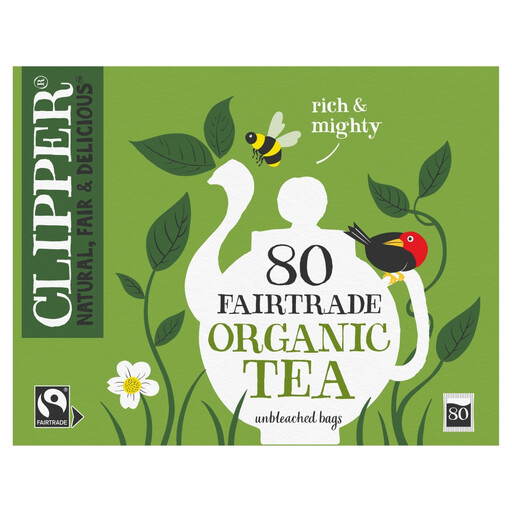 No image available
An organic tea option for lunch service, supplied as 80 bags in a 232g pack. Check the delivered pack’s Fairtrade wording and brewing instructions, and plan how often an 80-bag pack would need replacing.
Check the exact product pack or current specification for an explicit Fairtrade statement or FAIRTRADE Mark; a different certification or general brand statement is not enough. Clipper Tea Shop, for example, describes the tea in its Everyday One Cup catering product as traded in compliance with Fairtrade standards, total 100%.
Do not treat their Rainforest Alliance certification as proof of Fairtrade. Yorkshire Tea says its regular tea is not Fairtrade, while the Rainforest Alliance lists PG Tips tea under its own certification; either may be considered only if the brief accepts that different scheme, unless the exact product has separate Fairtrade evidence.
Follow the instructions for the product being served and use the same method during lunch service. Clipper Tea Shop gives a 2–4 minute brew for its cited catering tea, while Coffee Masters gives 200ml of freshly boiled water and 1–3 minutes for its different Tea Masters product; those instructions should not be transferred to another pack without checking it.
Account for the drink as served, including milk, plant drinks and flavoured additions, as well as accompanying food. GOV.UK’s food-business guidance and Food Standards Scotland address allergen information for prepacked and non-prepacked food and drink; keep supplier details current and follow the canteen’s procedures for managing allergens.