Commuters who require Fairtrade tea
If you make tea at work, home or another destination with boiling water, check the Fairtrade wording on the particular pack you plan to use, not just the brand’s wider range.


If Fairtrade is essential, choose tea bags whose exact pack or product listing states that the tea is traded in compliance with Fairtrade standards; Clipper’s Organic & Fairtrade Everyday 40 Tea Bags are one product-specific example. Rainforest Alliance certification, organic status and general sourcing claims answer different questions. For a cup made at work or another destination, also check the bag count, access to boiling water and whether you want the decaf variant.
The useful starting point is whether Fairtrade is a requirement or one of several sourcing credentials you would consider.
If you make tea at work, home or another destination with boiling water, check the Fairtrade wording on the particular pack you plan to use, not just the brand’s wider range.
If you are open to different sourcing programmes, compare what the tea’s own label says. Fairtrade and Rainforest Alliance are distinct certifications, so one name does not establish the other.
If you want a decaffeinated black tea for a later cup, check both the Fairtrade wording and the decaf variant. Joybuy lists a Clipper Organic Fairtrade Decaf Everyday 80-bag product.
Start with the certification on the exact tea, then choose the type and pack count for where you will make it. A sourcing label does not determine whether a blend is decaf or how many bags you need.
| Priority | What to check | Your needs |
|---|---|---|
| Fairtrade claim | Read the exact pack or product page. Check that its Fairtrade wording applies to the tea ingredient and the variant you are buying. Clipper Tea Shop states that its Organic & Fairtrade Everyday 40-bag tea is traded in compliance with Fairtrade standards, total 100%. | Fairtrade is a requirement for my everyday brew, so a brand-wide ethical-sourcing message alone will not answer the question. |
| Certification type | Identify whether the stated certification is Fairtrade or Rainforest Alliance. Yorkshire Tea says its tea comes from Rainforest Alliance-certified suppliers; Fairtrade International’s 2021 Tea Standard describes a Fairtrade Premium framework. | I am willing to consider another certification, but I want to know which one applies before choosing a familiar blend. |
| Traceability | Look for an explicit physical-traceability claim if that matters to you. Fairtrade International’s June 2026 Trader Standard describes mass balance as allowing materials to be mixed or exchanged during handling, subject to equivalent Fairtrade purchasing volumes. | A Fairtrade purchasing claim matters to me, but I do not want to mistake the label alone for a promise that every leaf was kept physically separate. |
| Tea type and pack | Check whether the exact variant is decaf, how many bags it contains and its preparation directions. Clipper Tea Shop gives a 2–5 minute infusion for its 40-bag Everyday tea and 2–4 minutes for its separate 440-bag catering product. | For cups made after arrival, I need a pack I can store conveniently, boiling water where I brew and the tea type I actually want. |
A certification may apply to a particular collection or product rather than every tea the brand sells. Twinings has an Organic & Fairtrade collection, while the cited information for several other familiar brands concerns Rainforest Alliance-certified tea.
Read the certification and ingredient wording on the exact variant. If Fairtrade is essential, decide that another programme meets your criteria before substituting it.
Fairtrade International’s June 2026 Trader Standard describes mass balance, under which eligible materials may be mixed or exchanged during handling while equivalent purchasing volumes must be maintained. A Fairtrade claim alone therefore does not establish physical separation throughout handling.
If physical traceability matters to you, look for a separate, explicit statement about it on the pack or in the product information.
Clipper Tea Shop lists distinct 40-bag and 440-bag Fairtrade products. The larger count changes how much tea you need to carry or store for an individual routine.
Match the bag count to the people using it and how often they brew; a shared workplace and one commuter may need different pack sizes.
Clipper describes its tea-bag material as plant-based and gives food-waste disposal guidance. Collection arrangements can differ, so the material description alone does not settle how to dispose of a used bag locally.
Check the instructions on the specific pack alongside your local council’s food-waste guidance.
These references describe particular products or published brand statements, not a certification that applies to every tea bag a brand makes.
Clipper Tea Shop lists Organic & Fairtrade Everyday 40 Tea Bags and a separate 440-bag Fairtrade catering product.
Twinings has an Organic & Fairtrade collection that may interest shoppers comparing tea styles.
Yorkshire Tea describes its suppliers as Rainforest Alliance-certified.
Tetley says its tea sold in Europe is Rainforest Alliance-certified.
The Rainforest Alliance lists PG Tips tea as certified and available in the United Kingdom.
Typhoo describes the blend in its 240-bag product as sourced from Rainforest Alliance-certified tea gardens.
These Clipper 80-bag options cover an everyday tea and a separate decaf choice for brewing at home, work or another destination with boiling water. Check the exact pack’s Fairtrade wording if certification is a firm requirement.
 No image available
Consider this variant if you want both Fairtrade wording and decaffeinated black tea for a later cup. Joybuy identifies it as an 80-bag pack of naturally decaffeinated tea; check the pack’s preparation directions for your brewing routine.
 No image available
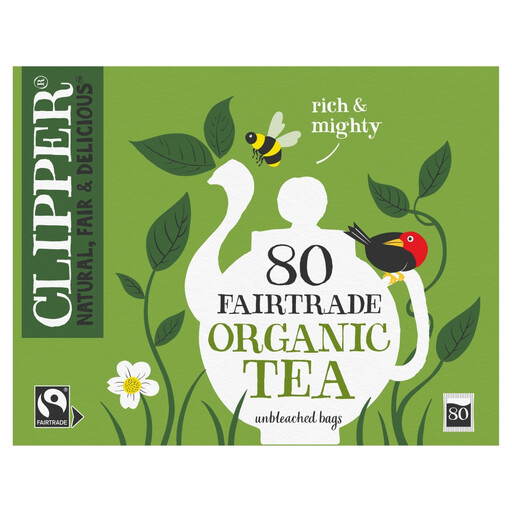
This 80-bag option has Organic Fairtrade wording in its product name. If the certification is non-negotiable, confirm the claim on the exact pack before buying; also check its preparation directions for brewing after arrival.
Check the Fairtrade wording on the exact pack or product page and whether it applies to the tea. For example, Clipper Tea Shop says the black tea in its Organic & Fairtrade Everyday 40-bag product is traded in compliance with Fairtrade standards, total 100%; an organic claim or brand reputation alone does not establish that status for another pack.
Not necessarily. Fairtrade International’s June 2026 Trader Standard describes mass balance, which permits eligible Fairtrade and non-Fairtrade materials to be mixed or exchanged during handling provided equivalent volumes were purchased on Fairtrade terms. Look for an explicit physical-traceability statement if that distinction matters to you.
No; they are distinct certification routes. Yorkshire Tea says its suppliers are Rainforest Alliance-certified and explains that Rainforest Alliance does not stipulate a minimum price or social premium, while Fairtrade International’s 2021 Tea Standard describes a Fairtrade Premium. Check which certification the particular tea carries rather than treating either label as proof of the other.
Choose by the number of people using the tea and where you will store it. Clipper Tea Shop lists a 40-bag Everyday product with a 2–5 minute infusion instruction and a separate 440-bag catering product with a 2–4 minute instruction; the larger pack is a different proposition if you are only supplying your own cups.
Yes. Joybuy lists Clipper Organic Fairtrade Decaf Everyday 80 Tea Bags as decaffeinated black tea. Check that the current pack is the decaf variant and read its Fairtrade wording and preparation directions before choosing it for your routine.