Hosts who require Fairtrade tea
If Fairtrade is part of your cream tea shopping list, check the claim on the exact tea-bag pack. A brand’s wider sourcing programme does not establish that every product it sells is Fairtrade.


For a cream tea where guests may add milk, start with a black tea whose exact pack carries the Fairtrade claim you want, rather than assuming a familiar brand is Fairtrade. Clipper describes both an Assam-and-Ceylon English Breakfast and Everyday black-tea options with product-level Fairtrade claims; choose by blend style and the number of bags you expect to use. Rainforest Alliance certification is a different claim, so check the FAIRTRADE Mark and pack wording if Fairtrade is a requirement.
The choice changes depending on whether Fairtrade certification is essential, which black-tea blend you want to serve and how many cups you expect to make.
If Fairtrade is part of your cream tea shopping list, check the claim on the exact tea-bag pack. A brand’s wider sourcing programme does not establish that every product it sells is Fairtrade.
For guests who may take their tea with milk, you can compare a named Assam-and-Ceylon English Breakfast blend with an Everyday black-tea blend. The descriptions identify different styles, not an independent taste-test winner.
If you are considering Tetley, PG Tips, Yorkshire Tea or Typhoo, distinguish their stated Rainforest Alliance sourcing or certification from a Fairtrade claim on a particular pack.
Decide whether Fairtrade is a firm requirement, then compare the blend and pack quantity. Check preparation and disposal instructions on the product you buy rather than applying one tea’s directions to another.
| Priority | What to check | Your needs |
|---|---|---|
| Fairtrade claim | Look for the FAIRTRADE Mark and wording on the exact pack. Fairtrade International says its Mark can also apply to tea sourced under mass-balance conditions; do not treat a Rainforest Alliance claim as the same certification. | I want the tea I serve to carry a Fairtrade claim, not just a general brand commitment to responsible sourcing. |
| Black-tea blend | Clipper identifies Assam and Ceylon in its Organic Fairtrade English Breakfast tea. It describes its Fairtrade Everyday 80-bag tea as a blend from Africa and India with a full, classic flavour. | Would I rather offer a named English Breakfast blend or an Everyday black tea? Guests can decide for themselves whether to add milk or sugar. |
| Pack quantity | Compare the expected cups with the pack count. Clipper lists Fairtrade options containing 40 and 80 bags, as well as a 440-bag catering pack; these are different products, so check each one’s other claims separately. | For a small gathering, I would choose a box I expect to use rather than buy a catering quantity for one afternoon. |
| Brewing | Follow the chosen pack’s instructions. Clipper advises freshly boiled water and a 2–5 minute infusion for its Organic & Fairtrade Everyday 40-bag tea; its 440-bag catering tea gives a 2–4 minute range. | I want clear directions for making several cups and can let guests adjust the infusion time to their preferred strength. |
| Disposal | Read the instructions for the exact tea bag and packaging. Clipper gives food-waste disposal advice for its 440-bag catering product; check your local collection rules before using that route. | If disposal matters to me, I need instructions that apply to the pack I buy and the collection available at home. |
The Fairtrade Foundation has reported confusion among UK shoppers about the Fairtrade status of familiar tea brands. The cited Tetley, PG Tips, Yorkshire Tea and Typhoo statements concern Rainforest Alliance certification or sourcing, which is a different claim.
Check the FAIRTRADE Mark and wording on the specific tea-bag pack you plan to serve.
Yorkshire Tea’s explanation of its sourcing says Rainforest Alliance does not state a minimum price or require a social premium. Fairtrade International’s tea standard addresses Fairtrade Premium arrangements. These distinctions matter if your purchase requirement names one scheme.
Choose the certification you intend to buy, then check that the exact product carries the corresponding claim.
Clipper’s cited Fairtrade tea bags come in 40-, 80- and 440-bag formats. A larger count is useful only if you expect to make enough cups across the event or later use.
Estimate how many bags you will use before choosing the pack size.
A 440-bag box could leave many unused bags after a one-off afternoon.
Clipper gives food-waste instructions for its cited 440-bag catering product, but that instruction should not be applied automatically to every tea bag or local collection.
Follow the current pack directions and check what your local authority accepts.
These references help separate Fairtrade product claims from other sourcing statements; they do not mean every tea bag from a named brand has the same certification.
Clipper’s cited English Breakfast and Everyday black-tea products provide specific Fairtrade-labelled options for a cream tea.
Twinings has an Organic & Fairtrade collection for shoppers considering other tea styles.
Tetley is relevant if you are considering Rainforest Alliance sourcing instead of requiring Fairtrade.
PG Tips is another brand to consider when comparing Rainforest Alliance-certified tea with a Fairtrade requirement.
Yorkshire Tea’s sourcing explanation is useful for understanding why a Rainforest Alliance statement should not be read as Fairtrade certification.
Typhoo states a Rainforest Alliance tea-sourcing claim rather than a Fairtrade claim for the cited range.
These Clipper listings offer an 80-bag Everyday option and an 80-bag decaf Everyday option for a cream tea table. Check the current pack’s Fairtrade wording and brewing directions before choosing either one.
 No image available
Consider this listing if you want to offer guests a decaf option alongside your other tea. The title specifies 80 tea bags and 277g; check the exact pack for its Fairtrade claim and hot-water brewing instructions before serving.
 No image available
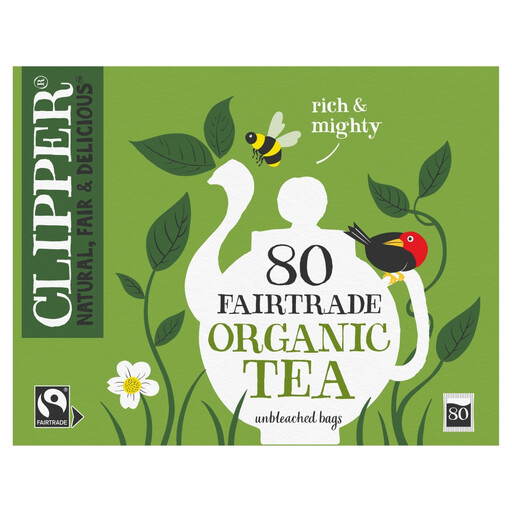
Consider this 80-bag listing if you want a Clipper tea for several guests. The title specifies 232g, while the Joybuy listing describes an organic Fairtrade tea blend; check the exact pack’s Fairtrade wording, tea type and hot-water brewing directions for your cream tea.
Check the FAIRTRADE Mark and accompanying wording on the exact pack, rather than relying on the brand name. Fairtrade International says the Mark can also be used for tea sourced under mass-balance conditions, so read what the pack claims rather than assuming every supply chain works in the same way.
One certification does not establish the other. Yorkshire Tea’s explanation distinguishes Rainforest Alliance sourcing from Fairtrade’s arrangements, including the Fairtrade Premium. If Fairtrade is your requirement, look for that claim on the particular pack, even when a brand makes another sourcing claim.
Choose by the blend you want to offer guests: Clipper identifies Assam and Ceylon in its Organic Fairtrade English Breakfast tea, while it describes its Fairtrade Everyday 80-bag tea as a full, classic blend from Africa and India. Neither description establishes a universal flavour preference.
Follow the directions on the product you serve. Clipper specifies freshly boiled water and 2–5 minutes for its Organic & Fairtrade Everyday 40-bag tea, whereas its 440-bag catering tea specifies 2–4 minutes; do not assume those timings apply to a different pack.
No. Fairtrade and organic are distinct product claims. Some of the cited Clipper teas are described as both, but check both claims on the exact pack if you want an organic Fairtrade tea.