Fairtrade-first everyday tea drinkers
If a tea bag is part of your usual lunch break, you may want a Fairtrade claim on the product itself rather than a general statement about the brand’s sourcing.


Start with the exact pack: look for the FAIRTRADE Mark or a product-level statement that its tea is traded in compliance with Fairtrade standards. For lunch, choose everyday black tea if you want a familiar brew, explicitly decaffeinated black tea if you are reducing caffeine, or green tea if you prefer a lighter flavour. Rainforest Alliance certification and broader sourcing programmes are not, by themselves, Fairtrade claims.
If a tea bag is part of your usual lunch break, you may want a Fairtrade claim on the product itself rather than a general statement about the brand’s sourcing.
An explicitly decaffeinated black tea lets you keep that style of lunch drink while choosing a different caffeine option. Check the same pack for its Fairtrade claim.
If you prefer a lighter-flavoured tea with lunch, look for a Fairtrade claim on the specific green-tea pack. Green tea is not a caffeine-free infusion, and its preparation instructions may differ from those for black tea.
Choose the tea style you will drink at lunch, then check the exact product’s Fairtrade claim and pack details. A certification associated with the brand does not establish the status of every tea bag it sells.
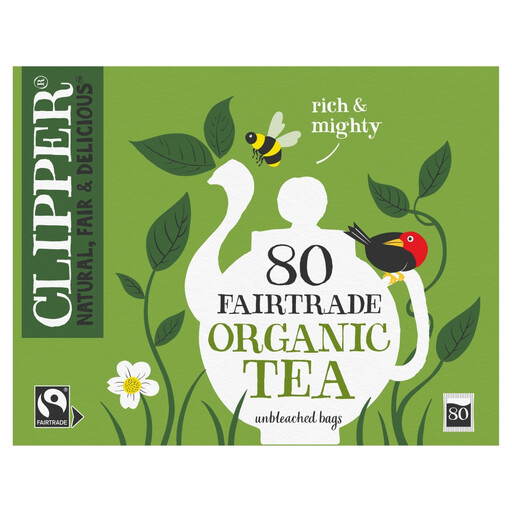
Choose it when: You want a conventional black-tea cup; Clipper Tea Shop states that the tea in its Organic & Fairtrade Everyday 80 Tea Bags is traded in compliance with Fairtrade standards.
Bear in mind: This is standard black tea, not the explicitly decaffeinated option.
Choose it when: You want black tea while reducing caffeine; Clipper Tea Shop identifies its Organic Everyday Decaf 80 Tea Bags as decaffeinated black tea traded in compliance with Fairtrade standards.
Bear in mind: Select the pack explicitly labelled decaf rather than relying on the tea’s flavour or colour.
Choose it when: You prefer a lighter tea; Clipper Tea Shop states that its Organic Fairtrade Pure Green Tea is traded in compliance with Fairtrade standards.
Bear in mind: It is not a caffeine-free choice. Clipper instructs drinkers to let boiled water cool for a minute, then infuse this product for 1–3 minutes.
| Priority | What to check | Your needs |
|---|---|---|
| Fairtrade status | Look for the FAIRTRADE Mark or an explicit product-level Fairtrade statement. For a flavoured blend, check what its claim says about the tea ingredients; read any traceability information if that matters to you. Fairtrade International permits mass balance for tea. | I want the tea bags I buy to carry a verifiable Fairtrade claim, not just a broad ethical-sourcing message. |
| Caffeine choice | Distinguish standard black tea, explicitly decaffeinated black tea and green tea. Do not treat a green-tea label as a decaf claim. | For a later lunch, I would rather choose a pack clearly labelled decaf than guess from the type of tea. |
| Flavour and preparation | Choose the tea style you prefer and follow that product’s brewing directions. Clipper Tea Shop specifies cooled boiled water and a 1–3 minute infusion for its Organic Fairtrade Pure Green Tea. | A black-tea cup is part of my usual break, or I would prefer a lighter green tea that I can prepare as directed. |
| Pack for home use | Check the number of bags and stated weight on the exact pack. If choosing between variants, confirm that the tea style, caffeine description and Fairtrade claim all meet your requirements. | I want enough bags for regular lunch breaks without choosing solely by the size of the box. |
Rainforest Alliance certification or a brand sourcing programme does not establish that a particular tea bag meets a Fairtrade requirement. Fairtrade International has its own rules for use of the FAIRTRADE Mark.
If Fairtrade is your deciding condition, check the mark or an explicit Fairtrade statement on the exact pack or product listing.
Fairtrade International permits mass balance for tea, so a Fairtrade claim does not necessarily mean the physical tea was segregated throughout the supply chain.
Read the on-pack Fairtrade claim and any traceability information if physical separation matters to your choice.
Green tea offers a different flavour from black tea, but the name does not mean it is caffeine-free. Choosing by flavour alone could miss your reason for changing drinks.
For a lower-caffeine choice, look for a product explicitly labelled decaf and check that its Fairtrade claim applies to that variant.
These brand references describe particular products, ranges or sourcing statements; they do not establish Fairtrade status for every tea bag a brand sells.
Clipper Tea Shop lists Fairtrade everyday black, decaf black and green-tea products, giving shoppers several tea styles to check for lunch.
Twinings UK has an Organic & Fairtrade collection and lists a Jacksons of Piccadilly Fairtrade range.
Yorkshire Tea states that it is Rainforest Alliance Certified and describes its approach to supplier relationships.
Rainforest Alliance lists PG Tips tea as certified in the UK, and the brand’s range includes a decaf option.
Rainforest Alliance lists Tetley tea as certified and available in the UK.
Typhoo describes its 80 Premium Tea Bags as a Kenyan black-tea blend sourced from Rainforest Alliance Certified tea gardens.
These two Clipper black-tea packs cover an everyday and an explicitly decaffeinated choice for a working-from-home lunch. Check the exact listing and pack when deciding which variant meets your Fairtrade and caffeine preferences.
 No image available
An everyday black-tea option for a regular lunch break when you want a product-level Fairtrade claim. The Joybuy listing identifies organically grown black tea in an 80-bag, 232g pack. This is not the explicitly decaffeinated variant.
 No image available
An explicitly decaffeinated black-tea option for lunch when you are reducing caffeine. The Joybuy listing identifies an 80-bag, 277g pack; check the exact pack if you need a stated residual caffeine amount.
Check the exact pack or product listing for the FAIRTRADE Mark or an explicit product-level statement about Fairtrade standards. Fairtrade International’s mark guidelines concern products meeting its requirements; a broad ethical-sourcing phrase or a different certification does not establish the same claim.
Not necessarily. Fairtrade International permits mass balance for tea, so read the pack’s Fairtrade claim and any traceability information rather than assuming physical separation from the mark alone.
Choose a product explicitly labelled decaf rather than assuming green tea is caffeine-free. Clipper Tea Shop identifies its Organic Everyday Decaf 80 Tea Bags as decaffeinated black tea traded in compliance with Fairtrade standards; check the exact pack if you need more detailed caffeine information.
No. Rainforest Alliance certification is distinct from Fairtrade, so a Rainforest Alliance claim for Tetley, PG Tips, Yorkshire Tea or Typhoo does not establish Fairtrade status. If Fairtrade is essential to your choice, check for that claim on the exact tea-bag product.