Fairtrade-first top-up shoppers
You want an everyday refill and need the specific tea-bag pack to carry a Fairtrade claim or Mark, rather than relying on a familiar brand name.


If Fairtrade certification is essential for your tea-bag top-up, choose by the claim or Mark on the individual pack, not by the brand name: Fairtrade International’s 2025 UK research says shoppers wrongly assume several familiar tea brands are Fairtrade. Clipper has identifiable Fairtrade Everyday packs, while Rainforest Alliance certification and brand sourcing programmes are different routes; if physical separation of the tea matters to you, also check the pack’s traceability information because Fairtrade permits mass balance for tea.
You want an everyday refill and need the specific tea-bag pack to carry a Fairtrade claim or Mark, rather than relying on a familiar brand name.
You care about how tea is sourced and need to decide whether Fairtrade is a requirement or whether you would also consider Rainforest Alliance certification or a brand sourcing programme.
You want the right number of bags for your next top-up while keeping your preferred tea type and certification in view.
Start with the certification you require, then compare the tea type, pack count and any traceability information that matters to you.
| Priority | What to check | Your needs |
|---|---|---|
| Fairtrade status | Look for the Fairtrade Mark or explicit Fairtrade wording on the exact pack. For an online order, check the individual product listing as well as the pack when it arrives. | I want the tea I pick up for this top-up to meet a Fairtrade-only requirement, not merely to come from a brand I recognise. |
| Other sourcing labels | Read the precise certification or programme named. Rainforest Alliance certification and a brand’s responsible-sourcing programme do not, by themselves, establish Fairtrade status. | I’m open to another sourcing route only if Fairtrade is a preference rather than a firm requirement. |
| Traceability | Read the pack’s Fairtrade traceability statement if physical separation matters. Fairtrade International permits mass balance for tea, under which Fairtrade and non-Fairtrade tea can be mixed during processing. | Does the sourcing claim need to mean that the tea in my bags was kept physically separate? If so, I need to check the pack’s explanation before choosing. |
| Refill size and tea type | Check the number of bags and whether the variant is the type you want, such as decaffeinated tea. Read the current pack information rather than assuming variants within a brand are alike. | A smaller refill may suit my immediate top-up; for a longer-lasting pack, I’ll check the bag count without overlooking the tea type. |
| Food information | Read the ingredients, including any allergen information, and the date label on the pack. UK food-labelling guidance from the Department for Environment, Food & Rural Affairs and the Food Standards Agency identifies these as information to check. | Before putting the pack away, I want to know what the current label says and check its date. |
Fairtrade International’s 2025 UK research says shoppers wrongly assume PG Tips, Tetley, Typhoo and Yorkshire Tea are Fairtrade. That distinction matters when Fairtrade certification is your reason for buying.
Use the exact pack’s Fairtrade claim or Mark as your check. Treat a Rainforest Alliance label or a brand sourcing statement as a separate claim.
Fairtrade International permits mass balance for tea, so Fairtrade and non-Fairtrade tea can be mixed during processing.
If physical separation matters to you, read the Fairtrade traceability information for the individual pack before choosing it.
A brand’s sourcing approach is a starting point, not a substitute for checking the certification on the tea-bag pack you intend to buy.
Clipper has identifiable Fairtrade Everyday tea-bag products, including an Organic & Fairtrade Everyday 40-bag listing on its own shop and a Fairtrade Everyday 80-bag listing at Tesco.
Twinings describes Sourced with Care as its responsible-sourcing programme and has an online collection labelled Organic & Fairtrade Tea.
Rainforest Alliance lists PG Tips tea as a certified product available in the United Kingdom. This is a different certification route from Fairtrade.
Tata Consumer Products’ 2025 sustainability report says it sources Tetley tea from Rainforest Alliance Certified farms.
Yorkshire Tea says its tea comes from suppliers with Rainforest Alliance certification, rather than presenting that sourcing as Fairtrade certification.
The Ethical Tea Partnership says Typhoo sources from Rainforest Alliance-certified estates in Kenya and Malawi.
These Clipper options are both listed as organic Fairtrade 80-bag packs for an everyday top-up; one is a decaffeinated variant. Check the Fairtrade wording on the individual pack, particularly where the claim itself is decisive for your purchase.
 No image available
Consider this 80-bag refill if you want the decaffeinated variant. The product name identifies it as organic and Fairtrade; check the pack’s Fairtrade and traceability wording if either is important to your choice.
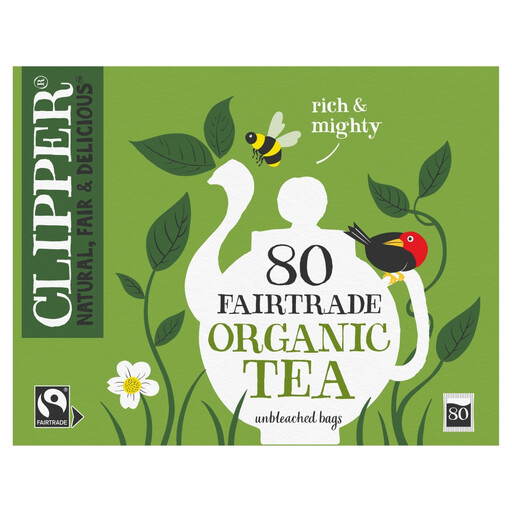 No image available
This is another 80-bag refill whose product name identifies an organic Fairtrade variant. Confirm the Fairtrade claim on the physical pack before buying if certification is a firm requirement.
Check the Fairtrade Mark or explicit Fairtrade wording on the exact pack. Brand recognition is not enough: Fairtrade International’s 2025 UK research says shoppers wrongly assume PG Tips, Tetley, Typhoo and Yorkshire Tea are Fairtrade.
Yes. Fairtrade International permits mass balance for tea, which can involve mixing Fairtrade and non-Fairtrade tea during processing. Read the individual pack’s traceability information if physical separation matters to you.
No. They are different certification routes, so a Rainforest Alliance claim alone does not meet a Fairtrade-only requirement. Check the specific tea-bag pack for Fairtrade wording rather than treating a brand’s sourcing approach as proof.
Check the ingredients, including any allergen information, and the date label on the current pack. The Department for Environment, Food & Rural Affairs and the Food Standards Agency identify these as food-label information; also confirm that the bag count and tea variant suit your top-up.