If Fairtrade is the priority, check the claim on the exact tea-bag pack rather than relying on a familiar brand name or a different sourcing certification. Clipper identifies Fairtrade everyday and decaf black-tea options; choose between them according to whether the drinker wants regular tea or would prefer to reduce tea-derived caffeine, while considering caffeine from other drinks and foods too.
Who is this choice for?
Households making Fairtrade a requirement
If the sourcing claim determines which tea you buy, look for the FAIRTRADE Mark or an explicit Fairtrade statement for the particular product. A brand’s broader sustainability message does not answer that pack-level question.
Breastfeeding parents considering decaf
If you want to reduce caffeine from tea, a clearly labelled decaf Fairtrade product offers a different choice from regular black tea. Consider caffeine from other drinks and foods as well, rather than treating the tea bag as your only source.
What should you check before buying?
Start with the exact pack’s Fairtrade claim, then decide whether regular or decaf tea suits the drinker and whether the pack size fits household use.
| Priority |
What to check |
Your needs |
| Fairtrade claim |
Look for the FAIRTRADE Mark or a clear Fairtrade statement on the exact product. Check whether a stated percentage describes the tea ingredient: Clipper says the tea in its cited everyday and decaf products is traded in compliance with Fairtrade standards, total 100%. |
I want the claim to apply to the tea bags I am buying, not just to the brand. The Fairtrade Foundation explains that products bearing its Marks meet Fairtrade Standards. |
| Caffeine choice |
Check whether the pack says regular black tea or decaf black tea. If a precise caffeine figure matters, check the particular product rather than assuming that a decaf label gives one. |
For a breastfeeding parent who wants less caffeine from tea, I would consider decaf and also account for other caffeine sources. NHS breastfeeding guidance discusses total caffeine intake, not tea in isolation. |
| Pack and ingredients |
Confirm the bag count, tea type and any organic claim on the chosen variant. Clipper’s cited everyday black-tea product has 80 bags, while its cited decaf product page describes a 40-bag pack; do not assume every listing has the same size. |
Our household gets through tea regularly, so I want a pack size that fits how we use it without overlooking whether I have selected everyday or decaf tea. |
What is easy to overlook?
-
Choosing by brand name instead of the pack claim
A familiar tea brand does not, by itself, establish that a particular box of tea bags meets a Fairtrade requirement.
Check the exact pack for the FAIRTRADE Mark or an explicit statement about Fairtrade standards before making that choice.
-
Reading another certification as Fairtrade
Rainforest Alliance and Fairtrade are distinct certifications. Rainforest Alliance information for a tea brand does not establish a Fairtrade claim for the product in your basket.
If Fairtrade is essential, look for a separate Fairtrade claim on the exact tea bags, even when other sourcing information is available.
-
Considering tea without other caffeine sources
For a breastfeeding parent monitoring caffeine, changing tea alone does not account for caffeine from other drinks and foods.
If you prefer to reduce tea-derived caffeine, check for a clearly labelled decaf Fairtrade pack and seek individual advice from a health professional if you have concerns about your total intake.
How do the named brands differ?
These brand references describe specific product claims or sourcing information; they do not mean that every tea bag sold under a brand has the same certification.
Clipper
Clipper’s own product pages describe both everyday and decaf black-tea bags with explicit Fairtrade statements.
- Its Organic & Fairtrade Everyday 80 Tea Bags page says the tea is traded in compliance with Fairtrade standards, total 100%.
- Its cited Everyday Decaf product page is for 40 bags. Check the claim and bag count on the exact variant you select.
Twinings
Twinings has an Organic & Fairtrade tea collection.
- The collection provides a starting point if you want to browse tea types with those designations.
- Check the individual tea-bag product and pack rather than applying the collection name to every Twinings tea.
Yorkshire Tea
Yorkshire Tea states that it is Rainforest Alliance Certified.
- Its published ethics information identifies its sourcing certification.
- Rainforest Alliance certification is not a Fairtrade claim; check the exact pack if Fairtrade is required.
Tetley
Tetley publishes Rainforest Alliance sourcing information for tea sold in Europe.
- Its sourcing statement gives shoppers a specific certification to identify.
- That statement does not establish that a particular Tetley pack is Fairtrade.
PG Tips
The Rainforest Alliance lists PG Tips tea as certified and available in the UK.
- The listing identifies tea as the certified ingredient.
- Check for a separate claim on the exact pack if your requirement is Fairtrade rather than Rainforest Alliance certification.
Typhoo
Typhoo says its blend is sourced from Rainforest Alliance Certified gardens.
- The brand states which sourcing scheme its blend uses.
- That sourcing statement should not be treated as an exact-pack Fairtrade claim.
Joybuy tea-bag options
These Clipper listings cover two choices for a household seeking Fairtrade tea bags: decaf black tea and everyday black tea. Check the selected pack’s wording and size when deciding between them.
 No image available
Clipper Organic Fairtrade Decaf Everyday 80 Tea Bags 277g
Consider this listing if you want a decaf black-tea option while keeping an explicit Fairtrade claim. It describes decaffeinated, organically grown black tea in an 80-bag pack and describes the tea as 100% Fairtrade. Check the exact pack if you need a residual caffeine figure, and account for caffeine from other sources.
View on Joybuy
 No image available
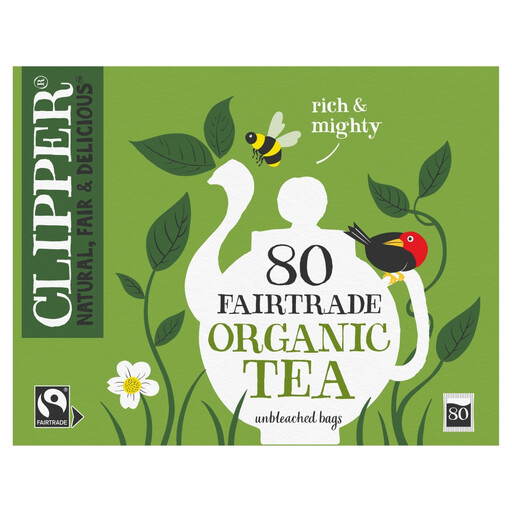
Clipper Organic Fairtrade 80 Tea Bags 232g
Consider this listing for everyday black tea when you do not want the decaf variant. The 80-bag listing identifies organically grown black tea; Clipper’s page for its Everyday 80 Tea Bags says the tea is traded in compliance with Fairtrade standards, total 100%. Check the exact pack for preparation instructions.
View on Joybuy
Questions about Fairtrade tea bags
How can I tell whether tea bags are Fairtrade?
Check the exact product for the FAIRTRADE Mark or an explicit statement that its tea is traded in compliance with Fairtrade standards. The Fairtrade Foundation says products bearing its Marks meet Fairtrade Standards; Clipper’s cited everyday and decaf product pages each state that their tea meets Fairtrade trading standards, total 100%.
Does Rainforest Alliance certification mean the tea is Fairtrade?
No: these are different certification schemes. Tetley, PG Tips, Yorkshire Tea and Typhoo have published Rainforest Alliance-related information, but if Fairtrade is your buying requirement, check the particular tea-bag pack for its own Fairtrade claim.
When might a breastfeeding parent choose decaf tea bags?
Decaf is an option if you want to reduce caffeine from tea while choosing a product with a Fairtrade claim. Consider caffeine from other drinks and foods too; NHS breastfeeding guidance addresses total caffeine intake, and a health professional can advise on individual concerns.


