Workers planning to sleep after their shift
If a tea break falls late in your shift, caffeine timing matters. NHS TIMS advises stopping caffeine at least four hours before the shift ends because it may affect daytime sleep.


Choose a tea bag with a claim on the specific product if Fairtrade sourcing matters to you. For a break closer to the end of a night shift, consider a clearly labelled decaf option: NHS TIMS advises stopping caffeine at least four hours before the shift ends because it may affect daytime sleep. Rainforest Alliance certification is a separate sourcing route, not a Fairtrade claim.
If a tea break falls late in your shift, caffeine timing matters. NHS TIMS advises stopping caffeine at least four hours before the shift ends because it may affect daytime sleep.
Look for a claim on the tea you intend to buy, rather than relying on the brand name. Clipper identifies Fairtrade compliance for specified Everyday tea products.
If you are open to other certification routes, compare the claim on each pack. Yorkshire Tea describes its tea as Rainforest Alliance Certified and states that it is not Fairtrade.
Start with when you will drink the tea, then check the exact product’s certification and pack format.
| Priority | What to check | Your needs |
|---|---|---|
| Caffeine timing | Check whether the tea is labelled decaf. NHS TIMS advises stopping caffeine at least four hours before a night shift ends if it could affect daytime sleep; do not assume a lighter-tasting tea is decaf. | I want a tea break late in my shift and plan to sleep after work. Earlier in the shift, ordinary black tea may fit my plans instead. |
| Fairtrade claim | Look for the Fairtrade Mark or an explicit claim on the exact pack. The Fairtrade Foundation says its classic Mark indicates that all ingredients eligible for Fairtrade certification are certified; Clipper states that the tea in its Organic & Fairtrade Everyday product is traded in compliance with Fairtrade standards. | Fairtrade matters to me, so I want the claim to apply to the tea I am buying, not just to another product from the same brand. |
| Other sourcing labels | Read the name of the scheme rather than treating certification labels as interchangeable. Fairtrade International describes a Minimum Price safety net and Fairtrade Premium for its tea system; Yorkshire Tea describes its tea as Rainforest Alliance Certified, not Fairtrade. | I am open to another sourcing scheme, but I want to know which claim the selected tea actually carries. |
| Break-room use | Check the number of bags and the storage instructions on the selected pack. An 80-bag format is listed for some Clipper products; pack size does not establish certification or decaf status. | For a quick break or a shared staff kitchen, I want a pack size that suits how often the tea will be used. |
Yorkshire Tea states that its tea is Rainforest Alliance Certified and not Fairtrade. Tata Consumer Products describes sourcing Tetley tea from Rainforest Alliance Certified farms. Neither statement turns an individual pack into a Fairtrade product.
Check the certification named on the specific pack or product listing before choosing it for a Fairtrade requirement.
Caffeine in tea may affect planned daytime sleep. NHS TIMS advises stopping caffeine at least four hours before the shift ends.
If you want tea later than that, check for a clearly labelled decaf product rather than assuming an ordinary black tea is suitable.
Green tea and decaf describe different product attributes. A Fairtrade claim on a green tea does not establish that it is decaffeinated.
When caffeine timing is the deciding factor, look for an explicit decaf label as well as the sourcing claim you want.
Organic and Fairtrade wording describes different attributes. Clipper identifies organically grown tea and Fairtrade trading compliance separately on its Organic & Fairtrade Everyday product.
If both matter to you, check for both claims on the selected pack.
Clipper lists specified Organic & Fairtrade tea bags, including Everyday black tea and an Everyday Decaf product.
Twinings has an Organic & Fairtrade tea collection alongside its wider range of teas and infusions.
Yorkshire Tea describes its tea as Rainforest Alliance Certified rather than Fairtrade.
Tetley’s owner discusses Rainforest Alliance sourcing for the brand.
Typhoo describes its 1100 Everyday Tea Bags product as Rainforest Alliance Certified.
For PG Tips, make the decision from the certification and caffeine wording on the particular pack.
These Clipper options cover a labelled Fairtrade decaf tea for later breaks and an everyday black tea for earlier breaks. Check the certification wording on the exact pack, particularly for the everyday black tea.
 No image available
The decaf label makes this the option to consider when you want tea later in a shift and are following NHS TIMS advice to stop caffeine at least four hours before finishing. The listing describes decaffeinated black tea and makes organic and Fairtrade claims. If you need a specific caffeine limit, check the pack.
 No image available
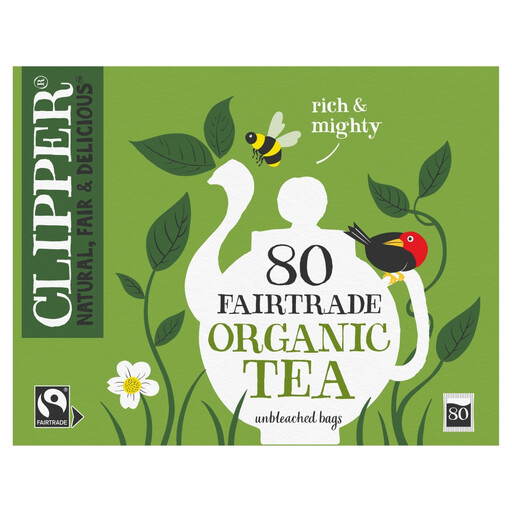
Consider this black tea for an earlier shift break rather than treating it as decaf. The listing identifies 80 bags of organically grown black tea and makes a Fairtrade claim; check that claim on the exact pack before buying. NHS TIMS advises stopping caffeine at least four hours before a night shift ends if daytime sleep may be affected.
If you plan to sleep after work, NHS TIMS advises stopping caffeine at least four hours before the shift ends because it may affect daytime sleep. For a later tea break, look for a clearly labelled decaf tea rather than assuming ordinary tea is decaffeinated.
No. They are separate certification routes. Yorkshire Tea says its tea is Rainforest Alliance Certified and explains that it is not Fairtrade; check the exact claim on any tea bag you are considering.
Check the exact pack or product listing for a Fairtrade Mark or explicit Fairtrade wording. The Fairtrade Foundation says its classic Mark indicates that all ingredients eligible for Fairtrade certification are certified. Clipper states that the tea in its Organic & Fairtrade Everyday product is traded in compliance with Fairtrade standards, total 100%; that statement applies to the specified product, not the whole brand.
Clipper says used bags from its Organic Fairtrade Pure Green Tea product can go in a food-waste container. That is guidance for that product: check the packaging of the tea you buy and your local collection rules.