Households topping up an everyday tea supply
An 80-bag Fairtrade black tea may suit a regular grocery order. Compare the bag count and the retailer’s strength description so a substitute does not change the kind of tea you intended to buy.


Choose a tea bag product with an explicit Fairtrade claim, then match its stated strength and pack size to the cups you make and the grocery order you place. Sainsbury’s lists everyday and extra-strong Fairtrade black teas, M&S lists a medium-strength option through Ocado, and specific Clipper products add organic or tea-bag material claims. Check the exact variant: Fairtrade status does not by itself establish that the tea is organic or that every leaf has remained physically separate from non-Fairtrade tea.
The useful starting point is whether your order calls for an everyday black tea, a particular sourcing claim or an additional product attribute.
An 80-bag Fairtrade black tea may suit a regular grocery order. Compare the bag count and the retailer’s strength description so a substitute does not change the kind of tea you intended to buy.
Look for the claim on the specific tea rather than relying on its brand name. The Fairtrade Foundation reports that shoppers can mistakenly assume familiar brands, including PG Tips, Tetley, Typhoo and Yorkshire Tea, are Fairtrade.
Check each attribute on the exact variant. Clipper lists an Organic & Fairtrade Everyday tea, while its Organic Fairtrade Decaf Everyday tea is a distinct product; neither name establishes the attributes of every tea in the range.
Start with the Fairtrade claim, then narrow the options by the tea you want to drink and the details that matter when a grocery order is delivered or substituted.
| Priority | What to check | Your needs |
|---|---|---|
| Fairtrade claim | Find an explicit Fairtrade statement or FAIRTRADE Mark for the exact variant. Check the delivered pack as well as the online listing; read its traceability information if physical separation matters. | I want the tea I receive, not just a familiar brand, to carry the Fairtrade claim I selected. |
| Pack format | Compare the number of bags and pack weight. Check the variant and the retailer’s unit-price measure when comparing different pack sizes. | For a routine grocery order, I want to know how many tea bags the pack contains, especially if a replacement is offered. |
| Strength and flavour | Read the product’s own strength description. Ocado describes M&S Fairtrade Everyday as medium strength; Sainsbury’s describes Extra Strong Red Label as full-bodied and robust. | A medium-strength everyday tea may suit my usual cups, or I may specifically prefer the stronger description on the Extra Strong Red Label pack. |
| Extra attributes | Verify organic, decaf and tea-bag material claims separately. Clipper’s Organic & Fairtrade Everyday listing states organically grown black tea; Sainsbury’s lists unbleached, plant-based, biodegradable bags for Clipper Fairtrade Everyday. | If I want organic tea, decaf tea or a particular bag material, the exact product needs to state that attribute. |
| Delivery fit | Check eligibility for your postcode and delivery slot at checkout. If the retailer offers a substitution, compare its Fairtrade claim, bag count and variant with your original choice. | I want the delivered pack to meet the same requirements as the one I added to my basket. |
The Fairtrade Foundation reports mistaken assumptions about the Fairtrade status of several familiar UK tea brands. A brand name alone does not identify the claim on the pack you are ordering.
Look for an explicit Fairtrade claim on the individual listing and check the delivered packaging.
Fairtrade International explains that mass balance can allow Fairtrade and non-Fairtrade tea to be mixed while volumes sold on Fairtrade terms are tracked and audited.
If physical traceability matters to you, read the pack’s Fairtrade information rather than treating the mark alone as a segregation guarantee.
A bag count, pack weight or variant can differ even when two listings look like everyday black tea. That matters when choosing a repeat order or assessing a proposed substitution.
Compare bag count and weight alongside the exact variant, using the retailer’s unit-price measure where it is supplied.
Organic, decaf and tea-bag material claims belong to particular products. For example, Clipper’s Organic & Fairtrade Everyday tea and its Fairtrade Everyday tea have different stated attributes.
Confirm each attribute you require on the exact variant before adding it to your order.
These product lines offer different stated strengths and attributes; check the individual listing rather than applying a range-level description to every tea.
Sainsbury’s lists Fairtrade Red Label, Extra Strong Red Label and Gold Label black teas in 80-bag packs.
Ocado lists M&S Fairtrade Everyday Tea Bags as an 80-bag, medium-strength option.
Clipper lists distinct Fairtrade products, including an Organic & Fairtrade Everyday tea and a Fairtrade Everyday tea with stated bag-material attributes.
These two Clipper 80-bag products cover organic Fairtrade black tea, including a separately labelled decaf variant. Choose between them by checking whether decaf is part of your order.
 No image available
Consider this variant when your grocery order calls for organic Fairtrade black tea that is also decaffeinated. The listing describes 80 naturally decaffeinated tea bags in a 277g pack, with plastic-free, unbleached bags. If physical separation of tea leaves matters to you, check the delivered pack’s traceability information; confirm delivery for your postcode at checkout.
 No image available
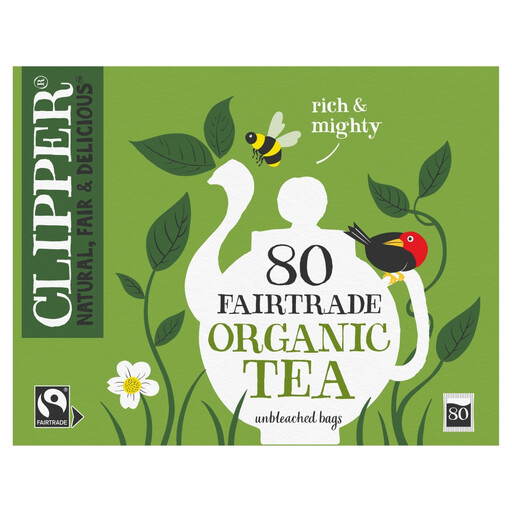
Consider this pack when organic Fairtrade black tea is the attribute you are seeking. It contains 80 tea bags and weighs 232g. If brew strength or bag material affects your choice, check the exact listing; confirm delivery for your postcode and inspect the delivered pack’s traceability information if that matters to you.
Look for an explicit Fairtrade claim or FAIRTRADE Mark on the exact product listing, then check the pack you receive. Do not infer the claim from the brand name: the Fairtrade Foundation reports that shoppers can mistakenly assume several familiar UK tea brands are Fairtrade.
No, not necessarily. Fairtrade International explains that tea can use mass balance, under which Fairtrade and non-Fairtrade tea may be mixed while sales volumes on Fairtrade terms are tracked and audited. Read the pack’s traceability information if physical separation is important to you.
Sainsbury’s describes its Extra Strong Red Label Fairtrade Tea Bags as full-bodied and robust, while Ocado lists M&S Fairtrade Everyday Tea Bags as medium strength. Those are the retailers’ descriptions of specific products, so compare them with the strength you prefer rather than assuming every everyday blend tastes alike.
Sainsbury’s lists its own-label Fairtrade teas online, and Ocado lists M&S Fairtrade Everyday Tea Bags. Check your postcode and delivery slot at checkout, along with the exact product and any proposed substitution.
Check the replacement’s explicit Fairtrade claim, bag count and variant against what you ordered. If you selected organic or decaf tea, or chose a particular bag material, verify that attribute on the replacement too and read its delivered label before use.