Choose tea bags with the FAIRTRADE Mark or a clear Fairtrade statement for the exact product, rather than relying on a familiar brand name. For a winter black-tea brew, check the blend and brewing instructions as well; choose an organic product if that matters to you, or a decaffeinated one if you want to reduce caffeine. A Rainforest Alliance label does not establish that a tea is Fairtrade-certified.
Who is this choice for?
Shoppers requiring Fairtrade certification
If Fairtrade is a condition of your purchase, check the exact tea-bag pack. Fairtrade International says the FAIRTRADE Mark is used when a product’s ingredients meet the applicable Fairtrade Standards; a brand name alone is not confirmation.
Regular black-tea drinkers
If you want black tea for cold-weather cups, compare the stated blend and pack instructions alongside its Fairtrade claim. Clipper, for example, describes its Organic & Fairtrade Everyday tea as full-bodied; that description applies to that product, not every tea in the range.
People choosing decaffeinated tea
If you prefer decaffeinated tea bags, check both the decaffeinated description and the Fairtrade claim on the particular pack. Neither claim automatically applies to other products from the same brand.
What should you check?
Start with the certification requirement, then compare the type of tea and the instructions you will use for your everyday brew.
| Priority | What to check | Your needs |
|---|
| Fairtrade status |
Look for the FAIRTRADE Mark or a clear Fairtrade statement on the exact pack. Check that a claim refers to this tea, rather than only to the brand or another range. |
I want to know that the tea bags I am buying meet my Fairtrade requirement, not just that the brand discusses ethical sourcing. |
| Black-tea blend |
Read the tea description and ingredients for the specific product. Check its brewing directions rather than applying another blend’s infusion time. |
For winter cups, I’m looking for a black-tea flavour I will enjoy regularly, with a Fairtrade claim on the same product. |
| Organic claim |
If organic matters too, check that the exact tea is described as organic and separately carries the Fairtrade claim. One description does not establish the other. |
I’d like both organic and Fairtrade criteria to apply to the tea bags in this pack. |
| Caffeine |
Check whether the product is described as decaffeinated. If you are tracking caffeine, consider tea alongside other foods and drinks containing it. |
A decaffeinated tea would fit my routine better, but I still want to confirm the pack’s Fairtrade status. |
| Other labels |
Identify which certification appears on this product. Rainforest Alliance certification does not by itself establish Fairtrade certification. |
I may consider different sourcing schemes, but I do not want to mistake one label for another when Fairtrade is required. |
Common buying mistakes
-
Assuming a familiar brand is Fairtrade
Fairtrade International’s 2025 UK report identifies PG Tips, Tetley, Typhoo and Yorkshire Tea among brands shoppers may wrongly assume are Fairtrade. That finding does not establish the status of every product those brands make.
Check the FAIRTRADE Mark or product-level statement on the exact tea-bag pack you plan to buy.
-
Treating certification labels as interchangeable
Typhoo describes its Premium 80 Tea Bags as Rainforest Alliance Certified. That description does not establish that this product meets a Fairtrade-specific requirement.
Decide which certification you require, then check that label or claim on the individual product.
-
Overlooking caffeine when choosing a daily tea
Tea can contribute to daily caffeine intake. NHS guidance for pregnancy sets a daily caffeine limit of 200mg and notes that caffeine occurs in several foods and drinks, not only tea.
If caffeine content affects your choice, check whether the particular tea bags are decaffeinated and consider caffeine from the rest of your day.
-
Relying on an older product description
A past brand statement cannot confirm the ingredients or certification wording of the pack currently in front of you.
Check the current pack for its certification claim, ingredients and brewing or storage instructions.
Brand references
These brand examples help distinguish product-level Fairtrade claims from broader range descriptions and other certification labels; they do not establish the status of every tea each brand sells.
Clipper
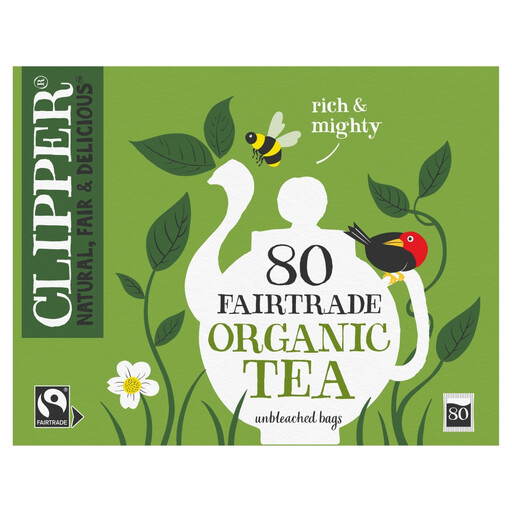
Clipper’s Organic & Fairtrade Everyday 80 Tea Bags product information describes organically grown black tea traded in compliance with Fairtrade Standards, total 100%.
- The product-level statement gives a specific Fairtrade claim for this Everyday pack.
- Check the claim on the exact pack when buying a different Clipper tea or variant.
Twinings
Twinings presents an Organic & Fairtrade tea collection for shoppers considering those two criteria together.
- The collection provides a starting point for comparing individual teas.
- Check the Fairtrade status, ingredients and tea type of the particular pack you choose.
Tetley
Tetley is a familiar brand, but familiarity does not confirm Fairtrade certification for an individual tea.
- Fairtrade International’s 2025 UK report identifies Tetley among brands shoppers may wrongly assume are Fairtrade. Check the exact product rather than inferring that all Tetley teas have, or lack, the certification.
PG Tips
A PG Tips brand name or general sourcing statement is not a substitute for a Fairtrade claim on the tea bags being purchased.
- Fairtrade International’s 2025 UK report names PG Tips among brands shoppers may wrongly assume are Fairtrade; verify the individual pack.
Yorkshire Tea
Yorkshire Tea described sourcing from Rainforest Alliance-certified suppliers in a 2017 explanation. That historical statement does not establish certification for a current pack.
- Fairtrade International’s 2025 UK report also identifies Yorkshire Tea among brands shoppers may wrongly assume are Fairtrade. Inspect the current product label if Fairtrade is required.
Typhoo
Typhoo describes its Premium 80 Tea Bags as Rainforest Alliance Certified.
- The Premium 80 product has a stated certification for shoppers considering that scheme.
- Rainforest Alliance certification is not confirmation of Fairtrade status; check the exact pack if Fairtrade is your requirement.
Tea bags on Joybuy
These Clipper options cover two different winter black-tea choices: a decaffeinated Everyday product and an organic black-tea product. Check the Fairtrade claim on the particular pack before deciding.
 No image available
Clipper Organic Fairtrade Decaf Everyday 80 Tea Bags, 277g
A decaffeinated Everyday tea-bag option for a winter black-tea routine. The product name specifies 80 bags and 277g, and makes organic and Fairtrade claims. Check those claims and the brewing directions on the exact pack; the listing also contains serving descriptions that do not clearly relate to tea bags.
View on Joybuy
 No image available
Clipper Organic Fairtrade 80 Tea Bags, 232g
An organic black-tea-bag option for regular winter cups. The product name specifies 80 bags and 232g and makes a Fairtrade claim. Check that claim and the brewing directions on the exact pack. If you want decaffeinated tea, confirm the caffeine information rather than assuming this variant is decaffeinated; the listing also contains serving descriptions that do not clearly relate to tea bags.
View on Joybuy
Frequently asked questions
How can I tell whether tea bags are Fairtrade?
Check the exact retail pack for the FAIRTRADE Mark or a clear product-level Fairtrade statement. Fairtrade International says the Mark is used when a product’s ingredients meet the applicable Fairtrade Standards; do not treat a brand’s general sourcing message as the same claim.
Is Rainforest Alliance certification the same as Fairtrade?
No. A Rainforest Alliance label does not establish Fairtrade certification. Fairtrade International describes its own standards and independent certification process, so check specifically for a Fairtrade claim if that is your buying requirement.
How should I brew Fairtrade black tea bags?
Follow the brewing directions on the exact pack you buy. Infusion instructions can differ between products, so a time stated for one black-tea blend should not be assumed to apply to another.
What should I check if caffeine matters to me?
Check whether the individual tea is described as decaffeinated; a Fairtrade claim does not tell you its caffeine status. NHS pregnancy guidance sets a limit of 200mg of caffeine a day and notes that caffeine can come from tea and other foods and drinks.
Is an online tea description enough to confirm the pack details?
Check the current pack when certification, ingredients or preparation instructions matter to your choice. A description of another variant or an older pack cannot confirm what is printed on the tea bags you receive.


