Fairtrade-first second-home owners
You want the tea left at the property to carry a Fairtrade claim that applies to the tea itself, rather than a different sourcing label.


For a second home with a firm Fairtrade requirement, start with a clearly labelled everyday black tea in a pack size you are likely to use, then add breakfast-style or green tea only if visitors want it. Check the Fairtrade claim on each product: Rainforest Alliance sourcing and brand-run programmes do not establish Fairtrade certification.
You want the tea left at the property to carry a Fairtrade claim that applies to the tea itself, rather than a different sourcing label.
You want a black-tea default for visits and guests without starting with several different blends. Clipper Tea Shop lists a Fairtrade everyday black tea in an 80-bag pack.
You expect some visitors to prefer breakfast-style black tea or green tea and want to check the Fairtrade claim on each additional product.
Choose the certification requirement first, then the tea styles and quantities that fit how often the property is used.
| Priority | What to check | Your needs |
|---|---|---|
| Fairtrade status | Check the chosen pack or product description for a Fairtrade claim applying to the tea. The Fairtrade Foundation explains what its Fairtrade Mark signifies; a different sourcing claim is not the same check. | I need tea that meets a specific Fairtrade requirement, not just a familiar brand or a general responsible-sourcing statement. |
| Tea style | Distinguish everyday black tea from breakfast-style black tea and green tea. Clipper Tea Shop lists Fairtrade 80-bag products in all three styles; its green-tea instructions call for cooled boiled water and a 1–3 minute infusion. | Will most visitors reach for ordinary black tea, or is there a regular preference for breakfast tea or green tea? |
| Pack and storage | Compare the pack quantity with likely use between visits. Check the best-before date on the pack and follow its storage instructions; Joybuy lists cool, dry storage for the Clipper 80-bag black tea shown below. | I want enough tea for visits without leaving several partly used packs at an unattended property. |
Fairtrade has identified mistaken assumptions about the certification of major UK tea brands. A brand name alone does not establish the status of the tea in a particular pack.
If Fairtrade is required, look for a Fairtrade Mark or explicit product-level wording that applies to the tea.
Rainforest Alliance certification and a brand’s own sourcing programme describe different approaches; neither, by itself, establishes that a product is Fairtrade-certified. Yorkshire Tea also distinguishes its Rainforest Alliance approach from Fairtrade’s minimum-price and premium model.
Decide whether Fairtrade certification is essential before comparing products with other sourcing claims on their own terms.
Everyday black tea, breakfast-style tea and green tea serve different preferences. Several open packs may be unnecessary at a property used only occasionally.
Start with the style visitors are most likely to drink, add others when there is a reason to, and check each pack’s best-before date and storage instructions.
These statements help distinguish sourcing approaches; check the certification claim on the individual tea product before treating it as Fairtrade.
Clipper Tea Shop lists Organic & Fairtrade Everyday, Organic Fairtrade English Breakfast and Fairtrade Organic Pure Green tea in 80-bag packs.
Tata Consumer Products describes Rainforest Alliance Certified farm sourcing for Tetley tea in its 2025 sustainability reporting.
Yorkshire Tea describes its tea as Rainforest Alliance Certified and explains how that approach differs from Fairtrade.
Twinings describes Sourced with Care as its responsible-sourcing programme, with work concerning sourcing communities and environmental impacts.
Typhoo describes its blend as sourced from Rainforest Alliance Certified gardens and identifies itself as an Ethical Tea Partnership member.
This 80-bag Clipper black tea is an option to consider for a Fairtrade-labelled everyday supply at a second home. Check the wording on the pack when choosing it.
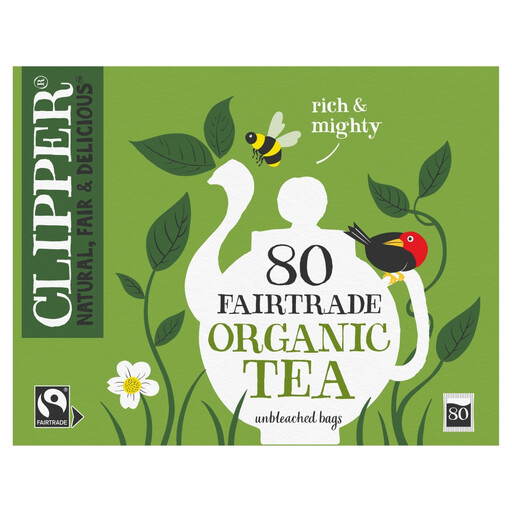 No image available
For an everyday black-tea supply at a second home, this is a Fairtrade-labelled 80-bag pack. Joybuy lists organically grown black tea as its ingredient and advises cool, dry storage; check the pack’s Fairtrade wording and best-before date before stocking up.
Look for a Fairtrade Mark or explicit Fairtrade wording that applies to the tea on the individual pack or product description. Clipper Tea Shop states that the tea in its cited Everyday, English Breakfast and Pure Green products is traded in compliance with Fairtrade standards, total 100%; a different ethical label does not establish the same claim.
No. They are distinct certification approaches, so a Rainforest Alliance claim alone does not confirm that a tea product is Fairtrade-certified. Yorkshire Tea discusses the difference between its Rainforest Alliance sourcing and Fairtrade’s minimum-price and premium model.
Start with one style that regular visitors are likely to use, such as everyday black tea, and add breakfast-style or green tea when those preferences are known. Clipper Tea Shop lists Fairtrade 80-bag packs in each of those styles, so check the likely use and best-before date before buying several packs.
Keep the pack in a cool, dry place and check its best-before date before adding more stock. Joybuy gives cool, dry storage instructions for the Clipper black tea shown here.