Fairtrade-first weekly shoppers
If Fairtrade is a firm requirement for your regular tea purchase, look for the claim on the particular pack and read what it applies to. A general ethical-sourcing message does not answer that question.


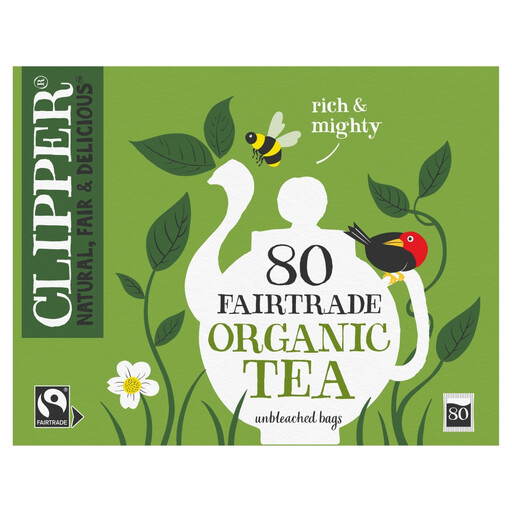
For a weekly shop where Fairtrade is essential, choose tea bags with an explicit Fairtrade claim on the individual pack or listing; Rainforest Alliance certification is a separate standard, not a substitute. Clipper Tea Shop lists an 80-bag Organic & Fairtrade Everyday option, while Twinings has an Organic & Fairtrade collection. Check the exact blend and pack rather than relying on the brand name alone.
If Fairtrade is a firm requirement for your regular tea purchase, look for the claim on the particular pack and read what it applies to. A general ethical-sourcing message does not answer that question.
When replacing a familiar box of black tea bags, compare the blend and bag count as well as the certification. Do not assume another product from the same brand carries the same claim.
If you are open to Rainforest Alliance-certified tea, decide whether that separate scheme meets your priorities before choosing a pack. It does not fulfil a Fairtrade-specific requirement.
Decide whether Fairtrade is a requirement first, then choose a tea type and quantity that fit your household’s usual shop.
| Priority | What to check | Your needs |
|---|---|---|
| Fairtrade claim | Look for explicit Fairtrade wording or the Fairtrade Mark on the selected pack or listing. Read any qualification about the tea or other ingredients. | I want the tea bags I put in the basket—not merely another product from the brand—to carry a Fairtrade claim. |
| Certification scheme | Check which scheme is named. Yorkshire Tea describes its suppliers as Rainforest Alliance-certified rather than Fairtrade; the schemes have distinct standards, according to Yorkshire Tea and Rainforest Alliance. | A separate sustainability certification may suit me, but if my shopping requirement is Fairtrade, a Rainforest Alliance claim alone will not meet it. |
| Tea type | Check whether the selected pack is the black, decaf or other tea your household intends to drink. Confirm the certification claim on that variant. | There is little reason to buy a larger box if it is not the brew we normally choose. |
| Bag count | Compare the number of bags in packs of the same tea type, then consider how many your household uses between shops. | For a routine shop, I want a quantity that fits our tea-drinking habits without choosing a different blend solely for its box size. |
Yorkshire Tea, Tetley, PG Tips and Typhoo have evidence of Rainforest Alliance sourcing or certification. That is not evidence that a particular pack meets a Fairtrade requirement.
Check the individual product for Fairtrade wording or the Fairtrade Mark. Treat a Rainforest Alliance claim as a choice under a separate scheme.
Twinings offers an Organic & Fairtrade collection, but its standard English Breakfast 80 Tea Bags listing does not state a Fairtrade claim. The collection name cannot establish the claim for that separate product.
Read the current description and packaging for the exact blend and pack you intend to buy.
A box with more bags is useful for a weekly shop only if its tea type suits the household’s usual brew.
Choose the blend first, then compare bag counts among packs you would actually use.
Certification claims can differ between products from the same brand, so use these references to narrow the search, then check the pack you choose.
Clipper Tea Shop lists an Organic & Fairtrade Everyday 80-bag product for shoppers seeking a routine tea pack.
Twinings offers an Organic & Fairtrade collection and describes its Jacksons of Piccadilly range as using Fairtrade registered growers.
Yorkshire Tea describes its suppliers as Rainforest Alliance-certified and explains that its tea is not Fairtrade.
Tetley’s parent company, Tata Consumer Products, describes Rainforest Alliance-certified farm sourcing for Tetley tea in its 2025 sustainability report.
Rainforest Alliance lists PG Tips tea as certified in the UK; an Asda listing also identifies Rainforest Alliance tea in PG Tips Original 240.
Typhoo says its blend is sourced from Rainforest Alliance Certified gardens.
These Clipper 80-bag options are relevant to a Fairtrade-focused weekly shop. One is labelled decaf; check each pack’s current Fairtrade wording and tea type before choosing.
 No image available
A decaf option for a household buying tea bags regularly. The product is labelled as an 80-bag, 277g pack; check the current pack’s Fairtrade claim and tea-specific directions before buying.
 No image available
An 80-bag, 232g option for a routine tea purchase. Fairtrade appears in the product name; if certification is essential to your shop, check the current pack for the precise claim and what it covers.
Check the current pack or product listing for explicit Fairtrade wording or the Fairtrade Mark, then read any qualification about the ingredient or percentage covered. For example, Clipper Tea Shop’s Everyday 40-bag listing states that its tea is traded in compliance with Fairtrade standards, total 100%; check other packs individually.
No. Rainforest Alliance and Fairtrade are separate certification schemes, so a Rainforest Alliance claim alone does not meet a Fairtrade-specific shopping requirement. If either scheme suits your priorities, check which one appears on the particular tea product.
Clipper Tea Shop lists an Organic & Fairtrade Everyday 80-bag product, and Twinings offers an Organic & Fairtrade collection. Check the exact pack: Twinings’ standard English Breakfast 80 Tea Bags listing, for instance, does not state a Fairtrade claim.
Confirm the certification claim on the chosen product, then compare bag counts among tea types your household actually drinks. An 80-bag box is useful only if that blend and quantity suit your regular use; check the selected pack’s storage instructions too.