Fairtrade-first everyday tea drinkers
If you want a familiar black-tea brew, look for a claim on the specific tea bags rather than relying on a brand’s wider sourcing message.


For a Fairtrade winter brew, start with an explicit Fairtrade claim on the tea you are buying, then choose the black-tea style, organic status and pack size that suit your cupboard. Clipper lists organic black teas whose tea is stated to be traded in compliance with Fairtrade standards, total 100%; Co-op and Sainsbury’s also list Fairtrade tea bags. If physical traceability matters to you, check the FAIRTRADE Mark and any explanation on the pack: Fairtrade International permits mass balance for tea.
If you want a familiar black-tea brew, look for a claim on the specific tea bags rather than relying on a brand’s wider sourcing message.
For a household, house-share or office, the number of bags matters alongside the Fairtrade claim. Check the current pack size before choosing how much tea to keep on hand.
If organic status or physical traceability matters, check each claim separately. A Fairtrade claim alone does not establish either one.
Start with the claim that matters most to you, then compare the tea and pack you will use.
| Priority | What to check | Your needs |
|---|---|---|
| Fairtrade claim | Look for explicit Fairtrade wording for the individual product and check the current pack for the FAIRTRADE Mark. A general responsible-sourcing programme is a different claim. | I want the tea bags I buy to carry a Fairtrade claim, not just to come from a familiar brand. The Fairtrade Foundation cautions against assuming that prominent tea brands are Fairtrade. |
| Tea and brew | Check whether the product is an English Breakfast or everyday black tea, then follow its own brewing instructions. Clipper lists 2–4 minutes for its English Breakfast bags and 2–5 minutes for its Everyday bags. | For a winter mug with milk or alongside food, I would choose the style of black tea I want to brew and adjust the steeping time to taste. |
| Organic status | Check for an organic claim on the specific product as well as its Fairtrade wording. Read the current ingredients list if its contents affect your choice. | Organic matters to me too, so I need a box that explicitly states both claims rather than treating them as the same thing. |
| Traceability | Read the FAIRTRADE Mark and any arrow or back-of-pack explanation. Fairtrade International says mass balance is permitted for tea, with Fairtrade sales volumes tracked and audited. | I want to know whether the pack confirms physical traceability; I would not assume every certified tea leaf stayed separate through processing. |
| Pack information | Compare the stated number of bags and read the physical pack’s current ingredients and allergen information, particularly if you have a dietary requirement. | A pack that fits how often we make tea is useful, but I need current label information before relying on its ingredients. |
The Fairtrade Foundation warns that shoppers may wrongly assume PG Tips, Tetley, Typhoo and Yorkshire Tea are Fairtrade. Brand recognition does not establish a claim for a particular box.
Check the current product for explicit Fairtrade wording and the FAIRTRADE Mark.
Fairtrade, organic and Rainforest Alliance are distinct claims. Yorkshire Tea describes sourcing from Rainforest Alliance-certified suppliers; that statement does not make a Yorkshire Tea product Fairtrade.
Decide which claim you require, then check it on the individual tea product.
Fairtrade International permits mass balance for tea, so certified and non-certified tea may be mixed during manufacture while Fairtrade sales volumes are tracked and audited.
If physical traceability is important, read the mark and any arrow or explanation on the pack before choosing.
Pack details and ingredients can change, which matters when a particular claim or ingredient affects your choice.
Check the physical box’s certification wording, ingredients and allergen information.
Clipper’s official shop lists Organic Fairtrade English Breakfast and Organic & Fairtrade Everyday black tea bags.
Co-op lists an own-label Fairtrade Tea Bags 80pk.
Sainsbury’s lists SO Organic Fairtrade Tea Bags x80, 250g.
Yorkshire Tea describes sourcing from Rainforest Alliance-certified suppliers, a different route from choosing a Fairtrade-labelled tea.
Twinings describes Sourced with Care as its responsible-sourcing programme.
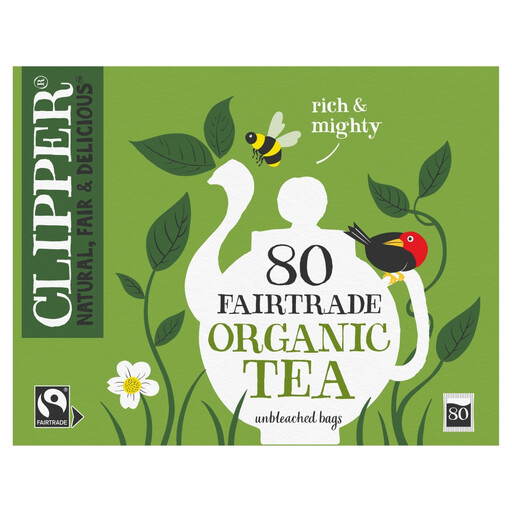
These Clipper options are organic Fairtrade black-tea bags in 80-bag packs. One is labelled decaf; check that distinction alongside the current pack’s Fairtrade and brewing information.
 No image available
An 80-bag organic black-tea option labelled decaf for a winter brew. The product information states that the ingredient is 100% Fairtrade and describes the bags as plastic-free and unbleached. Check the current pack’s FAIRTRADE Mark and traceability wording; if strict caffeine avoidance matters, confirm its residual caffeine information.
 No image available
An 80-bag organic black-tea option for an everyday cupboard. Its product name carries a Fairtrade claim, and its listed ingredient is organically grown black tea. Check the current pack’s FAIRTRADE Mark and preparation instructions before choosing how to brew it.
Do not assume that they are. The Fairtrade Foundation warns that shoppers may wrongly associate these brands with Fairtrade, while Yorkshire Tea describes sourcing from Rainforest Alliance-certified suppliers. If Fairtrade is a requirement, check the current box for an explicit claim and the FAIRTRADE Mark.
Not necessarily. Fairtrade International permits mass balance for tea: certified and non-certified tea may be mixed during manufacture while Fairtrade sales volumes are tracked and audited. Check the mark and any arrow or back-of-pack explanation for details relevant to the product.
Follow the instructions for your particular tea. Clipper lists 2–4 minutes for its Organic Fairtrade English Breakfast bags and 2–5 minutes for its Organic & Fairtrade Everyday bags; start within the stated range and adjust to taste.
No. Treat them as separate product claims and look for both on the individual box if both matter to you. Clipper’s listed organic Fairtrade black teas and Sainsbury’s SO Organic Fairtrade tea bags are examples of products described with both terms.
Read the current physical pack rather than relying solely on an online description. UK GOV.UK guidance says the ingredients list for pre-packed food must emphasise any of the 14 regulated allergens that are present.