Fairtrade-first tea drinkers
You want the tea in your afternoon cup to carry a product-specific Fairtrade claim, rather than choosing by a brand’s general ethical-sourcing message.


If Fairtrade is essential to your afternoon tea, check the claim on the exact pack rather than relying on the brand’s sourcing commitments; Clipper gives product-level examples for both black and green tea bags. Choose between them by the cup and brewing method you want, and do not treat Rainforest Alliance certification as a substitute for a Fairtrade claim.
You want the tea in your afternoon cup to carry a product-specific Fairtrade claim, rather than choosing by a brand’s general ethical-sourcing message.
You prefer a fuller black tea with a snack and want brewing directions for the blend you buy. Clipper describes its Organic & Fairtrade Everyday tea as full-bodied and specifies a 2–5 minute infusion.
You prefer a lighter green tea and are happy to follow the shorter, cooler-water preparation specified for Clipper Fairtrade Organic Pure Green.
Decide whether Fairtrade is a requirement, then choose the tea style and check the directions and disposal wording on the particular pack.
| Priority | What to check | Your needs |
|---|---|---|
| Fairtrade claim | Look for a Fairtrade mark or an explicit product-level statement. Check the stated proportion of tea where given: Clipper’s Everyday black tea and Pure Green pages each say the tea is traded in compliance with Fairtrade standards, total 100%. | I want a Fairtrade claim for the tea I am actually buying, not just a sourcing statement about its brand. |
| Sourcing terms | Read what the mark or programme claims. Yorkshire Tea identifies its tea as Rainforest Alliance Certified and explains that this is different from Fairtrade’s minimum-price and premium approach. A separate brand programme is not itself a Fairtrade claim. | If Fairtrade is non-negotiable for me, another certification or responsible-sourcing programme will not answer the same question. |
| Tea and brewing | Check the blend and its own instructions. Clipper specifies boiling water and 2–5 minutes for Organic & Fairtrade Everyday black tea; its Pure Green directions call for water cooled for one minute after boiling, then a 1–3 minute infusion. | A fuller black tea appeals to me with a snack; on another day I might prefer a lighter green tea and its different brewing routine. |
| Bag disposal | Read the individual pack’s disposal instructions and check what your local collection accepts. Compostability claims can depend on the disposal system: Tetley describes industrially compostable bags in part of its portfolio where suitable food-waste collection is available. | I want to know where these particular used bags can go, rather than assuming every plant-based or biodegradable bag belongs in home compost. |
A brand’s name or broader sustainability work does not establish the certification of a particular tea bag.
Check the exact pack or product page for a Fairtrade mark or an explicit Fairtrade statement before making a Fairtrade-only choice.
Yorkshire Tea says its Rainforest Alliance certification differs from Fairtrade’s minimum-price and social-premium approach. A company’s own sourcing programme makes a different claim again.
If you require Fairtrade specifically, look for that claim on the product rather than substituting another scheme.
The cited Clipper black and green teas have different preparation instructions, so one set of directions does not cover both products.
For Clipper Organic & Fairtrade Everyday, use its boiling-water, 2–5 minute directions. For Clipper Fairtrade Organic Pure Green, let boiled water cool for one minute and infuse for 1–3 minutes.
Plant-based, biodegradable and industrially compostable do not by themselves tell you whether a bag is accepted by a particular home-compost or food-waste system.
Follow the pack’s instructions and your local authority’s collection guidance.
These brand-level distinctions help narrow what to check; they do not establish the Fairtrade status of every tea bag a brand makes.
Clipper’s UK product pages identify its Organic & Fairtrade Everyday black tea and Fairtrade Organic Pure Green tea as traded in compliance with Fairtrade standards, total 100%.
Twinings has an Organic & Fairtrade collection and separately describes its Sourced with Care responsible-sourcing programme.
Yorkshire Tea identifies its tea as Rainforest Alliance Certified and states that Yorkshire Tea is not Fairtrade.
Typhoo says its blends use black tea leaves from Rainforest Alliance Certified gardens in Kenya.
Tetley discusses tea-bag materials and disposal in its sustainability information; those details address a different question from Fairtrade sourcing.
For a Fairtrade-only purchase, assess the specific PG Tips tea-bag pack rather than the brand name.
These two Clipper options are black tea bags for an afternoon snack: one is labelled decaf, while the other is an Everyday blend. Check the Fairtrade wording and brewing directions on the pack you choose.
 No image available
A decaf black-tea option to consider with an afternoon snack. The product’s ingredients statement identifies organically grown black tea as 100% Fairtrade; the pack contains 80 tea bags. Check the pack for directions specific to this decaf blend rather than applying instructions from another Clipper tea.
 No image available
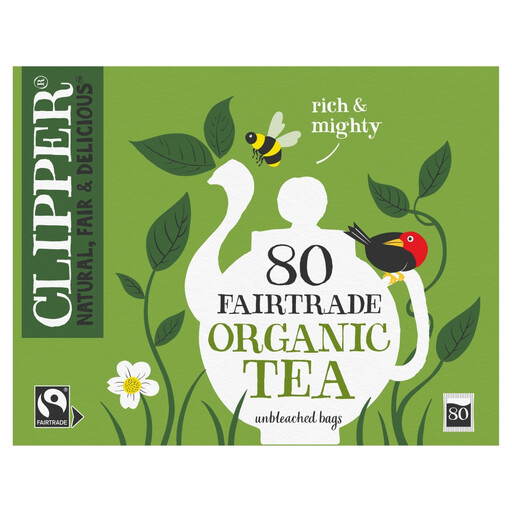
A black-tea option for a snack break, described in its product information as rich and full-flavoured. The pack contains 80 tea bags and carries a Fairtrade claim. If the proportion of tea traded on Fairtrade terms matters to you, check the exact pack; follow its own brewing directions.
Check the exact pack or product page for a Fairtrade mark or an explicit statement that its tea is traded in compliance with Fairtrade standards. A brand’s general ethical-sourcing message does not establish the status of every product it sells.
Not necessarily. The Fairtrade Foundation explains that under mass balance, the amount sold as Fairtrade must match the amount purchased on Fairtrade terms; the label alone does not establish that every leaf in a particular box was physically segregated.
No. Yorkshire Tea identifies its tea as Rainforest Alliance Certified and explains that this scheme does not state a minimum price or require a social premium in the way described for Fairtrade. If you specifically require Fairtrade, check for a Fairtrade claim on the tea you choose.
Follow the directions for the particular tea. Clipper specifies boiling water and a 2–5 minute infusion for its Organic & Fairtrade Everyday black tea; for its Fairtrade Organic Pure Green tea, it says to let boiled water cool for one minute before infusing for 1–3 minutes.