Choose a chocolate product with a clear, product-level Fairtrade claim, then choose a serving format that fits the meeting. A pretzel-toffee or caramel sharing bar can suit a small group, while individually wrapped Fairtrade chocolate offers sealed portions but may mean giving up the toffee flavour. Check the current pack’s ingredients and allergen warnings before serving; Fairtrade status does not establish dietary suitability.
Who is each format for?
The useful distinction for a work meeting is whether the Fairtrade claim, serving format and ingredient information meet the organiser’s requirements.
Organisers checking Fairtrade claims
If the sourcing claim is part of the refreshments brief, check the mark and its accompanying wording on the product pack. Fairtrade International distinguishes claims covering ingredients available on Fairtrade terms from claims naming particular Fairtrade-sourced ingredients.
Small teams sharing chocolate
A 180g pretzel-toffee or caramel bar gives a small group a way to serve the requested flavour. Plan how to divide it, and keep the ingredient and allergen information beside the refreshments.
Organisers needing sealed portions
Individually wrapped Fairtrade bars are an option when attendees will take their own portions. Check the flavour as well as the format: Divine’s 30-pack of 35g dark-chocolate bars is not toffee-flavoured.
What should you check before choosing?
Start with the product-level Fairtrade wording, then check whether sharing bars or sealed portions will work for the meeting. Flavour and allergens still need their own checks.
| Priority |
What to check |
Your needs |
| Fairtrade claim |
Read the pack’s Fairtrade mark and ingredient wording. Fairtrade International says a black-arrow FAIRTRADE Mark on a composite product covers ingredients available on Fairtrade terms; a Fairtrade Sourced Ingredient claim identifies the ingredient or ingredients concerned. |
I need to know what the claim covers, rather than relying on an ethical-sounding brand description. |
| Serving format |
Check whether you can divide a 180g sharing bar and keep its label available, or need sealed individual bars. Divine lists its Fairtrade 70% dark chocolate as a pack of 30 × 35g bars. |
For a small seated meeting, sharing may be workable. At a drop-in table, I would rather offer portions attendees can take individually. |
| Ingredients and allergens |
Read the current ingredient list and both contains and may-contain warnings. Tony’s pretzel-toffee bar includes wheat, milk and soya; Chocolate and Love’s Sea Salt 55% dark caramel bar contains milk. |
I need attendees to be able to check the actual product before taking a portion, especially where food requirements differ. |
| Flavour |
Distinguish toffee pieces from caramel pieces and plain chocolate. Tony’s describes a 42% dark-milk pretzel-toffee bar and a 32% milk-chocolate caramel-sea-salt bar; Chocolate and Love’s Sea Salt 55% is dark chocolate with caramel. |
If toffee flavour is essential, a plain individually wrapped dark-chocolate bar would not meet that part of the brief. |
What can go wrong when serving it?
-
Taking an ethical-sounding message as a Fairtrade claim
Chocolate contains several ingredients, and the scope of a Fairtrade claim depends on the mark and wording used. A brand mission statement does not tell you which ingredients a particular bar covers.
Check the product pack for its Fairtrade mark, named ingredients and any stated ingredient percentage. Fairtrade International explains the distinction between composite-product and Fairtrade Sourced Ingredient claims.
-
Choosing the flavour before checking allergens
Tony’s pretzel-toffee bar contains wheat, milk and soya and carries additional may-contain warnings for egg and nuts. A Fairtrade claim does not change those ingredients or warnings.
Check attendees’ requirements against the current physical pack before serving, and leave its ingredient and allergen information accessible.
-
Assuming dark or vegan-friendly means allergen-free
Chocolate and Love’s Sea Salt 55% dark bar contains milk. Divine describes its 70% dark-chocolate pack as vegan-friendly, but the pack may contain milk, gluten and nuts.
Use the specific product’s allergen statement to assess suitability; neither cocoa percentage nor a general dietary descriptor replaces it.
-
Putting a sharing bar on a table that needs sealed portions
Sharing bars require a way to divide them and keep the label with the food. Divine’s individually wrapped dark-chocolate bars offer a different serving format, but not the requested toffee flavour.
Decide whether individual portions are necessary before choosing a flavour. If they take priority, make the change from toffee-style chocolate clear when selecting refreshments.
Relevant brand references
These references concern specific chocolate products, not every confectionery item made by each brand.
Tony’s Chocolonely
Its UK product information lists both a 180g Dark Milk Pretzel Toffee bar and a 180g Milk Caramel Sea Salt bar, with Fairtrade cocoa-and-sugar claims.
- The pretzel-toffee bar is the closer flavour match; the caramel-sea-salt bar offers a different chocolate-and-caramel combination.
- Both are sharing bars rather than individually wrapped portions. Check each pack’s ingredients and allergen warnings separately.
Chocolate and Love
Its Sea Salt 55% bar combines dark chocolate and caramel pieces. Chocolate and Love states that its cocoa, sugar and vanilla are traded in compliance with Fairtrade Standards.
- A dark-chocolate caramel option when literal toffee pieces are not required.
- The bar contains milk and may contain tree nuts and peanuts; it is not an individually wrapped meeting pack.
Divine Chocolate
Divine lists a 30-pack of 35g Fairtrade 70% dark-chocolate bars for organisers who need individual portions more than a toffee flavour.
- Each bar provides a separate portion, and Divine states that the product uses Fairtrade cocoa and sugar.
- This is plain dark chocolate, not a toffee or caramel product. Divine describes it as vegan-friendly, but warns that it may contain milk, gluten and nuts.
Toffee-style chocolate options on Joybuy
These are sharing bars for a meeting where pretzel-toffee or caramel chocolate is acceptable and portions can be divided. Check the current pack’s Fairtrade wording and allergen information before serving.
 No image available
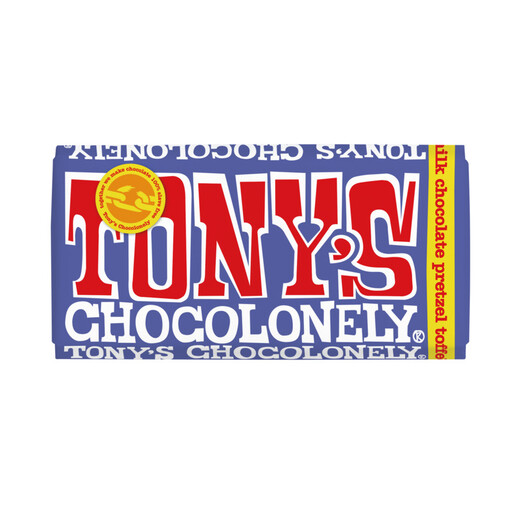
Tony’s Chocolonely Milk Chocolate Pretzel & Toffee 180g
This 180g sharing bar fits a small meeting where pretzel-and-toffee flavour is wanted and the bar can be divided. Joybuy’s product listing identifies 42% cocoa solids. Its product information lists milk, soya and wheat and flags possible cross-contact with eggs, nuts and peanuts; check the current pack’s Fairtrade ingredient wording and keep its allergen panel available.
View on Joybuy
 No image available
Tony’s Chocolonely Milk Chocolate Caramel Sea Salt 180g
This 180g sharing bar substitutes caramel and sea salt for literal toffee pieces. Tony’s product information describes the corresponding bar as 32% milk chocolate with 10% caramel pieces and Fairtrade cocoa and sugar. The product information lists milk and soya and flags possible cross-contact with gluten-containing cereals, eggs, nuts and peanuts; check the current pack before serving.
View on Joybuy
Frequently asked questions
Does Fairtrade chocolate contain only Fairtrade ingredients?
Not necessarily. Fairtrade International says the black-arrow FAIRTRADE Mark on a composite product concerns ingredients available on Fairtrade terms, while a Fairtrade Sourced Ingredient claim can name particular ingredients. Read the wording on the specific pack to see what its claim covers.
Can attendees avoiding milk, nuts, gluten or soya eat these bars?
Suitability depends on the current pack and the attendee’s requirements. Tony’s pretzel-toffee bar contains wheat, milk and soya and may contain egg and nuts; its caramel-sea-salt bar contains milk and soya and carries further may-contain warnings. Chocolate and Love’s Sea Salt 55% contains milk and may contain tree nuts and peanuts.
Should the wrappers stay with meeting refreshments?
Yes. Keep the original packaging or its ingredient and allergen information accessible so attendees can check the product being served. This matters particularly if you divide a sharing bar and its individual portions no longer carry a label.
When do individually wrapped bars make more sense than a sharing bar?
Choose individually wrapped bars when attendees need to take separate sealed portions, such as at a larger or drop-in meeting. A 180g sharing bar can work when you can divide it and retain its label, but the Divine 30-pack example is plain dark chocolate rather than toffee-flavoured.


