Fairtrade-first weekly shoppers
If sourcing is the deciding factor, check the claim on the individual pack. The Fairtrade Foundation’s guidance distinguishes a classic FAIRTRADE Mark from an FSI Mark naming one ingredient.


For a Fairtrade-focused weekly shop, choose a toffee only when its exact pack or current product listing identifies a Fairtrade claim and what it covers; a retailer’s Fairtrade range or a chocolate coating does not establish certification for that toffee. The Fairtrade Foundation distinguishes the classic FAIRTRADE Mark, which covers ingredients that can be certified, from the Fairtrade Sourced Ingredient (FSI) Mark, which applies to the named ingredient. Check the mark before treating chocolate with caramel as an alternative to plain toffee.
If sourcing is the deciding factor, check the claim on the individual pack. The Fairtrade Foundation’s guidance distinguishes a classic FAIRTRADE Mark from an FSI Mark naming one ingredient.
Compare pack sizes and check availability for your planned shop. Tesco lists a 175 g dairy toffee, while Thorntons lists several toffee formats; neither retailer’s range alone establishes a Fairtrade claim for a particular pack.
Read the current ingredient and allergen label for everyone who will eat the toffee. The Tesco, M&S and Werther’s Original examples list milk ingredients, and the Werther’s Original listing also names soya lecithin.
Start with the claim on the exact sweet, then compare its format, ingredients and suitability for the planned shop.
| Priority | What to check | Your needs |
|---|---|---|
| Fairtrade claim | Check the exact pack or current listing for the mark and any named ingredient. The Fairtrade Foundation says the classic mark covers ingredients that can be Fairtrade-certified; Fairtrade International says an FSI claim covers the specified ingredient, not necessarily the rest of a composite product. | I want to know whether the claim covers the certifiable ingredients in the sweet or a particular ingredient such as cocoa or sugar. |
| Type of sweet | Check whether the product is plain toffee, an assortment or chocolate containing caramel. Read any Fairtrade claim for that exact format rather than carrying it over from another product. | Plain toffee is what I set out to buy; chocolate with caramel only works if I am happy to change the type of sweet. |
| Allergens | Read the current ingredients and allergen information. Tesco, M&S and Sainsbury’s product listings show milk in their respective toffee examples; Sainsbury’s Werther’s Original listing also names soya lecithin. | Someone sharing the sweets needs to avoid an ingredient, so I will check the pack rather than rely on a previous purchase. |
| Sugars and portions | Compare sugars per 100 g on the same basis and use the stated serving size where available. Total sugars on a nutrition panel are not the same measure as free sugars; the NHS identifies sweets as a source of free sugars. | I want the portion I buy and serve to fit our usual approach to sweets, not judge it by pack size alone. |
| Availability | Check the product and pack details for the store or delivery slot you intend to use. A catalogue listing does not establish that a particular sweet will be available for that shop. | I need an option I can add to this week’s order without assuming every listed variety is in stock. |
A composite sweet can carry a claim about a named Fairtrade-sourced ingredient without the claim applying to every ingredient.
Read the mark on the exact pack. For an FSI Mark, identify the ingredient named alongside it, as Fairtrade International’s guidance requires.
Waitrose describes a Fairtrade programme for specified own-label products and cocoa used in confectionery, while Sainsbury’s has a Fairtrade grocery range. Neither statement, on its own, identifies the claim on a particular toffee pack.
Use the range to look for candidates, then check the individual product’s current packaging or listing.
Toffee examples listed by Tesco, M&S and Sainsbury’s contain milk ingredients, and the Werther’s Original example also lists soya lecithin. The relevant ingredients depend on the exact product.
Check the physical pack before consumption when an allergy or intolerance affects the choice.
A product page can remain visible when the sweet cannot be added to a particular order.
Confirm availability for your store or delivery slot after checking that the product meets your Fairtrade and ingredient requirements.
These are references for comparing toffee formats and checking claims, not a list of Fairtrade-certified toffees.
Tesco Groceries lists a 175 g own-label dairy toffee.
Sainsbury’s lists a 135 g Werther’s Original chewy toffee.
Thorntons lists original and chewy special toffee formats.
M&S lists a 200 g toffee assortment with several flavours.
Waitrose & Partners describes a Fairtrade programme covering specified own-label groceries and cocoa used in confectionery.
Sainsbury’s has a Fairtrade grocery category and separately lists Werther’s Original chewy toffee.
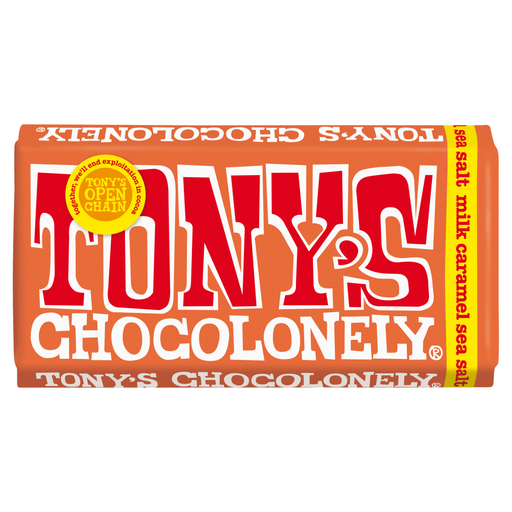
This selection is chocolate with caramel pieces for shoppers willing to consider a different sweet; it is not a plain-toffee recommendation.
 No image available
Consider this 180 g milk chocolate bar only if caramel pieces are an acceptable alternative to plain toffee. Its product description identifies sugar, cocoa butter and cocoa mass as Fairtrade ingredients; check the current pack to establish the exact mark, what the claim covers and any mass-balance wording. The product information lists milk and soya and states 51.1 g sugars per 100 g; check the pack for current allergen information.
Not necessarily. The Fairtrade Foundation says the classic FAIRTRADE Mark covers ingredients that can be Fairtrade-certified, whereas the FSI Mark identifies a particular Fairtrade-sourced ingredient. Read the mark and accompanying wording on the exact pack.
No. A range or retailer-level commitment does not establish the sugar sourcing of a specific toffee. Check that product’s current Fairtrade claim and any ingredient named beside an FSI Mark.
Do not assume an ordinary toffee is suitable. The Tesco, M&S and Werther’s Original examples list milk ingredients; check the current physical pack for the exact sweet before it is eaten.
Compare the nutrition panels using the same measure, such as sugars per 100 g, and check the stated serving size if you are planning portions. The NHS identifies sweets as a source of free sugars, but the total-sugars figure on a product label is not itself a free-sugars figure.