Families choosing a treat for home
If the chocolate will be eaten after school at home, compare the Fairtrade wording, caramel or toffee-style ingredients and current allergen label before choosing.


For an after-school treat eaten at home, compare Fairtrade caramel- or toffee-style chocolate by its ingredient statement, allergen label and bar size. Divine’s 90g salted-caramel bar states that it uses Fairtrade cocoa and sugar, while Tony’s Chocolonely lists a smaller 47g caramel-and-sea-salt bar. Before taking any chocolate into a school or club, check its food and allergy policies; an at-home treat is a different context from food provided by a school.
If the chocolate will be eaten after school at home, compare the Fairtrade wording, caramel or toffee-style ingredients and current allergen label before choosing.
If a treat might go into a school bag or after-school club, read precautionary allergen warnings and check the venue’s policy rather than assuming a toffee-style product is acceptable there.
Tony’s Chocolonely lists a 47g Fairtrade caramel-and-sea-salt bar, whereas the Divine salted-caramel and Green & Black’s butterscotch bars discussed here are 90g. Check the pack’s serving information if portion size matters to your household.
Start with where the chocolate will be eaten, then check the exact bar’s Fairtrade statement, allergens and size.
| Priority | What to check | Your needs |
|---|---|---|
| Fairtrade wording | Read which ingredients the statement names. The Fairtrade Foundation explains that mass balance allows certified and non-certified supplies to be mixed while corresponding Fairtrade quantities are purchased. | I want to understand what the Fairtrade claim covers, rather than assuming a logo means every ingredient in this bar was physically segregated. |
| Allergens | Check the current pack for ingredients and precautionary warnings. Divine’s 90g salted-caramel bar states that it contains milk and may contain gluten and nuts; Tesco lists a nut warning for Green & Black’s Butterscotch. | If a child has an allergy, I need the label for the exact product. If the treat may go to school or a club, I also need that venue’s policy. |
| Where it will be eaten | Separate a treat eaten at home from food a school provides. England’s 2014 school-food regulations define chocolate products as confectionery, and the Department for Education says school food standards are a legal requirement for state-funded schools. | For something eaten at home after school, I can make a household choice. Before sending it onto school premises, I need to check the school’s food and allergy rules. |
| Bar size | Compare the stated weight and serving information: Tony’s Chocolonely lists a 47g caramel-and-sea-salt bar, while the Divine salted-caramel and Green & Black’s butterscotch bars are 90g. | A smaller bar may be easier for me to use without dividing a 90g bar, but I still want to read its nutrition and allergen label. |
A mass-balance claim does not establish that the Fairtrade ingredients physically present in an individual bar were kept separate throughout processing.
Read the product’s ingredient-specific statement. The Fairtrade Foundation says mass balance requires companies to buy corresponding Fairtrade quantities of the relevant ingredients.
A bar can have no nuts listed as ingredients yet still carry a “may contain nuts” warning. Divine’s salted-caramel bar and Green & Black’s Butterscotch have nut-related precautionary warnings.
Check the current pack and the school or club’s allergy policy before sending a treat there.
England’s school-food regulations classify chocolate products as confectionery, while the Department for Education says school food standards are legally required for state-funded schools. A treat eaten at home after school is a separate setting.
If food will be brought into or provided at a school or club, ask the venue which food rules apply rather than relying on its suitability for home.
Divine describes its business as co-owned by cocoa farmers. Its 90g salted-caramel milk-chocolate bar is described as made with Fairtrade cocoa and sugar.
Its 90g Organic Butterscotch Milk Chocolate Bar is listed by Tesco as Fairtrade, with 37% cocoa and crunchy pieces of sweet toffee.
Tony’s Chocolonely describes a 47g Fairtrade milk-chocolate bar with caramel and sea salt on its UK product page.
Waitrose lists Green & Black’s Organic Butterscotch Milk Chocolate Bar as Fairtrade, with butterscotch pieces.
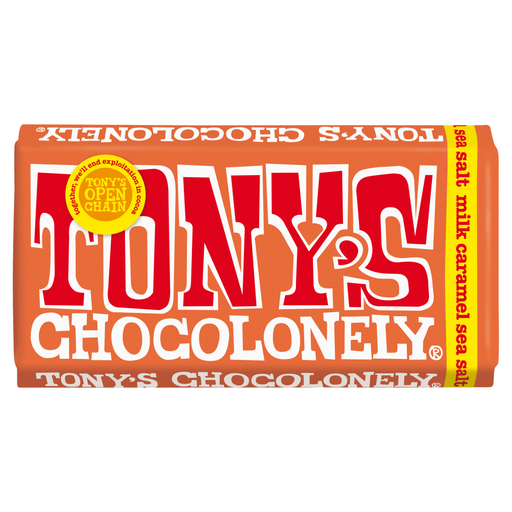
This 180g Tony’s Chocolonely bar is a caramel-and-sea-salt chocolate option for a treat eaten at home after school; it is a different size from the brand’s 47g bar discussed above.
 No image available
This 180g milk-chocolate bar has caramel and sea salt for an at-home after-school treat. Its listing identifies milk and soya allergens and warns of possible gluten-containing cereals, eggs, nuts and peanuts; check the current pack against the child’s needs and any club policy.
Check the school’s food and allergy policies before sending it. England’s 2014 school-food regulations define chocolate products as confectionery, and the Department for Education says school food standards are legally required for state-funded schools; eating a treat at home after school is a different context.
No. It is a precautionary warning about possible unintended presence, not an ingredient declaration. Divine’s 90g salted-caramel bar and Green & Black’s Butterscotch carry nut-related warnings, so check the current pack and any relevant school or club policy.
It means certified and non-certified supplies may be mixed during processing while the company buys corresponding Fairtrade quantities of the relevant ingredients, as the Fairtrade Foundation explains. It does not establish that those ingredients were physically segregated in a particular bar.
Compare the pack weight and its nutrition information per serving or per 100g. Divine’s salted-caramel and Green & Black’s butterscotch bars are 90g; Tony’s Chocolonely also describes a distinct 47g caramel-and-sea-salt bar. Neither weight establishes a serving size for an individual child.
Read that school’s published allergy safety policy or ask the school or after-school club. England’s Department for Education says schools must publish an allergy safety policy; check how the individual venue treats both nut ingredients and precautionary warnings.