Shoppers seeking a Fairtrade toffee flavour
If the sourcing claim matters as much as the flavour, check the mark on the exact chocolate or toffee-style product. A brand’s reputation alone does not tell you which ingredients its pack covers.


If a verifiable Fairtrade claim matters, choose a toffee-style product only after checking the mark on its pack: the classic FAIRTRADE Mark covers all ingredients that can be Fairtrade certified, according to the Fairtrade Foundation. For a personal mid-morning treat, compare sugars per 100g, the portion you intend to eat and allergens; food supplied at a state-funded school in England also needs a separate school-food check.
If the sourcing claim matters as much as the flavour, check the mark on the exact chocolate or toffee-style product. A brand’s reputation alone does not tell you which ingredients its pack covers.
For a mid-morning treat, compare total sugars per 100g, consider how much of the pack you would eat and read the current allergen declaration.
Food supplied to pupils at a state-funded school needs to meet the applicable England School Food Standards. Check the requirements for the proposed snack independently of its Fairtrade claim.
Start with the claim on the pack, then assess the food itself and where it will be served.
| Priority | What to check | Your needs |
|---|---|---|
| Fairtrade scope | Find the mark on the exact pack and check whether it covers all certifiable ingredients or names a particular ingredient. The Fairtrade Foundation says the classic black-background FAIRTRADE Mark covers all ingredients that can be Fairtrade certified. | I want to know whether the sourcing claim covers the ingredients that matter to me, rather than relying on a toffee flavour or brand name. |
| Sugars and portion | Compare total sugars on the same per-100g basis, then consider the amount you would eat. The NHS describes 22.5g or more total sugars per 100g as high in sugar. | For a mid-morning treat, I want to compare the label and decide what portion suits the occasion. |
| Allergens | Read the current ingredients, highlighted allergens and any precautionary statement on the specific pack. The Food Standards Agency explains that precautionary labelling communicates possible unintended allergen presence. | If milk, soya, wheat or nuts are relevant to me, I need the declaration for this recipe and pack, not an assumption based on its chocolate style. |
| School provision | For a state-funded school in England, check the current School Food Standards and the proposed service. The Department for Education says compliance is a legal requirement; the Requirements for School Food Regulations 2014 include non-chocolate confectionery and chocolate within their definition of confectionery. | When buying for pupils, I need to establish whether this particular food can be supplied during the school day. A Fairtrade claim does not answer that question. |
A Fairtrade claim may refer to the product’s certifiable ingredients or to a named ingredient, so the distinction changes what the claim tells you.
Read the mark and its wording on the exact pack. The Fairtrade Foundation says the classic black-background FAIRTRADE Mark covers all ingredients that can be Fairtrade certified.
Fairtrade certification does not describe the amount of sugar in a snack. The NHS classifies 22.5g or more total sugars per 100g as high in sugar.
Compare the per-100g declaration across products, then look at the portion you intend to eat.
The Department for Education says the School Food Standards are legally required for state-funded schools in England. The Requirements for School Food Regulations 2014 include toffee-style non-chocolate confectionery and chocolate within the definition of confectionery.
Check the current standards and school catering requirements before choosing food to supply to pupils.
A dark-chocolate or Fairtrade description cannot establish whether a particular product contains milk, soya or other relevant allergens.
Read the ingredients and any precautionary allergen statement on the current pack each time you choose a product.
A Fairtrade chocolate brand with a toffee-and-sea-salt milk chocolate listing.
A chocolate option for shoppers considering caramel or pretzel-and-toffee flavours.
A chocolate brand whose direct site describes Fairtrade and organic ranges.
An own-brand chocolate reference for shoppers checking Fairtrade claims alongside other groceries.
These chocolate bars offer caramel or toffee flavours for a personal mid-morning treat. Check each pack’s Fairtrade claim, nutrition label and allergens before choosing; the selection does not settle whether either bar can be supplied as school food.
 No image available
The caramel-and-sea-salt flavour offers a toffee-style chocolate option for a mid-morning treat.
Check the current pack to see what its Fairtrade claim covers, and compare total sugars per 100g, your intended portion and the allergen declaration.
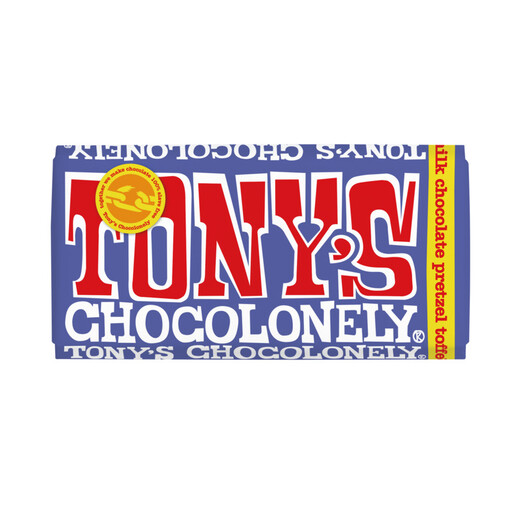 No image available
This 180g milk chocolate bar combines pretzel and toffee flavours for shoppers seeking that particular mix.
Check the pack’s Fairtrade mark and ingredient scope rather than assuming the claim covers every ingredient. Read its sugar and allergen declarations for the portion you plan to eat.
Not necessarily. The Fairtrade Foundation says the classic black-background FAIRTRADE Mark covers all ingredients that can be Fairtrade certified; a mark naming a sourced ingredient identifies that ingredient instead. Read the wording on the exact pack.
Do not use its Fairtrade claim as permission to supply it. The Department for Education says the School Food Standards are legally required for state-funded schools in England, and the Requirements for School Food Regulations 2014 define confectionery to include non-chocolate confectionery and chocolate. Check the current requirements for the proposed food and service before purchasing.
No UK-wide conclusion follows from the England rules cited here. For school provision in Scotland, Wales or Northern Ireland, check the requirements applicable there before selecting a product.
Compare total sugars per 100g on both labels, then consider the portion you intend to eat. The NHS describes 22.5g or more total sugars per 100g as high in sugar.
Read the exact pack’s ingredients, highlighted allergens and any precautionary statement before choosing. A flavour name, dark-chocolate description or Fairtrade mark does not establish allergen suitability.