For pieces on a street-party table, Waitrose lists a 180g Belgian White Chocolate bar with Fairtrade-certified cocoa and 10 servings; its Cooks' Ingredients bar is intended for cooking. Green & Black's offers a smaller, organic Fairtrade-labelled bar, while Tesco lists Ombar Blonde as a vegan white-confectionery alternative rather than conventional dairy white chocolate. The sourcing claims differ, so check the current wrapper for the exact mark, ingredients and allergen warnings before serving.
Who is this for?
Hosts checking cocoa sourcing
If you want a white-chocolate bar to share or use in a bake, compare the sourcing statement on the actual product with its pack size and intended use. Waitrose describes the cocoa in its Belgian White Chocolate as Fairtrade certified; ASDA lists Fairtrade Standards wording for specified ingredients in Green & Black's Organic White Chocolate.
Hosts serving vegan guests
Tesco lists Ombar Blonde as vegan. It is a blonde white-confectionery alternative, not a conventional dairy white-chocolate bar; its stated nut and peanut warning still matters when deciding whether to serve it.
Community and school-linked organisers
For a community table, guests need access to the original ingredient information. The Food Standards Agency recommends keeping packaging so people with food hypersensitivities can check it. If food will be supplied in a school setting in England, check the school's requirements separately.
What matters when choosing?
Start with how the chocolate will be served, then compare the precise sourcing claim and the ingredient warnings on each pack.
| Priority | What to check | Your needs |
|---|
| Sourcing claim |
Read the mark and accompanying ingredient wording. The Fairtrade Foundation distinguishes its classic Fairtrade Mark from an ingredient-specific claim; mass balance does not mean certified ingredients remain physically separate. |
I want to describe the chocolate's sourcing accurately, rather than treat every fair-trade claim as the same certification. |
| Serving format |
Compare the listed weight and intended use: Waitrose lists a 180g Belgian sharing bar and a 180g Cooks' Ingredients bar; Green & Black's is listed at 90g and Ombar Blonde at 70g. |
Will guests take pieces from a table, or will I melt the chocolate into a party bake? For a larger group, I need to work out how many packs the recipe or serving plan requires. |
| Ingredients and allergens |
Check the current wrapper for milk, soya and nut statements. The listed dairy bars contain milk; Tesco lists Ombar Blonde as vegan but its nut and peanut warning remains relevant. |
If guests have different dietary requirements, I need clearly identified options and their original wrappers available for checking. |
| Event setting |
Keep packaging available at a community event, as the Food Standards Agency recommends. For food supplied in a state-funded school in England, check with the school catering lead; Department for Education school-food guidance addresses chocolate separately. |
A neighbourhood street party and food supplied at a school are different settings, so I need to check which arrangements apply to this event. |
Common buying mistakes
-
Treating every fair-trade phrase as the same mark
A claim about one sourced ingredient differs from a claim covering all ingredients that can be Fairtrade certified. Mass-balance wording also does not establish that the certified ingredient is physically segregated in a particular bar.
Read the mark and its accompanying wording on the current pack. Keep Ombar's stated World Fair Trade Organization-related sugar claim distinct from Fairtrade Foundation claims.
-
Choosing a small bar for a large shared recipe
A 70g or 90g bar may mean opening several packs when the serving plan calls for more chocolate. A cooking-oriented product may also be easier to match to a melting recipe than a bar chosen for individual pieces.
Work from the recipe quantity or the number of portions you plan to put out, then compare pack weights and intended uses before buying.
-
Assuming a vegan label resolves every allergen concern
The listed dairy white chocolates contain milk, while the vegan Ombar product carries a nut and peanut warning. A vegan declaration does not remove that warning.
Keep original wrappers beside separately served products so guests can check the current ingredient and allergen information. The Food Standards Agency recommends retaining packaging at community events for this purpose.
-
Using street-party arrangements for a school event
Department for Education guidance addresses food provided in state-funded schools in England, and its practical guide lists chocolate among confectionery across the school day. That setting needs its own check rather than an assumption based on an ordinary community party.
Ask the school catering lead what may be supplied before planning chocolate for pupils; do not use a retail HFSS label as a substitute for checking school-food requirements.
Brands and product lines to consider
Waitrose
Waitrose lists a Belgian White Chocolate bar for sharing and a separate Cooks' Ingredients White Chocolate product for recipes.
- The Belgian bar is listed at 180g and 10 servings; Waitrose states that its cocoa is Fairtrade certified.
- The Cooks' Ingredients product is described as suitable for melting in cooking.
- The products contain milk and may contain nuts. Waitrose says Fairtrade sugar and vanilla may be mixed with non-certified ingredients on a mass-balance basis.
Green & Black's
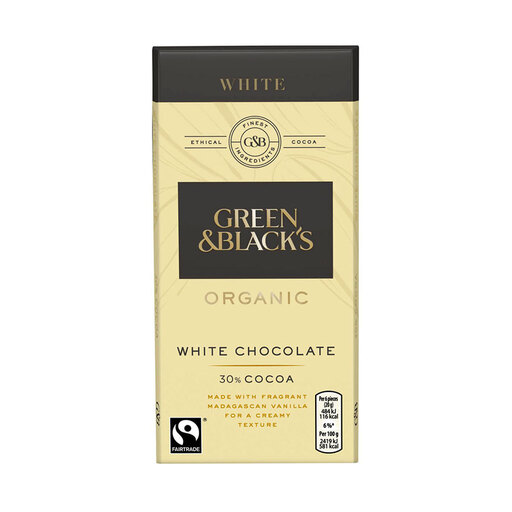
ASDA lists the 90g Organic White Chocolate Bar with a Fairtrade claim.
- Its ingredient statement says sugar, cocoa and vanilla, totalling 71%, are traded in compliance with Fairtrade Standards.
- This 90g bar contains milk and soya and may contain nuts; plan the number of bars around the amount you intend to serve.
Ombar
Tesco lists Ombar Blonde as a vegan blonde white-confectionery option rather than conventional dairy white chocolate.
- The listing describes a fair-trade claim for its sugar against the World Fair Trade Organization standard, which should be identified separately from a Fairtrade Foundation mark.
- The product carries a nut and peanut warning and is not suitable for guests with those allergies.
Joybuy white-chocolate option
This 90g white-chocolate bar is a smaller-format option to consider when planning street-party portions. Confirm its current sourcing statement and ingredients on the pack before presenting it to guests.
 No image available
Green & Black's White Chocolate 90g
The 90g bar offers a smaller format for serving pieces at a street party. Its product description lists milk and soya and says it may contain nuts; keep the current wrapper available so guests can check the ingredients and sourcing claim.
View on Joybuy
Frequently asked questions
Does Fairtrade wording mean every ingredient is physically separate from non-certified ingredients?
No. The Fairtrade Foundation says its classic Fairtrade Mark covers ingredients that can be Fairtrade certified, while an ingredient-specific claim has a narrower scope. Where a product states that mass balance is used, certified and non-certified material may mix during processing; read the wording on the particular pack rather than assuming physical segregation.
What should I keep with chocolate served at a street party?
Keep the original packaging available so guests can check ingredients and allergen warnings. The Food Standards Agency recommends retaining packaging at community and charity events for people with food hypersensitivities.
Is Ombar Blonde an option for vegan guests?
Tesco lists Ombar Blonde as vegan, but it is blonde white confectionery rather than conventional dairy white chocolate. Check its current wrapper before serving: the listed product carries a nut and peanut warning and is not suitable for guests with those allergies.
Can I plan the same chocolate table for an event at a school in England?
Check with the school catering lead before supplying chocolate to pupils. Department for Education guidance for state-funded schools in England addresses school food separately, and its practical guide lists chocolate among confectionery across the school day; an ordinary street-party serving plan does not settle what the school can provide.


