Hosts handing out individual treats
If each guest should receive a separate bar, pack count and wrapping matter alongside the Fairtrade claim on the exact product.


Check the Fairtrade Mark or an explicit product-level statement about Fairtrade ingredients; a general responsible-cocoa claim is not the same thing. Individually wrapped bars suit one-per-guest treats, while cooking chocolate suits cake decoration and a sharing bar suits a smaller gathering. Check the current pack against guests’ dietary needs before serving; if a state-funded school in England is providing food to pupils, choose a non-chocolate alternative.
If each guest should receive a separate bar, pack count and wrapping matter alongside the Fairtrade claim on the exact product.
Chocolate intended for melting or drizzling fits a different plan from bars handed out whole. Check the cooking description and keep the packaging available for ingredient checks.
Check guests’ dietary requirements and the current pack. For food provided to pupils by a state-funded school in England, school-food rules also affect whether chocolate is an appropriate choice.
Settle the serving plan first, then check the Fairtrade wording, ingredients and event setting on the product you intend to use.
| Priority | What to check | Your needs |
|---|---|---|
| Fairtrade claim | Look for the Fairtrade Mark or named Fairtrade ingredients on the product. The Fairtrade Foundation distinguishes the classic Mark from its Sourced Ingredient Mark; mass balance allows certified and non-certified commodities to mix during processing while equivalent Fairtrade volumes are purchased. | I want to know which ingredients the Fairtrade claim covers, rather than relying on a brand’s general cocoa-sourcing message. |
| Individual treats | Compare the number of wrapped bars with the guest count and check each bar’s size. Divine Chocolate lists a pack of 30 individually wrapped 35g white-chocolate bars with Fairtrade cocoa, sugar and vanilla. | Every guest needs a separate treat without cutting up a larger bar. |
| Cake or shared dessert | Check whether the product is described for melting or cooking, then plan how it will be served. Waitrose & Partners describes its Cooks’ Ingredients white chocolate as a cooking product and states 10 servings; a sharing bar is not individually portioned. | I’m decorating a cake or putting chocolate on a shared dessert, rather than filling party bags. |
| Allergens | Read the current pack’s ingredients and precautionary statements against each guest’s requirements. The Divine, Waitrose Cooks’ Ingredients, Green & Black’s and Tony’s products discussed here contain milk and have differing additional allergen statements. | Before serving, I need to know whether a particular guest can have the exact product I bought. |
| School setting | Establish who is providing the food and ask the school about its event policy. Department for Education guidance updated in September 2026 says school-food standards are a legal requirement for state-funded schools in England; the Requirements for School Food Regulations 2014 define confectionery to include chocolate. | If the school is providing food to pupils, I need a non-chocolate option. For a privately organised event, I’ll confirm the school’s policy before buying. |
Cocoa-sourcing programmes and product-level Fairtrade claims describe different things. The Fairtrade Foundation also distinguishes its classic Mark, Sourced Ingredient Mark and mass-balance approach.
If Fairtrade sourcing is your requirement, check the exact pack for a Fairtrade Mark or a statement naming the Fairtrade ingredients, and read any mass-balance wording.
A shared bar needs dividing, whereas Divine Chocolate lists 30 individually wrapped 35g bars in its party-sized pack. For a cake, separately wrapped bars may not match the preparation plan.
Count guests and decide whether the chocolate will be handed out, shared or melted before choosing a format.
The products discussed here contain milk and carry different additional allergen warnings. Waitrose & Partners advises that recipes can change.
Ask about dietary requirements, keep the original packaging and check its current allergen declaration before serving.
Department for Education guidance updated in September 2026 says school-food standards are legally required for state-funded schools in England. The Requirements for School Food Regulations 2014 include chocolate within confectionery.
Where a state-funded school in England is providing food to pupils, choose a non-chocolate alternative. Confirm the school’s policy for any privately organised event.
These examples show different product formats and sourcing claims; a brand’s inclusion does not establish the status of every product it makes.
Divine Chocolate lists a 30-pack of individually wrapped 35g white-chocolate bars for handing out to guests.
Its white cooking chocolate is described by Waitrose & Partners for melting and use in desserts.
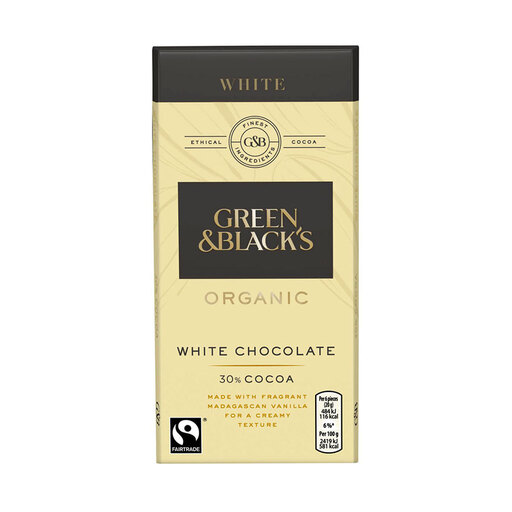
Waitrose & Partners lists an Organic 30% White Chocolate Bar bearing a Fairtrade claim, a format to consider for a small gathering.
The white raspberry popping-candy bar is a flavoured sharing option; Tony’s Chocolonely UK describes it as Fairtrade certified.
Cadbury’s Cocoa Life information describes a cocoa-sourcing programme, not a Fairtrade claim for a particular Cadbury white-chocolate product.
This 90g white-chocolate bar is a format to consider for a small birthday gathering, rather than for handing out individually wrapped treats.
 No image available
For a small gathering, plan how to divide this single bar rather than expecting one wrapped item per guest. Its product description lists milk and soya and says it may contain nuts; check the current pack before serving. If you require the Organic 30% Fairtrade variant, confirm that identity and its Fairtrade wording on the pack.
Check the exact product for the Fairtrade Mark or a statement naming its Fairtrade ingredients. The Fairtrade Foundation says the classic Mark covers ingredients that can be Fairtrade certified, while its Sourced Ingredient Mark identifies a particular ingredient. A general responsible-cocoa statement does not establish the same claim.
No, not necessarily. The Fairtrade Foundation explains that certified and non-certified commodities may mix during processing under mass balance, while equivalent Fairtrade quantities are purchased. Read the product’s wording to see which ingredients the claim covers.
Choose one explicitly described for cooking or melting if the plan involves a drizzle or dessert decoration. Waitrose & Partners describes its Cooks’ Ingredients white chocolate for cooking and states 10 servings; check the current pack for milk and nut warnings before use.
If a state-funded school in England is providing food to pupils, choose a non-chocolate alternative. Department for Education guidance updated in September 2026 says compliance with school-food standards is legally required for those schools, and the Requirements for School Food Regulations 2014 include chocolate in the definition of confectionery. For a privately organised event, ask the school about its policy.
All four Fairtrade product examples discussed here contain milk, but their other statements differ. Divine may contain gluten and nuts; Waitrose Cooks’ Ingredients may contain nuts; Green & Black’s contains soya and may contain nuts; Tony’s contains soya and may contain gluten, egg and nuts. Check the current pack against each guest’s requirements before serving.