Fairtrade-focused treat shoppers
If you want a few squares after supper, compare the claim on the exact bar: a classic FAIRTRADE Mark and a claim about one Fairtrade-sourced ingredient do not mean the same thing.


For an after-supper square, look for a white bar whose pack makes its Fairtrade claim clear; for a dessert you plan to melt, check the claim on a cooking-format product instead. The Fairtrade Foundation says the classic FAIRTRADE Mark covers all ingredients that can be Fairtrade certified, whereas its Sourced Ingredient Mark covers the named ingredient. Mass balance can allow certified and non-certified ingredients to mix, so check the exact pack’s wording and allergens before eating or sharing.
If you want a few squares after supper, compare the claim on the exact bar: a classic FAIRTRADE Mark and a claim about one Fairtrade-sourced ingredient do not mean the same thing.
If you are making a drizzle, mousse or fruit topping, look for white chocolate intended for melting, then check which ingredients its Fairtrade wording covers.
Check the current pack before serving white chocolate to anyone with an allergy or intolerance. The cited products have different ingredient and precautionary allergen information.
Decide whether you need squares to eat or chocolate to melt, then compare the exact product’s Fairtrade wording and ingredient panel.
| Priority | What to check | Your needs |
|---|---|---|
| Fairtrade scope | Look for the classic FAIRTRADE Mark or a Fairtrade Sourced Ingredient claim. The Fairtrade Foundation says the former covers all certifiable ingredients; the latter identifies the ingredient covered. | I want to know whether the claim extends beyond cocoa to other certifiable ingredients in the white chocolate. |
| Mass balance | Read any mass-balance statement alongside the ingredient claim. It allows certified and non-certified ingredients to mix rather than establishing physical separation in an individual bar. | If separation matters to me, I need to understand what the wording on this particular product does—and does not—say. |
| Serving format | Check whether the product is a bar for eating or a cooking chocolate described for melting. For portion planning, Waitrose lists an 18 g serving for its Green & Black's 90 g bar. | A few squares suit my after-supper treat; a drizzle or mousse calls for a product intended for that preparation. |
| Ingredients and allergens | Read the current ingredient list, allergen declarations and any precautionary statements on the exact pack before serving. | I need to check suitability for everyone sharing dessert, rather than assuming two white-chocolate products have the same ingredients. |
Cocoa programmes can cover different standards and products. Galaxy’s UK responsible-cocoa page names selected Smooth Milk products and describes Rainforest Alliance sourcing; it does not establish a Fairtrade claim for a Galaxy white-chocolate product.
For a Fairtrade-led purchase, check the wording on the exact white-chocolate pack rather than relying on a brand-wide statement.
Under mass balance, certified and non-certified ingredients can be mixed. A Fairtrade purchasing claim is not, by itself, a claim that the ingredients in one bar remained separate throughout the supply chain.
Read the product’s mass-balance statement if physical traceability matters to your choice.
The cited white chocolates contain milk, while other ingredient and precautionary statements differ between products. Recipes and labelling can change.
Check the exact pack before eating, melting or sharing it, particularly when an allergy or intolerance is involved.
A Fairtrade claim does not tell you whether the product is intended as squares to eat or as an ingredient to melt for dessert.
Choose the format your supper needs, then compare its Fairtrade wording and allergens.
Waitrose lists an Organic 30% White Chocolate Bar with product-specific Fairtrade ingredient wording.
Its Cooks’ Ingredients White Chocolate offers a cooking-format example with a specific Fairtrade cocoa declaration.
M&S says its ChocMarks range is made with Fairtrade cocoa and links it to its Shared ImPact sourcing programme.
Galaxy describes responsible cocoa sourcing for named UK Smooth Milk products.
Lindt describes its Farming Program and other responsible-sourcing standards for cocoa products.
Cadbury’s UK range includes white chocolate.
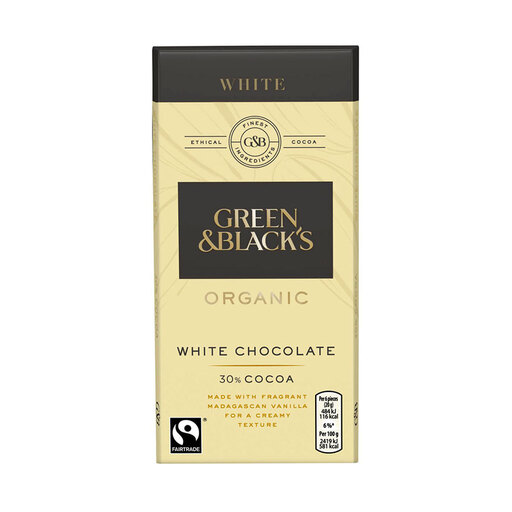
This white-chocolate bar is an option to consider for an after-supper square. Check its current pack for the Fairtrade claim before making that the basis of your choice.
 No image available
The 90 g bar is a format for serving squares after supper. Its product information lists milk and soya and warns that it may contain nuts; check the current pack before sharing it. Confirm the exact Fairtrade wording on the pack if that claim is central to your choice.
Not necessarily. The Fairtrade Foundation says the classic FAIRTRADE Mark covers all ingredients that can be Fairtrade certified, while a Fairtrade Sourced Ingredient Mark identifies the particular ingredient covered. Check which mark and ingredient wording appear on the exact product.
No. The Fairtrade Foundation explains that mass balance allows certified and non-certified ingredients to mix while an equivalent volume is purchased on Fairtrade terms. It does not establish physical separation of the cocoa in an individual bar.
Choose a cooking-format white chocolate if the recipe calls for melting. Waitrose describes its Cooks’ Ingredients White Chocolate for uses including mousse and drizzling, and says its cocoa is Fairtrade certified. Check the current pack’s ingredients and allergens before serving.
No. The cited Green & Black's bar contains milk and soya and may contain nuts; Waitrose’s cooking white chocolate contains milk and may contain nuts. Check the exact current pack, including precautionary statements, for anyone with an allergy or intolerance.