What should you check?
Start with what the Fairtrade claim covers, then choose a format you intend to carry and check the pack details that affect that choice.
| Priority |
What to check |
Your needs |
| Fairtrade scope |
Identify the exact mark and any named Fairtrade-sourced ingredient. The Fairtrade Foundation says the standard FAIRTRADE Mark covers ingredients that can be Fairtrade certified, while the Sourced Ingredient Mark identifies one ingredient; mass balance allows certified and non-certified material to mix during processing. |
I want the claim on the pack to match the ingredients I care about, without assuming they were physically segregated in my bar. |
| Portion and format |
Compare the whole-bar weight with any stated serving. Divine Chocolate lists a 35g bar; Waitrose & Partners lists a 90g Green & Black's bar and a 180g Waitrose bar with 10 servings. |
A small bar would give me one unit to carry. If I choose a larger bar, I'll decide what to take before putting it in my bag. |
| Nutrition and allergens |
Read sugars and saturates on the same per-100g basis, then check the serving information and allergen statement. Divine Chocolate lists 59g sugars and 19g saturates per 100g for its 35g bar, which contains milk and may contain gluten and nuts. |
Fairtrade sourcing matters to me, but I still need to check what is in the particular chocolate I plan to eat. |
| Storage |
Read the pack's storage directions and consider how warm the bag may get. Ocado advises keeping the Divine bar cool and dry; Waitrose & Partners advises keeping its Belgian White Chocolate away from heat and sunlight. |
My snack may stay in a bag for a while, so I want a place to keep it that follows the pack directions. |
Relevant brand references
These examples refer to particular white-chocolate products, not every product made by each brand.
Divine
Divine Chocolate describes its 35g White Chocolate bar as made with Fairtrade cocoa and sugar; its ingredient information also names Fairtrade vanilla.
- The 35g format is a small bar to carry as one unit.
- It contains milk and may contain gluten and nuts. Divine Chocolate lists 59g sugars and 19g saturates per 100g.
Waitrose
Waitrose & Partners lists its Belgian White Chocolate as a plain 180g bar with 10 servings and Fairtrade-certified cocoa, sugar and vanilla statements that include mass-balance wording.
- The listed servings give shoppers a reference for dividing the bar.
- A 180g block needs dividing if you intend to carry less than the whole bar.
Green & Black's
Waitrose & Partners describes the reviewed Organic 30% White Chocolate as a 90g Fairtrade bar with 30% cocoa solids and mass-balance wording for sugar, cocoa and vanilla.
- Its 90g format gives shoppers a smaller block to divide than the reviewed 180g bars.
- It is not a single-serve bar. The reviewed product contains soya and may contain nuts.
Tony's Chocolonely
Tony's Chocolonely describes its White Raspberry Popping Candy as a flavoured, 180g Fairtrade-certified white-chocolate bar with Fairtrade cocoa and sugar.
- It provides a flavoured option for someone specifically seeking raspberry and popping candy rather than plain white chocolate.
- It contains milk and soya and may contain gluten, egg and nuts; its 180g size also calls for portioning if you want to carry less.
Joybuy product options
This 90g white-chocolate bar is an option if you want to divide a larger bar for an occasional gym-bag treat. Check its current pack for the Fairtrade mark and ingredient wording that matter to you.
 No image available
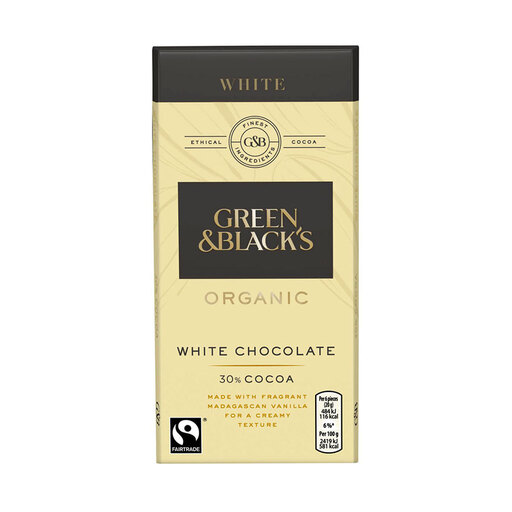
Green & Black's White Chocolate 90g
For a gym-bag treat, decide how much of this 90g bar to carry before leaving home. Waitrose & Partners lists an 18g serving for the matching Green & Black's white-chocolate bar; check the current pack for its Fairtrade wording, allergens and storage directions.
View on Joybuy
Questions about choosing and carrying it
How can I tell what a Fairtrade mark on white chocolate covers?
Read the mark and any ingredient named beside it. The Fairtrade Foundation says the standard FAIRTRADE Mark covers all ingredients that can be Fairtrade certified, while the Fairtrade Sourced Ingredient Mark identifies one Fairtrade-sourced ingredient; a cocoa claim alone should not be read as a claim about sugar or vanilla.
Does mass balance mean certified ingredients were kept separate in my bar?
No. The Fairtrade Foundation explains that, under mass balance, certified commodities may mix with non-Fairtrade material during processing. Read that wording as a sourcing arrangement, not a guarantee of physical segregation in an individual bar.
Should I take a 35g bar or divide a larger one?
A 35g Divine bar gives you one small unit to carry; a larger bar is an option if you divide it deliberately. Waitrose & Partners lists 10 servings for its 180g Belgian White Chocolate, so use the stated serving information rather than treating the whole block as one portion.
What should I check before putting white chocolate in a gym bag?
Read the current pack for allergens and storage instructions, and consider how warm the bag may get. The reviewed Divine bar contains milk and may contain gluten and nuts; Ocado advises storing it in a cool, dry place.
Do England's school-food standards apply to a personal gym-bag snack?
The Requirements for School Food Regulations 2014 concern food provided to pupils in maintained schools and pupil referral units in England, not a general rule about carrying a personal gym-bag snack. The Department for Education's standards exclude chocolate from that school-provided food across the school day; check the relevant school's policy separately if you plan to take chocolate onto school premises.


