Parents planning an occasional treat
A stated serving or individually sized bar can make it easier to decide how much chocolate to offer after school. Check the pack’s total sugars per serving alongside what else the child is having that day.


For an occasional after-school treat, check the Fairtrade mark and sourcing statement on the individual pack, then choose a serving size you can plan before opening it. Compare total sugars per stated serving and read the current allergen information: Fairtrade certification describes sourcing, not the chocolate’s nutrition or suitability for a particular child.
A stated serving or individually sized bar can make it easier to decide how much chocolate to offer after school. Check the pack’s total sugars per serving alongside what else the child is having that day.
The classic FAIRTRADE Mark, a Fairtrade Sourced Ingredient mark and mass-balance wording communicate different things. Read the mark and the accompanying statement to see which ingredients the claim covers.
The white-chocolate examples below contain milk, and their other ingredient declarations and precautionary warnings differ. Check the exact current pack rather than relying on another flavour or an older listing.
Start with what the Fairtrade claim covers, then compare the serving you intend to offer and the information on the current pack.
| Priority | What to check | Your needs |
|---|---|---|
| Fairtrade scope | The Fairtrade Foundation says the classic mark covers ingredients that can be Fairtrade-certified; a Fairtrade Sourced Ingredient mark identifies a named ingredient. Read any mass-balance statement separately. | I want to know whether the claim covers eligible ingredients across the recipe or a named ingredient, and whether mass balance applies. |
| Serving and sugar | Compare total sugars for the portion you plan to serve, not just per 100g. Tesco lists 9.2g total sugars per 18g serving for Green & Black’s 90g bar; total sugars are not the same measure as free sugars. | A stated serving gives me a starting point. With a larger bar, I still need to decide how much to break off. |
| Allergens | Read the current ingredients, highlighted allergens and any may-contain warning. The Divine, Green & Black’s and Waitrose examples declare different ingredients and warnings. | If milk, soya, wheat or nuts matter in our household, I need the information for this exact product and pack. |
| Where it will be served | Separate a snack served at home from food provided by a school. In England, school-provided food in state-funded schools is subject to school-food requirements, and the 2014 Regulations define chocolate as confectionery. | For a home after-school treat, I can make a portion choice; for food taken onto school premises, I need to check the school’s policy. |
According to the Fairtrade Foundation, the classic mark and the Fairtrade Sourced Ingredient mark have different scopes. Mass balance describes how matching Fairtrade ingredient volumes are sourced; it does not promise physical segregation in an individual bar.
Read the mark, any named-ingredient tab and the sourcing statement on the current pack before choosing.
Pack sizes and stated servings differ. An individually sized bar and an 18g serving taken from a larger bar are not the same portion.
Decide on the serving before opening a larger bar, and compare the declared total sugars for that serving.
The Divine, Green & Black’s and Waitrose examples contain milk, while their other declared ingredients and may-contain warnings differ.
Read the exact current pack before serving; do not substitute another flavour’s label or an older product image.
Department for Education guidance concerns food provided in state-funded schools in England, and the 2014 school-food regulations define chocolate as confectionery. Those school-food requirements and a family’s after-school choice at home have different scopes.
If the food will be taken onto school premises, check the school’s current policy and the rules applicable in that nation.
These product examples illustrate different pack sizes and Fairtrade statements; the claim and ingredients should be checked on the product being bought.
Divine describes its 35g white-chocolate bar as made with Fairtrade cocoa and sugar, offering an individually sized format.
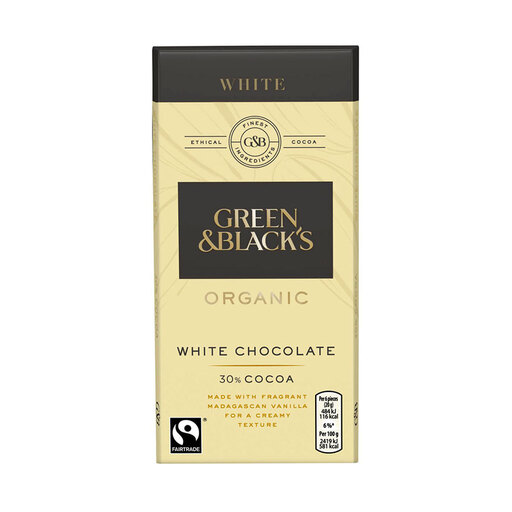
Tesco’s listing for the 90g Organic White Chocolate bar gives an 18g serving and describes Fairtrade sugar, cocoa and vanilla on a mass-balance basis.
Waitrose describes its Fairtrade Blonde Chocolate as caramelised white chocolate with feuilletine wafer and sea salt, rather than plain white chocolate.
This 90g white-chocolate bar has a stated 18g serving to consider when planning an occasional after-school treat.
 No image available
For a planned after-school portion, the matching product information states an 18g serving with 9.2g total sugars. Tesco describes its Fairtrade sugar, cocoa and vanilla claim as 71% in total on a mass-balance basis. The product information lists milk and soya and says it may contain nuts; check the current pack. If squares matter to your portion plan, check the bar’s format before buying.
Look for the mark and its accompanying wording on the current pack. The Fairtrade Foundation says the classic FAIRTRADE Mark covers ingredients that can be Fairtrade-certified, while a Fairtrade Sourced Ingredient mark identifies the ingredient named on its tab.
No. The Fairtrade Foundation explains that mass balance allows certified and non-certified supplies to mix during processing while matching volumes of Fairtrade ingredients are purchased. It is not a claim that the physical ingredients in each bar were segregated.
Start with the pack’s stated serving and decide how much to offer before opening a larger bar. Compare total sugars for that serving across products; the figure on the nutrition label is not a direct measure of free sugars.
Read the ingredients and may-contain statement on the exact current pack. The Divine example contains milk and may contain gluten and nuts; Green & Black’s lists milk and soya and may contain nuts; the Waitrose blonde chocolate contains wheat, milk and soya and may contain peanuts and nuts.
England’s school-food requirements concern food provided by state-funded schools, not a family serving a snack at home after school. The 2014 Regulations define chocolate as confectionery; for food taken onto school premises, check the school’s policy and the rules applicable in that nation.