Fairtrade-first tea-break shoppers
If Fairtrade is a firm requirement, check the current pack for its exact mark or named Fairtrade ingredients. General responsible-sourcing wording describes a different claim.


Start with the exact Fairtrade claim on the white chocolate you intend to buy: the Fairtrade Foundation distinguishes the classic FAIRTRADE Mark, which covers all ingredients that can be Fairtrade-certified, from a Fairtrade Sourced Ingredient mark naming one ingredient. For a morning tea break, a 90g Green & Black's bar offers a compact format with documented Fairtrade ingredient claims, while Waitrose Belgian White Chocolate is a larger 180g plain bar; check the current pack's serving information and allergens before choosing.
If Fairtrade is a firm requirement, check the current pack for its exact mark or named Fairtrade ingredients. General responsible-sourcing wording describes a different claim.
A bar's total weight is different from its stated serving size. Compare the serving you intend to have with the sugars and saturates shown on each product's nutrition panel.
Check the label of the exact bar or flavour, particularly when buying for someone else. The Green & Black's white-chocolate listing declares milk and soya lecithin and says the bar may contain nuts.
Choose the Fairtrade coverage you require first, then compare the chocolate's format, nutrition information and allergen statement.
| Priority | What to check | Your needs |
|---|---|---|
| Fairtrade coverage | Check whether the pack has the classic FAIRTRADE Mark or names a Fairtrade Sourced Ingredient. Read any stated ingredient coverage and mass-balance wording. | I want to know whether the Fairtrade claim covers certifiable ingredients generally or only a named ingredient. The Fairtrade Foundation distinguishes those two marks. |
| Format and serving | Compare bar weight with the stated serving size, then use the nutrition values per 100g and, where given, per serving. Check that serving sizes match before comparing serving figures. | A compact bar might suit my break, but its pack weight does not tell me what portion to choose. I want to compare the sugars and saturates for the amount I plan to eat. |
| Ingredients and allergens | Read the ingredients, declared allergens and any precautionary statement on the current pack. Recheck when changing product, size or flavour. | If I am buying for myself or sharing at work, I need the allergen information for that particular chocolate, not an assumption based on its Fairtrade claim. |
| Flavour and texture | Distinguish plain white chocolate from caramelised blonde chocolate with added wafer and sea salt. Check the ingredients if the addition matters to you. | For a simple white-chocolate break, I would choose a plain bar; if I want caramelised flavour and wafer texture, the blonde option is a different choice. |
These claims do not identify the same scheme. For example, Galaxy describes a Rainforest Alliance mass-balance programme for named Smooth Milk products; that statement does not establish a Fairtrade claim for white chocolate.
If Fairtrade matters to your choice, look for an explicit Fairtrade mark or ingredient statement on the white chocolate's current pack.
Waitrose & Partners says Fairtrade sugar and vanilla in its Belgian White Chocolate may be mixed with non-certified equivalents under mass balance. Its stated 76% Fairtrade total should be read alongside that qualification.
Check which ingredients the percentage covers and whether the pack describes mass balance; do not assume every ingredient in the physical bar was kept separate.
The Green & Black's white-chocolate listing declares milk and soya lecithin and says the bar may contain nuts. The Food Standards Agency explains that a ‘may contain’ statement communicates possible unintended allergen presence.
Read the current label of the exact product, especially before sharing it with someone who has an allergy.
A 90g or 180g bar weight does not specify how much is eaten at one break. Nutrition figures stated for different serving sizes are not directly comparable as serving figures.
Check each pack's serving basis and compare its per-100g values when you want a common basis.
Its Belgian White Chocolate is a plain-bar option with a documented Fairtrade cocoa claim; its No.1 blonde chocolate offers a caramelised alternative.
The 90g Organic White Chocolate bar is a compact option with a stated Fairtrade ingredient claim.
Cadbury lists a 90g white-chocolate bar and 100g white-chocolate buttons for shoppers comparing bar and bite-sized formats.
Lindt lists white-chocolate bars and truffles, including a 200g LINDOR White truffles box.
Galaxy's responsible-cocoa information is useful for distinguishing sourcing programmes, not for establishing a Fairtrade white-chocolate choice.
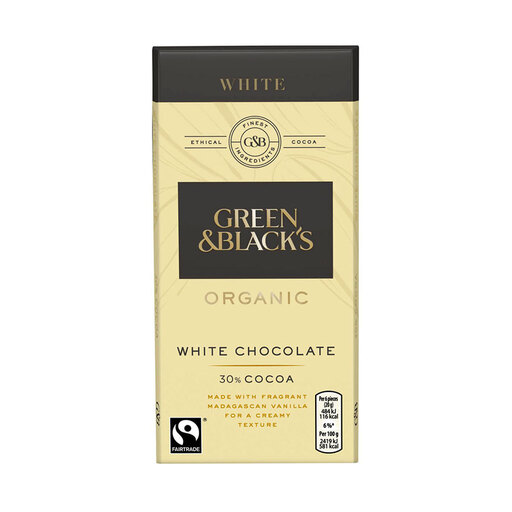
This 90g Green & Black's bar is an option to consider for a compact morning tea break. Compare its current Fairtrade claim and serving information with your requirements.
 No image available
The 90g bar is a compact format for a morning break. Sainsbury's listing for the matching Green & Black's Organic White Chocolate says its sugar, cocoa and vanilla are traded in compliance with Fairtrade Standards, totalling 71%. Check the current pack's exact Fairtrade claim, serving basis and allergen statement; serving sizes differ between the available product descriptions.
Not necessarily. The Fairtrade Foundation says the classic FAIRTRADE Mark covers all ingredients that can be Fairtrade-certified, while a Fairtrade Sourced Ingredient mark identifies the named Fairtrade-sourced ingredient. Check which mark and ingredients appear on the current pack.
Mass balance does not promise that certified ingredients remain physically separate throughout the supply chain. Waitrose & Partners says Fairtrade sugar and vanilla in its Belgian White Chocolate may be mixed with non-certified equivalents and states a 76% Fairtrade total; read both parts of the claim when deciding whether it meets your requirement.
Compare the amount you plan to eat with each pack's stated serving size, and use per-100g nutrition values for a common comparison basis. GOV.UK's nutrition-labelling guidance specifies values per 100g or 100ml where nutrition information is declared. Recheck the serving basis on the current Green & Black's pack before using per-serving figures.
Fairtrade status does not establish allergen suitability. The Green & Black's white-chocolate listing declares milk and soya lecithin and says the bar may contain nuts. Check the current pack of the exact product before buying it for someone with an allergy.