Office snack organisers
If colleagues help themselves, individually wrapped bars avoid breaking up a larger bar. Check what ingredient information remains with each portion, or keep the outer packaging beside the tin.


For a communal biscuit tin, Divine’s 30-pack of individually wrapped 35g plain white-chocolate bars avoids the portioning needed for a larger bar; Divine states that it uses Fairtrade cocoa and sugar. Green & Black’s plain bar or Tony’s raspberry-and-popping-candy bar can also suit an office willing to portion chocolate and keep its packaging available. Check the exact product’s Fairtrade wording and allergen label before sharing.
If colleagues help themselves, individually wrapped bars avoid breaking up a larger bar. Check what ingredient information remains with each portion, or keep the outer packaging beside the tin.
Look for a claim about the exact white-chocolate product and the ingredients it covers. A brand’s broader cocoa-sourcing message is not the same claim.
The white-chocolate products discussed here have different ingredient and precautionary allergen statements. Keep the current packaging accessible so colleagues can check the product for themselves.
Start with the Fairtrade claim on the particular product, then choose a portion format that works for the tin without losing its ingredient information.
| Priority | What to check | Your needs |
|---|---|---|
| Fairtrade claim | Check the exact bar or pack for a Fairtrade claim and which ingredients it covers. Read any mass-balance wording: the Fairtrade Foundation explains that certified and non-certified commodities may mix during processing. | I want the white chocolate in the tin to have a product-specific Fairtrade claim, not just a general brand sourcing statement. |
| Portion format | Divine describes a pack of 30 individually sized 35g bars. Green & Black’s is a single 90g bar; Tony’s is a single 180g bar. Check whether individual portions retain ingredient information. | Colleagues should be able to take a portion without someone repeatedly breaking up and replenishing a larger bar. |
| Allergen information | Read the delivered product’s ingredients and precautionary statements, and keep its packaging available. The Food Standards Agency explains that precautionary allergen labelling communicates the possibility of unintended allergen presence. | Anyone taking chocolate from the shared tin needs a way to check the exact product against their own requirements. |
| Flavour | Distinguish plain white chocolate from Tony’s bar with raspberry and popping candy. Check the flavour and ingredients before adding a new bar to an established tin. | Plain white chocolate may be what the office expects; I would label a flavoured option clearly. |
A statement about a brand’s sourcing programme does not establish a Fairtrade claim for the white-chocolate product you put in the tin.
Check the wording on the exact product and identify which ingredients the claim covers.
Colleagues then lose ready access to that bar’s ingredients and precautionary allergen statements.
Keep the current wrapper with the tin and check it again when replenishing from a different product.
The Fairtrade Foundation says certified commodities may mix with non-certified commodities during processing. A mass-balance statement should not be presented as a guarantee that the ingredients in a particular bar remained physically separate.
Read the product’s ingredient-level Fairtrade wording if that distinction matters to your office.
Raspberry and popping candy change both the flavour and the ingredients colleagues will encounter.
Keep a flavoured bar identifiable and retain its packaging for reference.
These examples illustrate different product claims and formats; a claim about one bar should not be assumed to apply to every product from its brand.
Divine describes its 30-pack of 35g plain white-chocolate bars as made with Fairtrade cocoa and sugar.
Waitrose describes its 90g Organic 30% White Chocolate Bar as a plain option with Fairtrade sugar, cocoa and vanilla.
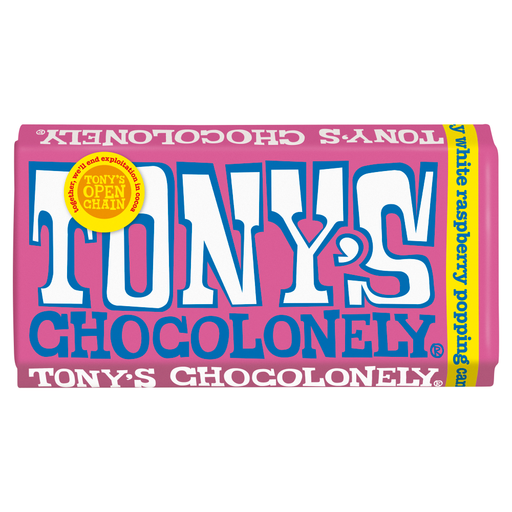
Tony’s describes its 180g white-chocolate bar with raspberry and popping candy as Fairtrade-certified.
This flavoured sharing bar is an option when the office welcomes raspberry and popping candy and someone can portion the chocolate while keeping its packaging available.
 No image available
This single flavoured bar needs portioning for an office tin; keep its packaging accessible. Tony’s product information identifies Fairtrade cocoa and sugar and states that the sugar is sourced on a mass-balance basis. The product description lists milk and soya and says it may contain cereals containing gluten, eggs and nuts; check the delivered label.
Read the claim on the exact product label or its official product information, including which ingredients it names. Divine states that its white-chocolate 30-pack uses Fairtrade cocoa and sugar; Tony’s identifies its raspberry-and-popping-candy bar as Fairtrade-certified.
No. The Fairtrade Foundation explains that certified commodities may mix with non-certified commodities during processing. Read the precise claim rather than treating mass balance as a guarantee of physical separation.
No. The products discussed contain milk and have differing ingredient or precautionary allergen statements. Keep each product’s current packaging available so colleagues can assess it against their own requirements.
No. A broader sourcing statement does not establish that a particular white-chocolate bar has a Fairtrade claim. Check the exact product rather than extending a brand-level statement to everything it makes.