Who is buying the milk?
The right milk type depends on who drinks it and whether the household can finish the pack within its storage instructions.
Adults and older children reducing dietary fat
Milk for cereal, drinks or cooking can still come in a family-size pack without being whole milk. The NHS advises lower-fat milk for older children and adults; compare fat and saturates per 100ml when choosing a variant.
Mixed-age households with a child under 5
One large pack may be used by people with different milk needs. Check guidance for the young child's main drink and any warning on the exact product before making skimmed milk the only household option.
Households trying to avoid milk waste
Match pack volume to how quickly the household uses milk, then check the refrigeration and after-opening instructions. A longer stated fresh life can matter for slower use, but filtered whole milk remains whole milk.
What should you check?
Choose the milk type for its regular drinkers first, then decide whether a family-size pack fits the household's rate of use.
| Priority |
What to check |
Your needs |
| Fat content |
Compare fat and saturates per 100ml on the exact bottles. Sainsbury's lists 3.7g fat and 2.4g saturates for its 4-pint whole milk, against less than 0.5g and less than 0.1g for its 4-pint skimmed milk. |
I use milk regularly and want to reduce dietary fat. The NHS advises lower-fat milk for older children and adults. |
| Regular drinkers |
Check who will use the milk as a main drink, particularly young children. Read age-related guidance and warnings for the exact product before choosing one pack for everyone. |
A young child shares our household milk, so I cannot choose solely on the adults' preference for lower-fat milk. |
| Pack and storage |
Check volume, available fridge space and the instructions after opening. The supermarket family packs compared here contain 2.272L, or 4 pints; follow the storage directions on the bottle you buy. |
We need a pack we can finish within its stated storage period, rather than choosing the largest bottle automatically. |
| Milk allergens |
Check the allergen declaration, not just a lactose-free description. Cambridge University Hospitals NHS Foundation Trust states that lactose-free dairy products are not suitable for someone with a cow's-milk-protein allergy. |
Someone in the household has a cow's-milk-protein allergy, so a lactose-free dairy label does not answer our allergen question. |
Brand and retailer references
Compare the exact milk variant and its label; a brand name alone does not establish its fat content or storage life.
Sainsbury's
Its 4-pint whole and skimmed milk listings allow a same-size comparison.
- Per 100ml, the whole milk lists 3.7g fat and 2.4g saturates; the skimmed milk lists less than 0.5g fat and less than 0.1g saturates.
- Use the current bottle label for the variant you buy, including its storage instructions.
Tesco
Tesco lists British skimmed and semi-skimmed milk in 2.272L, 4-pint bottles.
- Both listed types offer a family-pack format without choosing whole milk.
- Compare the nutrition panels on the individual bottles rather than assuming their values are the same.
Asda
Asda lists British whole milk in a 2.272L, 4-pint pack.
- The listed volume provides a whole-milk family-pack reference.
- If reducing milk fat is the aim, compare its label with lower-fat milk types rather than treating pack size as the deciding factor.
Cravendale
Its filtered whole-milk product has a stated fresh-life claim that may be relevant to slower-use households.
- Waitrose & Partners lists up to 3 weeks unopened and 7 days once opened for the researched product.
- That product is whole milk; the fresh-life claim is not a reason to treat it as a lower-fat variant.
Waitrose
Waitrose lists Essential British Free Range Whole Milk in a 2.272L, 4-pint pack.
- The listing gives a clear family-pack volume for whole milk.
- Check the bottle's nutrition panel against a lower-fat alternative if fat content drives the decision.
M&S
M&S lists British whole milk and describes its own-brand sourcing through M&S Select Farms and the M&S Milk Pledge.
- The product listing identifies the milk type clearly as whole milk.
- M&S sourcing statements do not establish a lower-fat advantage; check the current nutrition and storage labels.
Joybuy milk options
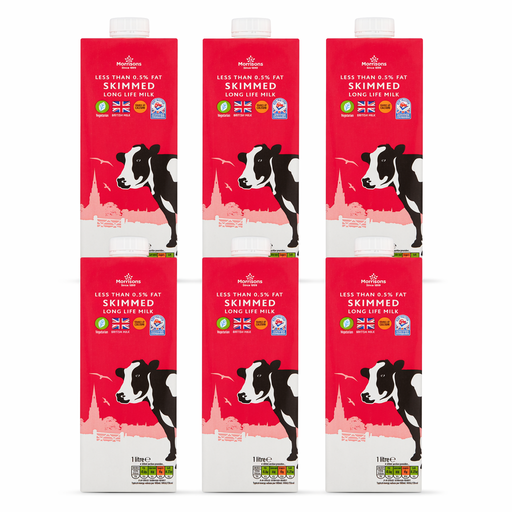
This skimmed UHT milk comes as six 1-litre cartons. It is a lower-fat milk-type option for the adult and older-child decision discussed here, rather than a family bottle of whole milk.
 No image available
Morrisons British UHT Skimmed Milk, 6 × 1 litre
Skimmed milk fits the milk-type choice for adults and older children reducing dietary fat, according to NHS guidance. This product is a six-pack of 1-litre UHT cartons, not a single 4-pint bottle or whole milk. The listing warns that it is not suitable for children under 5 and says to refrigerate after opening and use within 3 days.
View on Joybuy
Questions about family-pack milk
Should I buy whole milk for a low-fat household?
For adults and older children whose aim is to reduce dietary fat, lower-fat milk is the more relevant choice; the NHS advises it for these groups. For a same-size example, Sainsbury's 4-pint whole milk lists 3.7g fat and 2.4g saturates per 100ml, while its skimmed milk lists less than 0.5g fat and less than 0.1g saturates.
How can I compare whole and skimmed family packs fairly?
Compare total fat and saturates per 100ml on the current nutrition panels, then check volume and storage instructions separately. Sainsbury's 4-pint whole and skimmed listings provide a like-for-like pack-size comparison, but their nutrition figures apply to those specific products.
Can one skimmed milk pack serve every member of a mixed-age household?
Do not assume so when a young child uses milk as a main drink. The NHS lower-fat advice cited here applies to older children and adults, and the Morrisons UHT skimmed milk listing shown above warns that its product is not suitable for children under 5. Check age-related guidance and the exact product warning before choosing a shared pack.
Does filtered whole milk solve both storage and fat-content concerns?
No: a longer stated fresh life does not change its identity as whole milk. Waitrose & Partners lists up to 3 weeks unopened and 7 days once opened for a Cravendale filtered whole-milk product; if reducing milk fat is the priority, compare lower-fat variants and their own storage labels.
Is lactose-free dairy milk suitable for a cow's-milk-protein allergy?
No. Cambridge University Hospitals NHS Foundation Trust states that lactose-free dairy products are not suitable for people with a cow's-milk-protein allergy because they can still contain dairy protein. Check allergen declarations and seek clinical advice if an allergy is suspected.


