Buying priorities
Start with the format and pack size that fit how often your household uses oats, then check ingredients, storage and any dietary requirements on the exact pack.
| Priority |
What to check |
Your needs |
| Plain oats and lunch balance |
Choose a plain wholegrain oat ingredient where that is your preference; compare fibre figures only on the same per 100g or per serving basis; consider the rest of the meal as well. |
I want oats to be one wholegrain component of lunch, with other varied foods alongside them. NHS guidance identifies porridge oats as a fibre-contributing food and advises getting fibre from a variety of sources. |
| Pack size and storage |
Compare pack weight and unit price on the same basis; check cupboard and container space; follow the pack storage instructions after opening. |
A larger pack suits us only if we use oats regularly and can keep them cool, dry and sealed. |
| Preparation time |
Check whether the flakes are quick-cook or traditional; follow the product-specific liquid and cooking guidance; compare stated portion guidance when planning household quantities. |
For a rushed hot lunch, I would favour a format intended to absorb liquid more quickly. For overnight oats or baking, I may prefer a more versatile rolled-oat format. |
| Gluten-free and allergen suitability |
Look for an exact gluten-free claim where required; read the allergen declaration and any may-contain wording; check each variant rather than relying on “organic” or “100% oats”. |
If someone in the household needs gluten-free food or has an oat allergy, the exact pack information matters more than the product category name. |
Joybuy porridge oat options
Joybuy product options for family-size plain oats, including larger packs, standard 1kg cupboard staples and a gluten-free-labelled route.
 No image available
Flahavan's Organic Porridge Oats 2kg (2 x 1kg)
A larger plain-oat supply split into two 1kg packs for regular household use.
Stated as 100% organic wholegrain oat flakes, with 3.3g fibre per 40g serving. Contains oats labelled as gluten and is not a confirmed gluten-free option; check the pack if quick preparation is essential.
Joybuy
 No image available
Morrisons Free From Gluten Free Oats 1kg
A 1kg, 25-portion option for households needing an explicitly gluten-free-labelled plain oat product.
The listing states 100% gluten-free oat flakes and 3.4g fibre per 40g portion. It contains oats, so suitability for an oat allergy or an individual dietary plan should be checked.
Joybuy
 No image available
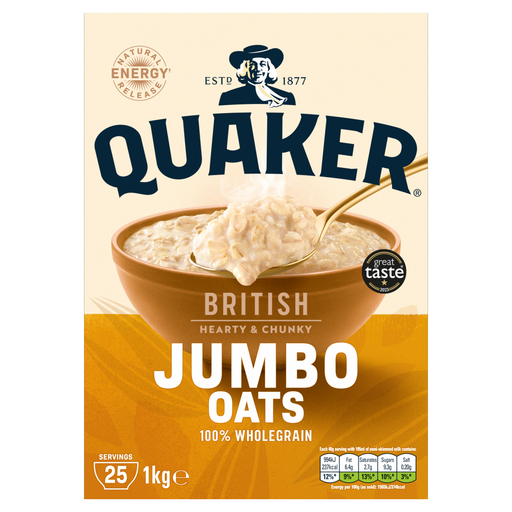
Quaker Jumbo Rolled Oats 1kg
A versatile 1kg plain jumbo rolled-oat pack stated for porridge, overnight oats and baking.
The listing states 100% wholegrain oat flakes, 9g dietary fibre per 100g and 1g sugars per 100g. It may contain traces of wheat, so it is not a confirmed gluten-free option.
Joybuy
 No image available
Scotts Porage Oats Original Porridge Oats 1kg
A 1kg household staple with 25 stated 40g portions for regular porridge use.
The listing states single-ingredient oatmeal, 9g dietary fibre per 100g and 0.4g sugars per 40g serving. It may contain wheat and barley, so it is not a confirmed gluten-free option.
Joybuy
 No image available
Flahavan's Organic Porridge Oats 1kg
A smaller plain-oat option for moderate repeat use or households with limited storage.
Stated as 100% organic wholegrain oat flakes, with 3.3g fibre per 40g serving. Contains oats labelled as gluten and is not a confirmed gluten-free option.
Joybuy
Frequently asked questions
What pack size counts as a family pack for porridge oats?
There is no universal UK legal or nutritional definition of a family pack for oats. Compare stated weight with your household’s usual portions: at an approximate 40g dry-oat serving, 1kg provides about 25 portions, 1.5kg about 37, 2kg about 50 and 3kg about 75. Choose the largest size only if it can be stored cool, dry and well sealed after opening.
Are plain porridge oats suitable for lunch?
Plain oats can be a fibre-contributing wholegrain carbohydrate component when paired with other foods. NHS guidance also stresses getting fibre from a variety of sources, so oats alone do not make a complete lunch.
Do organic or “100% oats” labels mean the oats are gluten free?
No. Coeliac UK says that “100% oats”, “pure oats” and “organic” do not indicate whether a product is gluten free. For a gluten-free requirement, use an exact product labelled gluten free and check the allergen information; Food Standards Agency guidance states that UK gluten-free labelling requires no more than 20mg/kg gluten in food sold to the consumer.
Can a person with coeliac disease use ordinary oats?
Do not assume ordinary oats are suitable. Coeliac UK states that many standard oats are made where wheat, barley and rye are handled and may be contaminated; follow the person’s clinician or dietitian advice where applicable.
How should a large oats pack be stored?
Follow the instructions on the actual pack. The reviewed Waitrose product advises storage in a cool, dry place away from strong odours and in an airtight container after opening; check the best-before date and buy only what the household can store and use appropriately.


