Families consolidating scattered photos
If photos are spread across phones, computers and older drives, work out what uploads automatically and what you still need to import.


For family photos spread across devices, choose an arrangement that collects files from each source and keeps a separately recoverable copy: synchronisation alone does not ensure that. Cloud storage can simplify uploads, access and sharing; an external drive keeps a local copy, while a NAS centralises a household library but needs ongoing administration. A hybrid arrangement can provide local access and off-site recovery, as long as a synchronised deletion cannot remove every copy.
If photos are spread across phones, computers and older drives, work out what uploads automatically and what you still need to import.
If losing the original device would also mean losing important photos, distinguish a synced library from a separate, recoverable copy.
When several people need access or want to add photos, check how storage is shared, who can access files and who will maintain the arrangement.
Start with whether you need automatic off-site access, a disconnected local copy or shared household storage. A hybrid setup can combine local access with off-site recovery, but the copies need protection from the same synced deletions.
| Concern | What to check when buying | Who this matters to |
|---|---|---|
| Recovery after loss or deletion | Check the recovery window and keep a disconnected or off-site copy; test restoring files. | If a lost phone or a household incident could take the only copy, I would prioritise recovery from another location. Around 31% of consumers put recoverability first. |
| Automatic coverage across devices | Check that each phone, computer and required folder is included; confirm uploads complete. | When manually copying every device would be difficult, I would look for a reliable upload process for each source. Around 25% of consumers prioritise automatic coverage. |
| Capacity for a growing library | Measure the current collection and allow for new videos and retained versions; check shared quotas or usable NAS capacity. | If the photo and video library keeps growing, I would want room for new files as well as retained copies. About 19% of consumers make capacity their primary concern. |
| Family access and sharing | Confirm who can view, add or remove files and whether storage is pooled; check access permissions. | When several people need to contribute or view photos, I would check how to share access without making the whole library public. Around 13% of consumers prioritise family sharing. |
| Ongoing cost and leaving a plan | Compare subscription and hardware upkeep; check how to export files and what happens if storage exceeds a lower allowance. | If a continuing subscription is hard to manage, I would want a practical way to retrieve files before changing plans. Roughly 12% of consumers put ongoing cost and an exit plan first. |
Apple says iCloud Photos synchronises changes and deletions, and that those photos are not duplicated in iCloud device backups. A synced library alone may not preserve an independent copy.
Keep a separate recoverable copy and check the service’s recovery conditions.
Synology says RAID is not a backup solution. A NAS kept at home also remains exposed to loss of that location.
Plan a separate recoverable copy away from the NAS and check the usable capacity of the chosen disk configuration.
Microsoft specifies a shared 2 TB pool for new Microsoft 365 Family subscriptions from 8 October 2026. Shared storage does not automatically mean that family members’ files are shared.
Check the subscription start or renewal date, the total household usage and who has access to each library.
A drive may not include every phone or folder unless the upload or backup workflow is configured. Crucial says the X9 Pro’s stated speed depends on the host connection, and formatting affects usable capacity.
Check the ports, format and software for the devices you use, then confirm that a copy completed and that you can restore a sample file.
These brands offer examples of cloud, direct-attached and network storage approaches; the points below apply to the named products and services, not every product from each brand.
iCloud Photos and iCloud+ are relevant if your household already uses Apple’s photo library and wants synced access.
OneDrive is worth considering for households using computers and mobile devices that want camera uploads and shared storage options.
Seagate’s Expansion Portable range is a direct-attached option for keeping a local copy of a computer-based collection.
The X9 Pro is a portable SSD option for households that prefer a compact drive they can move between compatible devices.
The DS223j is a NAS option for households prepared to administer shared storage and configure phone and computer backups.
The TS-233 is another two-bay NAS option for households considering centrally managed personal storage.
These options cover portable and desktop external drives for local copies, plus a two-bay NAS for households considering centralised storage. A local drive or NAS should not be treated as the only recoverable copy.
 No image available
This portable external drive is an option for keeping a local copy of photos and videos on compatible devices.
2 TB capacity; USB 3.2 Gen 2; the listing describes USB-C-to-C and USB-C-to-A cables.
A local drive is only one copy; keep another recoverable copy of important files.
 No image available
This centralised storage option may suit a household prepared to configure and maintain a shared photo library.
2-bay diskless NAS; drives must be supplied separately. The listing describes backup options to cloud services, external drives and remote NAS devices.
RAID redundancy does not replace a separate backup copy.
 No image available
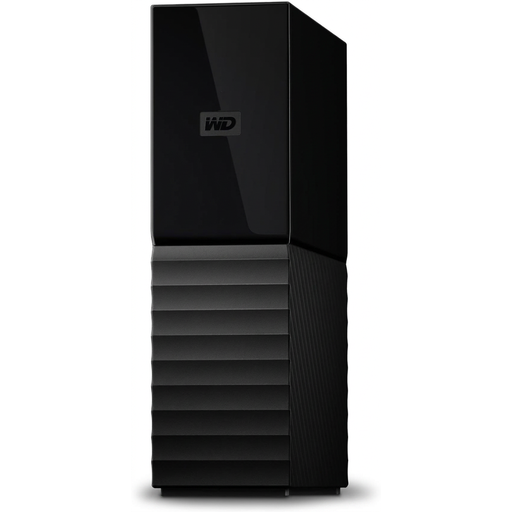
This desktop drive is an option for a large computer-based photo and video collection.
22 TB capacity; USB connectivity; the listing describes PC and Mac compatibility, backup software, password protection and hardware encryption.
A local drive is only one copy; keep another recoverable copy of important files.
 No image available
This portable drive may suit a household that wants to move a local copy between locations.
2 TB capacity; read speeds up to 800 MB/s; the listing describes a 0.04 kg drive and up to 2-metre drop protection.
A local drive is only one copy; keep another recoverable copy of important files.
 No image available
This portable hard drive is an option for keeping a local copy of an existing computer-based photo and video library.
4 TB capacity; USB 3.0; the listing describes a plug-and-play drive with a USB-A cable.
Keep another recoverable copy of important files rather than relying on this drive alone.
No. Apple says iCloud Photos synchronises changes and deletions, and its contents are not duplicated in iCloud device backups. Apple describes a 30-day Recently Deleted period; keep another recoverable copy if the photos cannot be replaced.
Check that the intended phone camera uploads and computer folders are included, then restore a representative photo and video from each source. Microsoft describes a Camera backup setting for OneDrive mobile, while Synology describes separate mobile and computer-folder backup processes for the DS223j.
Check the provider’s rules and download or move files that exceed the replacement allowance before cancelling or downgrading. Apple advises removing or downloading content that exceeds the new iCloud+ storage amount; Microsoft says cancellation can stop new OneDrive uploads when the account is over its allowance.
The Information Commissioner’s Office says UK GDPR does not apply to processing by an individual purely for personal or household activities. It distinguishes private family sharing from a public post viewable by an indefinite number of people, which is likely to go beyond personal use; this is a conditional distinction, not a general authorisation for public sharing.