Who family-size muesli suits

Large households planning shared breakfasts

For households that expect to use muesli regularly and want to compare pack sizes on a per-kg basis rather than only looking at the shelf price. Checked UK listings include 1 kg packs alongside smaller specialist options.

Families managing allergens or gluten requirements

For households where one person’s dietary safety determines the shared cereal choice. Many checked recipes contain gluten-containing cereals and nuts, while some also contain milk or precautionary allergen statements.

Households comparing no-added-sugar and fruit-and-nut recipes

For shoppers who want to compare the total sugars declaration, ingredient list and dried-fruit content rather than relying on a front-of-pack no-added-sugar claim alone.

What to check before choosing

Start with how quickly the household will finish the pack, then check the current label for ingredients, storage instructions and nutrition information.

Priority What to check Your needs
Pack size and unit price Compare net weight and price per kg on the same basis. Check the stated serving size when estimating how long the pack may last. A 1 kg pack can suit us if it will cover repeated shared breakfasts without being left unfinished.
Allergens and dietary suitability Read the ingredients, emphasised allergens and any “may contain” statement. Where gluten-free food is required, choose a product specifically labelled gluten-free. Everyone eating from the same bag needs to be able to have the recipe, or it needs to be kept separate.
No-added-sugar claims Check sugars per 100 g and per serving, then read the dried-fruit ingredients. A no-added-sugar claim does not mean sugar-free. I want to compare the nutrition panel, not assume that a fruit-containing muesli has no sugars.
Storage after opening Follow the pack’s storage directions, including any advice on keeping it cool, dry or in an airtight container. Check the best-before date before buying several packs. We need a pack size that can stay in good condition while the household works through it.

Common buying mistakes

  • Choosing the lowest shelf price rather than comparing pack size

    A smaller bag can appear cheaper while carrying a higher price per kg. A large bag is only worthwhile when the household is likely to finish it in good condition.

    Compare price per kg first, then choose a larger pack only when expected use and storage make it practical.

  • Treating “no added sugar” as “no sugar”

    Dried fruit contributes sugars even where a product makes a no-added-sugar claim. Checked no-added-sugar products list sugars per 100 g on their nutrition panels.

    Compare total sugars per 100 g and per serving, then check the fruit ingredients before deciding.

  • Buying one shared bag without checking every eater’s requirements

    Recipes can contain combinations of wheat, barley, oats, milk, nuts and precautionary allergen statements. A product that suits most of the household may not suit everyone.

    Read the current pack label at each purchase, including “may contain” wording where relevant. If gluten-free food is required, select a specifically labelled gluten-free product.

  • Assuming an offer or online listing will continue

    Promotional terms, seller details, availability and formulations can change between shops.

    Recheck the current pack size, seller, stock status, label and offer terms at the point of purchase.

Relevant muesli brand references

Tesco

Relevant for households comparing standard 1 kg own-brand muesli with a 1 kg Swiss Style No Added Sugar recipe.

  • Offers checked 1 kg options for a shared-breakfast shop.
  • The checked recipes contain gluten-containing cereals and nuts; the Swiss Style recipe also includes whey powder.

Jordans

Relevant for households looking for a branded 1 kg fruit-and-nut muesli.

  • The checked Natural Muesli is supplied in a 1 kg pack and carries no-added-sugar and no-added-salt claims.
  • It includes wheat, oats, barley, almonds and hazelnuts.

Alpen

Relevant for shoppers considering Alpen’s No Added Sugar recipe and its wholegrain, high-fibre brand positioning.

  • Alpen describes its No Added Sugar recipe as wholegrain and high in fibre.
  • Its listed ingredients include wheat, oats, skimmed milk powder, whey powder, hazelnuts and almonds.

Dorset Cereals

Relevant for households preferring a fruit-and-nut recipe in a smaller 500 g pack.

  • Delicious Fruit & Nut is a 500 g no-added-sugar product with a stated high-fibre claim.
  • It contains oats, wheat, barley, cashews and hazelnuts and may contain other gluten-containing cereals and nuts.

Rude Health

Relevant for shoppers seeking an organic, plant-based wholegrain specialist muesli.

  • The Ultimate Muesli is described as organic, plant based, whole grain and high fibre.
  • It contains oats, barley, rye, almonds, Brazil nuts and hazelnuts; Rude Health also states it may contain traces of milk, soya and other nuts.

Lizi's

Relevant for shoppers exploring specialist cereal ranges with low-sugar, high-protein and digestive-health options stated by the brand.

  • Lizi’s presents its range as high in fibre and includes different recipe styles.
  • Confirm the exact product, pack size, nutrition panel and retailer listing before adding it to a large family shop.

Joybuy muesli options

Joybuy product options for a household looking for a near-1 kg no-added-sugar muesli pack for regular shared breakfasts.
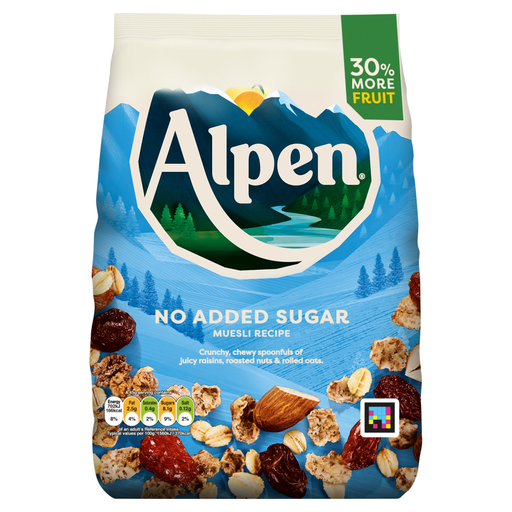
Alpen No Added Sugar Muesli 950 g

Alpen No Added Sugar Muesli 950 g

A near-1 kg option for regular shared breakfasts where a no-added-sugar recipe is a priority.

Stated pack size: 950 g. The nutrition panel states 8.0 g fibre and 18 g sugars per 100 g. Contains wheat, oats, milk, almonds and hazelnuts, and may contain other nuts.

Joybuy

Frequently asked questions

Is a 1 kg muesli bag always the right family-size choice?

No. A 1 kg pack is most suitable when several people will eat it consistently and you can store it appropriately after opening. Dietary suitability and expected consumption should be checked before choosing a larger bag.

Does “no added sugar” mean the muesli is low in total sugar?

No. The claim does not mean that the recipe contains no sugars. Checked Tesco Swiss Style No Added Sugar Muesli lists 13.3 g sugars per 100 g, while Alpen No Added Sugar lists 18 g per 100 g; both include raisins.

Can a household with coeliac disease choose ordinary muesli?

Do not assume ordinary muesli is suitable. The checked products contain gluten-containing cereals such as wheat, barley or rye. The Food Standards Agency states that food labelled gluten-free in the UK must contain no more than 20 mg/kg gluten as sold, so choose a specifically labelled product where this is required and check the current label.

How should an opened large muesli pack be stored?

Follow the pack instructions. Checked Tesco muesli labels advise keeping the product in a cool, dry place and, once opened, in an airtight container. GOV.UK explains that best-before dates relate to quality, with storage affecting how long that quality is maintained.

Does a best-before date mean dry muesli is unsafe after that date?

A best-before date relates to quality, rather than carrying the same meaning as a use-by date. GOV.UK says food after a best-before date is usually safe if it has been stored properly, though its quality may decline; use the pack’s storage guidance and assess the product appropriately.