For a household eating muesli on most weekday mornings, a 950 g–1 kg pack is a sensible starting point: at a 45 g bowl basis, it provides roughly 21–22 bowls, close to five breakfasts for four people. Choose the recipe as carefully as the pack size, comparing the per-100 g nutrition panel and ingredients list, and make sure every regular eater can have the exact product.
Who this suits
Four-person weekday-breakfast households
For households serving muesli to around four people across five weekday mornings. A 950 g–1 kg pack provides about 21–22 servings at a 45 g bowl basis, broadly covering 20 weekday bowls before allowing for larger adult portions.
Families reducing everyday added sugar
For shoppers choosing a large shared pack who want to distinguish no-added-sugar recipes from standard fruit-and-nut muesli. Compare the per-100 g sugars line and ingredients list, as dried fruit still contributes sugars.
Allergen-conscious shared households
For households where one person has a nut, milk or gluten-related dietary requirement. A large pack works for shared use only when every regular eater can have the exact recipe and its current label.
What to check before choosing
950 g–1 kg no-added-sugar muesli
Choose it when: Muesli is served most weekday mornings and the household wants a large pack without added sugar in the recipe.
Consider: Dried fruit still contributes sugars, and illustrated recipes contain gluten-containing cereals and nuts; Alpen also contains milk ingredients.
950 g–1 kg standard fruit-and-nut muesli
Choose it when: Familiar raisin-and-nut flavour matters more than selecting a no-added-sugar recipe.
Consider: Compare sugars on the same per-100 g basis instead of relying on wholegrain wording or fruit imagery.
500–650 g speciality muesli
Choose it when: One or two people eat muesli regularly, or the household is trying a distinctive fruity or nutty recipe.
Consider: Smaller packs need replacing more often, and recipes can have very different dried-fruit and nut ingredients.
| Priority |
What to check |
Your needs |
| Pack size |
Check the pack weight, stated serving size and the number of regular weekday eaters. A 950 g–1 kg pack gives about 21–22 bowls at a 45 g serving, while a 30 g serving changes the calculation. |
Our household needs enough muesli for the working week without buying another pack midweek. I would calculate from the bowls we actually pour, rather than the number on the box. |
| Recipe and nutrition panel |
Compare sugars and fibre per 100 g, then check the stated serving size. Alpen Muesli lists 18 g sugars per 100 g for No Added Sugar and 21 g for Original; Jordans Cereal lists 10.4 g for Natural Muesli. |
I want to compare everyday recipes on the same basis, particularly when muesli is served repeatedly through the week. Fruit-led recipes may include sweetened dried fruit. |
| Shared suitability |
Read the full ingredients, allergen statement and any precautionary wording on the current pack. Check cereals containing gluten, milk and nuts rather than assuming a no-added-sugar claim covers dietary suitability. |
Everyone who eats from the shared pack needs to be able to have that exact recipe. If that is not the case, a separate breakfast option may be more practical. |
Common buying mistakes
-
Assuming all fruit-and-nut muesli is low in sugars
Wholegrain ingredients and fruit imagery do not show the sugars value. Dorset Cereals lists 22 g sugars per 100 g for Fantastically Fruity, while Alpen Muesli lists 21 g per 100 g for Original.
Compare sugars per 100 g and look for sweetened dried fruit in the ingredients list. If lower added sugar matters, check the recipe wording as well as front-of-pack claims.
-
Buying a 1 kg pack without calculating household usage
A 950 g–1 kg pack is around 21–22 bowls at a 45 g serving, rather than an unlimited supply. It can suit four weekday users but may be excessive for one person or occasional muesli eaters.
Multiply the number of regular weekday eaters by the household’s usual bowl size and frequency before moving up from a 500–650 g pack.
A pack that is not finished consistently can lose freshness or lead to waste.
-
Treating “no added sugar” as an allergen or dietary-suitability claim
No-added-sugar muesli can still contain raisins, gluten-containing cereals, milk and nuts. Alpen Muesli lists wheat, oats, milk ingredients, almonds and hazelnuts in its No Added Sugar recipe.
Check the full ingredients and allergy advice on the exact pack instead of using one nutrition claim to decide whether it suits the household.
-
Treating a retailer price as a lasting value comparison
Pack sizes and brands can show different per-kilogram prices, while offers, marketplace status and local stock can change.
Compare like-for-like weights on the live retailer listing and exclude temporary promotions unless they are genuinely available to you.
Relevant muesli brands
Alpen
A mainstream muesli choice with Original and No Added Sugar recipes listed in 950 g formats by Tesco Groceries.
- Alpen Muesli lists wholegrain and fibre claims for both recipes.
- Both recipes contain wheat, oats, milk and nuts, so they are not suitable for every shared household.
Jordans
A natural-style option: Tesco Groceries listed Jordans Natural Muesli in a 1 kg format, and Jordans Cereal describes it as an oat, wheat and barley blend with dried fruit and nuts.
- Jordans Cereal states that Natural Muesli has no added salt or sugar and lists 9.2 g fibre per 100 g.
- It contains gluten-containing cereals and nuts; the manufacturer advises against it for people with a nut allergy.
Tesco
Tesco own-label Swiss Style Muesli and Swiss Style No Added Sugar Muesli were listed in 1 kg formats in Tesco Groceries’ UK muesli category.
- The 1 kg formats make this a relevant route when pack size is the main starting point.
- Check the current product page or pack for recipe-specific ingredients, allergens and nutrition before choosing.
Dorset Cereals
A flavour- and texture-led muesli range, with fruity and nutty recipes shown by the manufacturer in 500 g formats.
- Dorset Cereals lists distinct recipe information, including fibre and sugars values per 100 g.
- The 500 g formats are more suited to smaller households or recipe rotation than a large family pack.
Lizi's
A specialist breakfast-cereal brand that presents granola products through major UK supermarkets.
- The brand presents a range built around toasted oats, seeds and nuts.
- Check a current retailer listing before treating it as a 950 g–1 kg muesli option.
Rude Health
A premium and organic-leaning option represented in the Tesco Groceries muesli category by The Ultimate Muesli in a 400 g marketplace listing.
- It offers an alternative for shoppers considering smaller-format muesli.
- A 400 g format does not match a four-person weekday breakfast routine as closely as a 950 g–1 kg pack.
Joybuy muesli options
Joybuy product options for a 950 g family-size muesli routine on weekday mornings.
 No image available
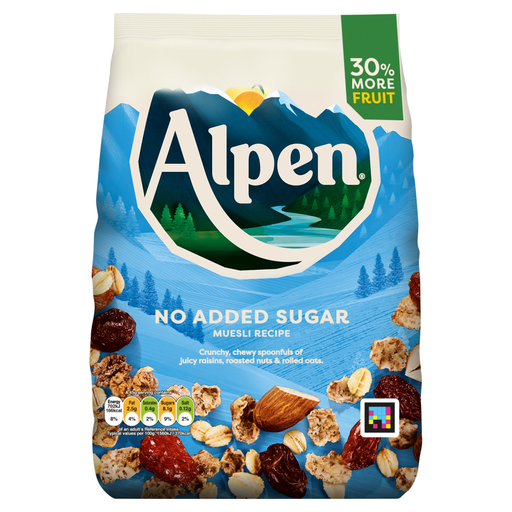
Alpen No Added Sugar Muesli 950 g
The 950 g pack provides about 21 bowls at its stated 45 g serving basis, which is close to a four-person weekday routine.
Listed nutrition values are 18 g sugars and 8.0 g fibre per 100 g. It contains wheat, oats, milk, almonds and hazelnuts, and may contain other nuts.
Joybuy
 No image available
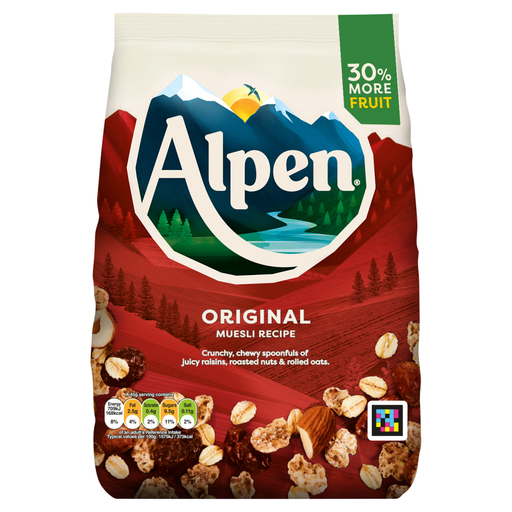
Alpen Original Muesli 950 g
This 950 g standard fruit-and-nut muesli is suited to a shared weekday breakfast where the familiar Original recipe is preferred.
It lists 21 g sugars per 100 g and contains wholegrain wheat, rolled oats, raisins, milk, almonds and hazelnuts. Check the current pack for full allergen information.
Joybuy
Questions about family-size muesli
What is a practical family-size muesli pack for weekday breakfasts?
A 950 g–1 kg pack is a practical starting point for regular shared use. At the 45 g bowl basis stated by Jordans Cereal for Natural Muesli, it provides about 21–22 bowls; at a 30 g serving, it provides roughly 32–33 bowls. Use your household’s usual portions when deciding.
Does “no added sugar” mean muesli is low in sugars?
No. It means sugar is not listed as an added ingredient, but dried fruit can still contribute sugars. Alpen Muesli lists 18 g sugars per 100 g for No Added Sugar, while Jordans Cereal lists 10.4 g per 100 g for Natural Muesli; compare products on the same per-100 g basis.
How should I compare muesli labels for an everyday family breakfast?
Compare the nutrition panel per 100 g first, then use the stated serving size to estimate a typical bowl. NHS guidance identifies more than 22.5 g sugars per 100 g as high in sugars for food labelling, and notes that manufacturer portion sizes may differ from the amount served.
Can a family share one muesli if someone has a nut, milk or gluten-related dietary requirement?
Only if the exact current pack is suitable for every regular eater. The recipes considered here commonly contain gluten-containing cereals and nuts, while Alpen Original and No Added Sugar also list milk ingredients, so check the physical pack and its precautionary statements each time.


