Households sharing porridge breakfasts
If several people eat porridge regularly, a 1kg pack can be a manageable starting point. Waitrose and Quaker guidance uses about 40g of oats per person, while Waitrose lists 25 servings for its 1kg packs.


For most households sharing breakfast, a 1kg bag is a practical starting point: several products use a serving guide of about 40g, giving around 25 servings per pack. Consider 1.5kg to 3kg only when oats are used often and you can keep an opened pack cool, dry and airtight; dietary requirements, oat texture and preparation time can matter more than bag size.
If several people eat porridge regularly, a 1kg pack can be a manageable starting point. Waitrose and Quaker guidance uses about 40g of oats per person, while Waitrose lists 25 servings for its 1kg packs.
Households using oats for porridge, flapjacks, overnight oats or baking may find 1.5kg and 3kg packs practical when there is space to store opened oats in a cool, dry, airtight container.
Anyone checking gluten-free status, wheat or barley warnings, oat allergy information or nut warnings should assess the label for the exact pack rather than relying on plain oats alone.
Choose the oat format first, then match the pack size to how often your household uses it and how you will store it after opening.
| Priority | What to check | Your needs |
|---|---|---|
| Pack size and repeat use | Check the pack weight, serving guidance and storage instructions. A 40g serving basis helps estimate how many shared breakfasts a pack may cover. Keep opened oats cool, dry and airtight. | A 1kg bag gives me a sensible amount to try before committing to a larger supply. If porridge and baking are regular household habits, I may prefer fewer repurchases with a larger pack. |
| Preparation time and texture | Choose between superfast, traditional rolled and jumbo oats. Follow the cooking method and microwave wattage stated on the exact pack rather than assuming one timing suits every format. | On busy mornings I want a format with instructions that fit our routine. When texture matters more, I would choose the oat style my household is likely to enjoy repeatedly. |
| Dietary suitability | Read the ingredients, allergen panel and any gluten-free claim on the specific product. The Food Standards Agency states that gluten-free food sold to consumers must contain no more than 20 mg/kg of gluten, while oat must still be emphasised as an allergen. | If someone needs gluten-free oats or must avoid a declared allergen, I need an explicit claim and a current label that match that requirement. |
| Plain-oat flexibility | Check whether the product is plain oats or portioned flavoured sachets. Plain rolled oats can suit porridge and baking, while sachets have their own ingredients and preparation method. | I want a plain base that can be made with water or milk and adapted with the toppings my household prefers. |
A bigger bag can reduce shopping frequency, but it is only useful when the household uses oats consistently and can store the opened pack properly.
Estimate your usual breakfast portions and choose 1.5kg to 3kg only when that rate of use and your pantry space make sense.
Oats are themselves an allergen, and individual products may carry warnings for wheat, barley, other gluten sources or nuts.
Check the current ingredient list, allergen panel and gluten-free claim on the exact pack. Do not substitute a standard rolled-oat product where certified gluten-free oats are required.
Superfast, traditional and jumbo oats can differ in preparation style and texture, so a large pack can be a poor fit if the household does not enjoy the result.
Decide whether fast cooking, classic rolled oats or a more textured jumbo oat is the priority before choosing the pack size.
Recipes and allergen information can change, so a retailer page may not always match the pack currently in hand.
For an allergy, intolerance or coeliac-related purchase, confirm the printed label before serving the product.
Waitrose offers own-label plain porridge oats in 1kg formats, including Essential and Scottish-style options, as well as a gluten-free own-label product in its porridge range.
Quaker offers Traditional Rolled Oats in 500g, 1kg and 1.5kg packs alongside sachet and specialised porridge ranges.
Mornflake is a UK oat specialist with traditional, superfast, gluten-free, jumbo, organic and bulk-oriented oat formats.
Flahavan's is a family-owned Irish oat miller offering organic porridge oats and organic jumbo oats in family-scale packs.
Jordans offers organic and chunky traditional porridge options alongside its wider cereal range.
Joybuy product options for shared breakfasts, including standard 1kg oats, gluten-free oats, organic packs and a quick-preparation sachet option.
 Image unavailable
A 1kg plain rolled-oat pack for shared breakfasts where a thicker porridge texture is preferred.
The listing states 100% rolled oats, a 40g serving basis, 4–5 minutes on the hob and 2–3 minutes in the microwave.
It may contain wheat and barley, so it is not a substitute for an explicitly gluten-free product. The listing advises using it within two months after opening for best quality.
 Image unavailable
This 1kg option is relevant where an explicitly gluten-free oat product is needed for repeat household breakfasts.
The listing states 100% gluten-free oat flakes, 25 portions and a 40g portion basis.
Oat remains an allergen even in gluten-free oat products, so check the current pack if oat allergy is relevant. Seal tightly after opening.
 Image unavailable
A two-pack format for frequent oat users who would rather open one 1kg pack at a time.
The listing states 100% organic wholegrain oat flakes and a 40g serving basis.
It is not presented as a certified gluten-free choice. Keep the packs cool and dry, and confirm the preparation instructions on the current pack.
 Image unavailable
A manageable family-scale organic option for households testing how quickly they use plain oats.
The listing states 100% organic wholegrain oat flakes and a 40g serving basis.
The listing identifies oats as containing gluten, so do not treat it as a certified gluten-free option. Confirm current preparation instructions if cooking time matters.
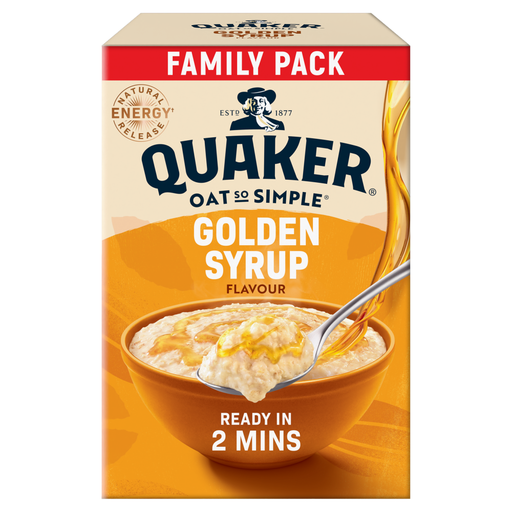 Image unavailable
This portioned sachet pack suits busy shared breakfasts where measuring loose oats is less convenient.
The listing gives 20 x 36g sachets, a two-minute method in a 900W microwave and approximately 180ml milk per sachet.
It contains sugar and natural flavourings rather than being a plain-oat product. It contains oats and may contain barley, wheat and soya.
Use the serving guide on the exact pack. Waitrose, Quaker and Flahavan's listings use approximately 40g per serving, which works out at around 25 servings from 1kg. For two people using 80g each morning, that is roughly 12 to 13 breakfasts.
Choose a larger pack when oats are a frequent household staple and you can store the opened product cool, dry and airtight. Quaker lists a 1.5kg traditional pack, while Mornflake lists 1.5kg and 3kg options; for occasional use, 1kg is often easier to finish.
Do not assume so. Choose a product specifically labelled gluten-free when that claim is required. The Food Standards Agency states that gluten-free food sold to consumers must contain no more than 20 mg/kg of gluten, and oat must still be emphasised as an allergen.
No. Product warnings differ: Quaker Traditional Rolled Oats may contain wheat and barley, while Jordans Organic Porridge may contain other gluten sources and nuts. Check the actual pack every time when an allergy or coeliac-related requirement applies.
Yes, when the exact pack provides a microwave method and you use a sufficiently large microwave-safe bowl. Waitrose gives different timings for different microwave wattages, and Quaker provides a separate two-serving microwave method, so follow the instructions printed for your product.