
24/7 Customer Support

Free returns

Same-day & Next-day Delivery

Quality Guaranteed

Unlock Your Welcome Offers: FREE Delivery | Up to 80% OFF | Free 30-day JoyPlus trial
Download the APP
A reliable fast car charger can keep a phone, sat-nav, tablet or laptop usable during a commute, delivery route or long family journey. However, headline wattage does not always translate into faster charging. The result depends on the charger’s port output, your cable, your device and your vehicle’s power socket.
Before buying a USB car charger, watch for these common traps.
A charger advertised as 100W or more may only provide that figure through one USB-C port. When several devices are connected, the output is divided between them. For example, a multi-port car charger may offer high output on its primary USB-C port but considerably less through USB-A.
Check both the maximum total output and the output available from each port. This matters when charging a laptop and a phone together.
USB-C describes the connector shape, not the charging performance. A USB-C car charger should ideally support USB Power Delivery (PD) and provide a suitable wattage for your device. Phones may need around 18W to 30W, tablets often benefit from 30W or more, while many USB-C laptops require 45W, 65W or higher.
Also check the cable. A 100W-capable USB-C port may require a 100W-rated E-marker cable to reach its stated performance.
Many UK cars use a 12V auxiliary socket, while vans, trucks and some commercial vehicles may use 24V systems. A charger marked DC 12V–24V offers broader compatibility, but always confirm the vehicle’s socket specification before purchase.
High-power charging can make an adapter warm. This is not automatically a fault, but the charger should not be covered, used in a damaged socket or left operating if it produces smoke, unusual smells or excessive heat.
Choose according to the devices you carry:
A built-in cable can reduce clutter, but check its connector carefully. Some retractable USB-C cables are not compatible with older phones or Lightning devices.
PD negotiates an appropriate voltage and current between the charger and compatible device. Other protocols, including QC, PPS, AFC, FCP and SCP, may improve compatibility with particular phones.
A high wattage alone does not guarantee fast charging. The charger, cable and device must support compatible standards. If your phone only accepts 20W, buying a 165W adapter will not make it charge at 165W.
For UK drivers, confirm whether the adapter supports 12V, 24V or both. A 24V car charger is particularly relevant to trucks and some vans, while a 12V car charger suits most passenger cars.
Look for clearly stated protection against over-current, over-voltage, overheating and short circuits. A secure fit is also important: a loose cigarette lighter charger can disconnect on uneven roads. Compact dimensions help prevent the adapter from interfering with gear levers, storage areas or dashboard controls.

Why This Fits Their Persona: A compact option for everyday commuters who need to charge a phone and a second small device from a 12V or 24V socket.
Its stated output is split clearly between a 20W USB-C PD port and an 18W USB-A QC port, rather than relying only on a large combined figure.
38W total output, built-in 1.2m coiled USB-C cable, LED port lighting and stated protection against over-temperature and over-current.

Why This Fits Their Persona: Suitable for drivers wanting a modern USB-C car charger with a supplied cable and visible charging feedback.
The specification distinguishes its 67W USB-C maximum from the 55W combined maximum when both ports are used.
USB-C output up to 67W, USB-A output up to 18W, a 1m E-marker USB-C cable and multiple stated electrical protections.

Why This Fits Their Persona: Designed for users carrying laptops, phones and other high-demand devices in cars, vans or trucks with 12V–24V sockets.
Its specification lists port-by-port limits and simultaneous distribution, so buyers can check whether 100W, 35W and 30W allocations suit their devices.
Three ports, USB-C1 up to 100W, OLED voltage and power display, and stated over-current, over-voltage and short-circuit protection.
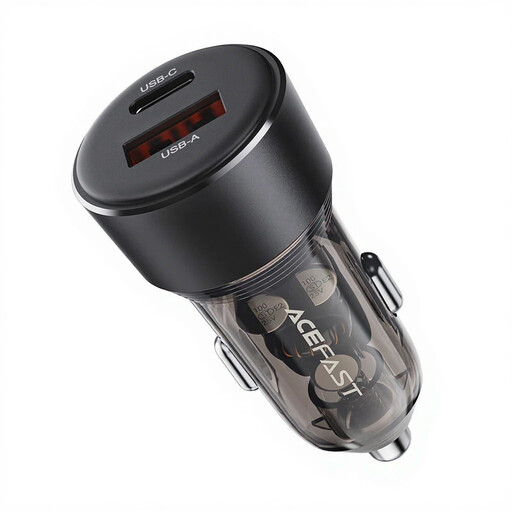
Why This Fits Their Persona: A balanced dual-port choice for two phones, a tablet or headphones during shared journeys and daily school runs.
It states up to 30W per port and supports both USB-C and USB-A, reducing uncertainty when two different cable types are needed.
60W total output, PD/QC/PPS and other listed protocols, 12V–24V input and flame-retardant PC housing.
We have compiled a complete, real-time list of products that fully satisfy these strict selection criteria and UK safety regulations.
A laptop car charger can be useful for compatible USB-C notebooks, but a standard USB port may not supply enough power. For older barrel-connector laptops, check the connector size and voltage rather than assuming USB-C compatibility. A GaN car charger can offer a compact design, but GaN technology alone does not determine charging speed or device compatibility.
It can be suitable when its input range matches the vehicle socket and it is used with compatible cables and devices. Check the product’s stated protections and stop using it if the socket or adapter is damaged, excessively hot or producing an unusual smell.
No. The phone controls how much power it accepts. A higher-rated adapter provides greater capacity, but fast charging also depends on compatible PD or other charging protocols, the cable and the phone’s own charging limit.
It may draw power whenever the socket is live. The effect depends on the vehicle, connected devices and charging duration. Disconnect devices and remove the cigarette lighter charger when the engine is off if your socket remains powered, especially during extended parking.