
24/7 Customer Support

Free returns

Same-day & Next-day Delivery

Quality Guaranteed

Unlock Your Welcome Offers: FREE Delivery | Up to 80% OFF | Free 30-day JoyPlus trial
Download the APP
A frayed, slow or incompatible charging cable is a modern-day frustration we all know too well. You buy a new one, lured by promises of "ultra-fast" speeds and "unbreakable" designs, only for it to fail within months. The market is flooded with options, but many fall short, leaving you with a drawer full of duds and a phone that's perpetually low on battery.
As the Joybuy Product Recommendation Officer, my role is to help you see past the marketing clutter. Before you spend another pound, let's look at the common pitfalls that catch out UK shoppers and how to choose a fast charging cable that delivers on its promises.
iPhone charger cable can lead to error messages and even potential damage, while using an underpowered cable for a powerful device like a MacBook means you'll be waiting hours for a full charge.To make a smart purchase, focus on these core parameters. They are the non-negotiable factors that determine a cable's performance and lifespan.
This is the most critical factor for a fast charging cable. The power a cable can handle is measured in watts (W).
Look for support for USB Power Delivery (PD), the universal standard for fast charging over USB-C. A cable with a higher wattage rating is safely backwards-compatible with less powerful devices, but it won't make them charge any faster.
Check the ports on your devices and your power adapter before buying.
A truly durable data cable is more than just its outer layer.
Instead of a generic list, we've matched specific cables to the people who will get the most value from them.
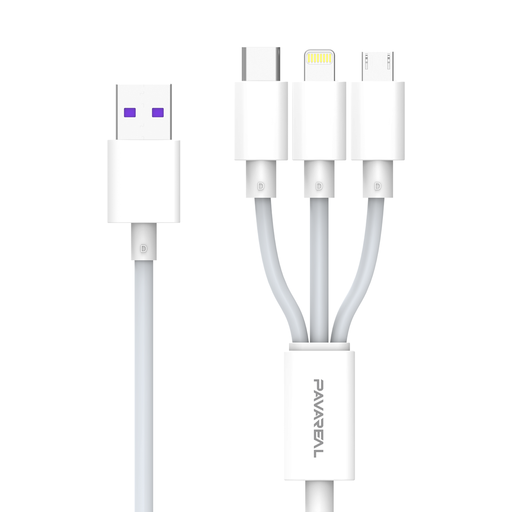
Why This Fits Their Persona: Perfect for the family or individual juggling an iPhone, an Android work phone and a Micro-USB device like a Kindle or power bank. It declutters the charging station and is ideal for travel.
It solves the "one-size-fits-all" fallacy by offering three distinct connectors. The integrated smart chip intelligently distributes power, avoiding the "speed myth" by matching output to each device's needs.
Unmatched versatility with USB-C, Lightning and Micro-USB heads. High total power output allows for charging multiple devices simultaneously.
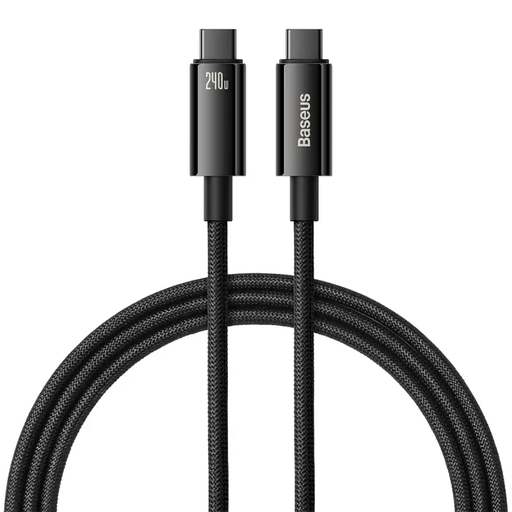
Why This Fits Their Persona: For the professional or student who relies on a high-power USB-C laptop (like a MacBook Pro) and wants the absolute fastest charge possible for all their modern devices.
This is a genuine high-wattage cable, not just a marketing claim. It is PD3.1 certified, ensuring it meets the technical standard for 240W charging. The robust zinc alloy connectors directly counter the durability deception of flimsy plastic heads.
Supports the maximum 240W PD3.1 charging standard. Features an E-marker smart chip for safe power negotiation with high-end devices.
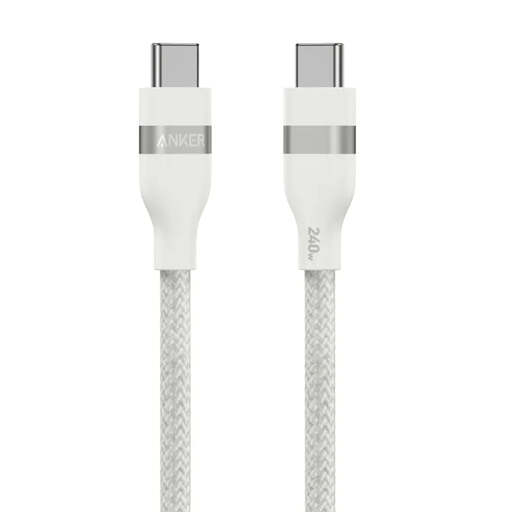
Why This Fits Their Persona: For anyone tired of replacing frayed cables every year. This user prioritises longevity and is willing to invest in a cable that is built to withstand daily wear and tear, from the office to the commute.
It directly counters the durability deception. According to Anker's own information, this cable is rated for a 30,000-bend lifespan and can withstand significant weight, providing a tangible measure of toughness beyond just a braided appearance.
Exceptional durability ratings provide confidence in its long-term performance. It also supports a high 240W power output, making this `Anker charging cable` a future-proof investment.
We have compiled a complete, real-time list of products that fully satisfy these strict selection criteria and UK safety regulations.
1. Can I use a 240W cable with my phone that only needs 25W?
Yes, absolutely. It is completely safe. Modern charging standards like USB Power Delivery allow the cable, charger and your device to communicate. The system will automatically negotiate the correct amount of power, so your 25W phone will only draw 25W. You won't get a faster charge, but the cable will work perfectly and will be ready for any more powerful devices you buy in the future.
2. Why do my "durable" fast charging cables stop working so quickly?
The most common point of failure is the strain relief—the flexible joint where the cable meets the connector head. Repeated bending, sharp angles and pulling on the cord itself (instead of the plug) cause the delicate internal wires to break over time. To maximise lifespan, always unplug by gripping the connector head and choose a cable with visibly reinforced, elongated strain relief.
3. Do I need a special plug for a fast charging cable?
Yes. To get the full benefit of a fast charging cable, you must pair it with a compatible wall adapter (plug). The plug needs to support the same fast-charging protocol (e.g., USB Power Delivery) and have a wattage rating equal to or greater than what your device requires. Using an old 5W USB-A plug with a new 100W USB C to USB C cable will result in a slow 5W charge.