
24/7 Customer Support

Free returns

Same-day & Next-day Delivery

Quality Guaranteed

Unlock Your Welcome Offers: FREE Delivery | Up to 80% OFF | Free 30-day JoyPlus trial
Download the APP
A fast charging power bank can be useful on a London commute, a university campus, a long train journey or while working away from a mains socket. However, headline figures do not always tell the full story. A power bank may advertise a large capacity but charge slowly, or quote a high wattage that only applies to one port and one compatible device.
As the Joybuy Product Recommendation Officer, I focus on practical specifications rather than marketing language. These are the main points to check before buying.
A 10000mAh power bank is compact and convenient, but its actual energy available to your phone is affected by voltage conversion and charging losses. The result will not equal 10,000mAh delivered directly to a handset battery.
Larger models, such as a 25000mAh power bank, provide more stored energy but are heavier and may be subject to airline restrictions. Check the watt-hour rating, airline guidance and the manufacturer’s documentation before travelling by air.
A 22.5W power bank, 45W power bank or 140W power bank usually reaches that figure only through a specified port, cable and charging protocol. When two or more devices are connected, the available output may be divided.
For example, the Baseus model listed below specifies up to 45W for a single-device connection through its USB-C port or built-in USB-C cable. Its description also states that simultaneous charging reduces total output to 15W. This distinction matters if you plan to charge a phone, tablet and earbuds together.
A magnetic wireless power bank needs a compatible phone or a suitable magnetic case for secure alignment. Wireless charging can also be slower and less energy-efficient than a wired connection. Thick cases, metal accessories and movement in a bag may interrupt charging.
If your phone does not support the required wireless standard or magnetic alignment, choose a model with a reliable cable or USB-C output instead.
For daily commuting, 10,000mAh is often a practical compromise between size and reserve power. Look for a clear capacity statement and consider whether the device will fit in a coat pocket, small bag or laptop sleeve.
If you regularly charge several devices or work away from sockets, a higher-capacity model may be more suitable. Remember that increased capacity normally means greater weight, and a high-capacity unit should not be left in a hot car or exposed to extreme temperatures.
Check the output wattage, not just the product title. USB-C Power Delivery, or USB-C PD, is particularly relevant for newer phones, tablets and laptops. A USB-C laptop power bank must provide enough output for the laptop and use a suitable cable. Some lightweight models can maintain a laptop’s battery or provide emergency power, while others may not deliver sufficient wattage during intensive use.
Also check how quickly the power bank itself can be recharged. A high-output unit can still be inconvenient if its input is slow.
A power bank with built-in cables can reduce the number of accessories you carry, but inspect which connector types are included. A built-in USB-C cable may suit Android phones, newer iPhones, iPads and some laptops, while older iPhone and iPad models may require a Lightning connector.
A digital display power bank shows remaining battery percentage more precisely than a basic light indicator. This is useful before leaving home, particularly when the difference between 20% and 5% matters during a long journey.
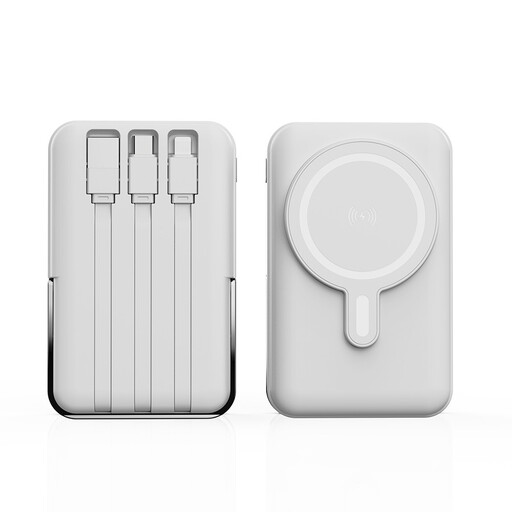
Why This Fits Their Persona: Its 10000mAh capacity is suited to everyday phone top-ups, while the magnetic wireless function and adjustable stand can be useful at a desk, in a café or on a commute. White, black, purple and blue versions are listed.
The stated 22.5W maximum is more informative than a vague fast-charging label. Buyers should still confirm their phone’s compatibility with the magnetic wireless function and use a wired connection when higher speed is required.
22.5W maximum output; 10000mAh capacity; magnetic wireless charging and an adjustable phone stand.
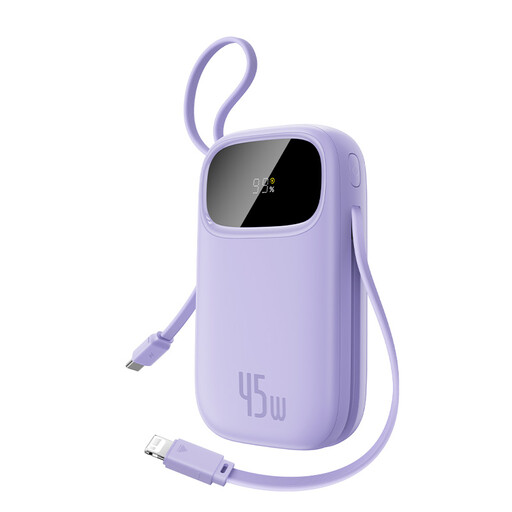
Why This Fits Their Persona: This is designed for users who want one compact charger for a mixture of phones, tablets and compatible laptops. The digital percentage display and built-in cables are practical for office bags, travel and shared household use.
Its specification identifies the conditions for 45W output and explains that simultaneous charging lowers the total. This helps prevent assumptions about full-speed charging across all connected devices.
45W single-device USB-C output; built-in USB-C and iP cables; digital battery display; support for up to four connected devices.
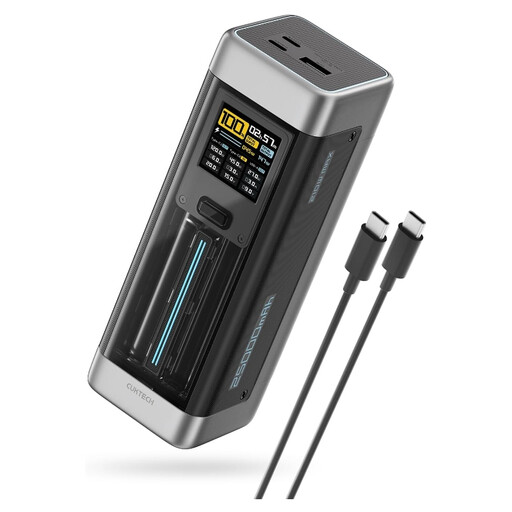
Why This Fits Their Persona: This larger unit is aimed at remote workers, photographers, professionals and travellers who need extended reserve power for compatible laptops and several USB devices.
The model identifies 140W USB-C output, three ports and PD3.1 support rather than relying only on capacity. Use a certified high-wattage cable, keep it ventilated and check laptop compatibility before purchase.
25,000mAh capacity; 140W USB-C output; three-port design for laptop and multi-device use.
We have compiled a complete, real-time list of products that fully satisfy these strict selection criteria and UK safety regulations.
It can be worthwhile if your phone, tablet or laptop supports the relevant charging protocol and wattage. Otherwise, a high-output model may not charge faster than a lower-output alternative. Match the power bank to your device’s accepted input and select a suitable cable.
Service life depends on charging cycles, heat, storage and physical handling. Avoid leaving it fully discharged for long periods, protect it from high temperatures and follow the supplied charging instructions. Replace it if the casing becomes damaged or swollen.
The electricity used to recharge a portable power bank is generally modest, but conversion losses mean the energy drawn from the socket is higher than the energy delivered to your phone. Recharging only when needed and using the correct charger can help avoid unnecessary energy use.