
24/7 Customer Support

Free returns

Same-day & Next-day Delivery

Quality Guaranteed

Unlock Your Welcome Offers: FREE Delivery | Up to 80% OFF | Free 30-day JoyPlus trial
Download the APP
A fast charging power bank can be useful on a London commute, a university day or a weekend trip across the UK. However, product listings often make it difficult to compare charging speed, usable capacity and device compatibility. A high wattage number alone does not guarantee that a power bank will charge every device quickly.
The most common buying mistakes are usually linked to three marketing traps:
For everyday phone use, a 10000mAh power bank is generally easier to carry in a coat pocket, handbag or work bag. It can provide useful additional phone charge without the bulk associated with larger models.
A 25000mAh power bank is more suitable for longer trips, frequent device charging or laptop support. Its extra capacity normally means greater weight and size, so check whether it fits your travel setup. If you plan to fly, confirm the watt-hour rating and airline requirements before travelling. Many airlines apply restrictions to spare lithium-ion batteries and rules can vary.
Capacity is often shown in milliamp-hours, while travel restrictions are usually based on watt-hours. The watt-hour figure can be calculated using:
Wh = mAh × nominal voltage ÷ 1,000
Do not rely on capacity alone. Look for clear information about output, input and the number of devices that can be charged at once.
A USB-C power bank with USB Power Delivery, commonly shown as USB PD, is a practical option for newer phones, tablets and compatible laptops. A 22.5W model may suit everyday smartphone charging, while a 45W power bank can offer more flexibility for tablets and some lightweight laptops.
A 140W power bank is designed for more demanding laptop charging, but the connected laptop, cable and charger must also support the required power. Use a certified cable rated for the intended wattage. A cable designed for basic phone charging may not safely support high-power output.
Check the small print for conditions such as:
For example, a power bank may provide 45W to one device but reduce total output when its built-in cables and other ports are used simultaneously.
A power bank with built-in cable reduces the need to carry a separate lead, which is helpful for commuting or travelling. Check whether it includes USB-C, Lightning or USB-A connections and whether the cable is used for input, output or both.
A power bank with digital display shows remaining battery percentage more clearly than a series of indicator lights. This can help you decide when to recharge it before leaving home.
A wireless magnetic power bank may be convenient when you want to use your phone while charging. Confirm your phone’s compatibility and remember that wireless charging can be affected by case thickness, alignment and heat. Wired charging is usually the more straightforward choice when speed is the priority.
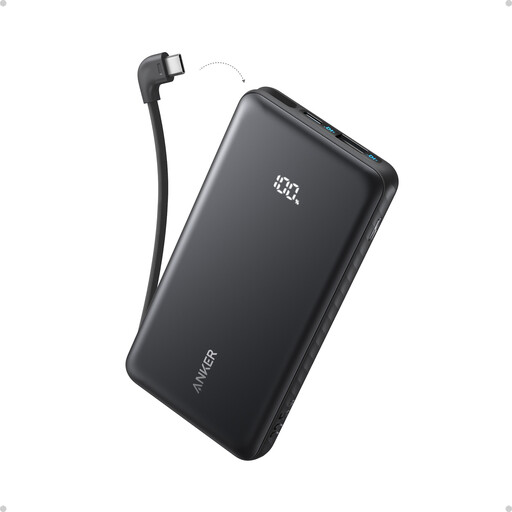
Why This Suits Their Persona: Its 10,000mAh capacity and built-in USB-C cable suit students, commuters and mobile users who want a compact everyday charging option.
The listing identifies both 22.5W output and 20W input, helping shoppers distinguish device charging speed from recharge speed.
Includes USB-A, USB-C and a built-in USB-C cable, plus an interactive screen showing charging status.
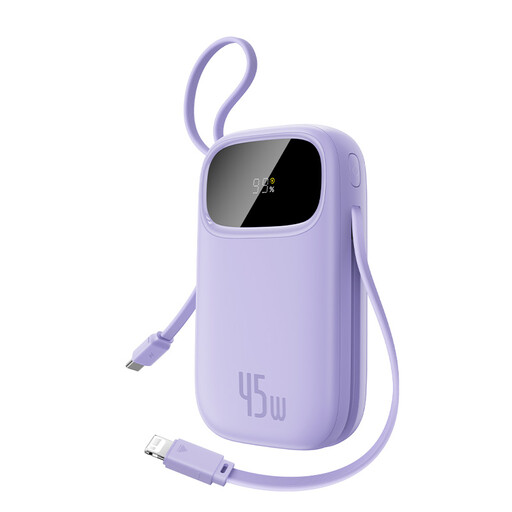
Why This Suits Their Persona: It is suited to users carrying a mixture of USB-C, Lightning and USB-A devices, including compatible phones, tablets and laptops.
Its specifications state that 45W output is available through USB-C with one device, while simultaneous charging reduces total output to 15W.
Offers built-in USB-C and Lightning cables, a USB-A port, digital battery display and charging for up to four devices.
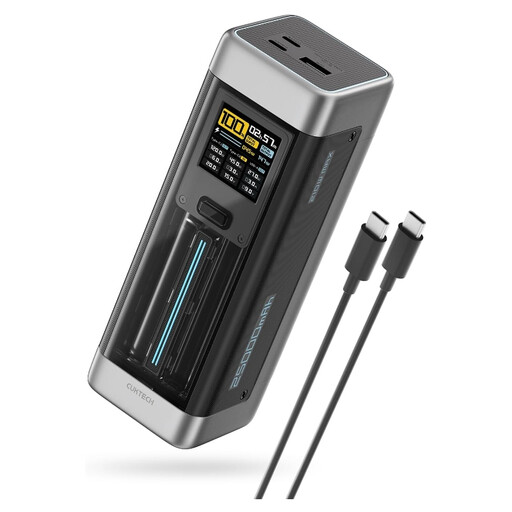
Why This Suits Their Persona: Its higher capacity and USB-C output are aimed at professionals, creators and travellers who need portable laptop charging away from mains power.
The product information identifies the 140W USB-C output and highlights the need for certified high-wattage cables during high-speed charging.
Provides 25,000mAh capacity, USB-C laptop charging and three ports for users managing several devices.
Lithium-ion power banks should be kept dry and away from extreme temperatures. Stop using a unit if it becomes unusually hot, swells, leaks or gives off an unusual odour. Do not puncture, disassemble or place it under bedding while charging.
For high-output models, use a suitable USB-C cable and compatible charger. Keep the power bank ventilated during operation, particularly when charging a laptop or several devices. Store it with some charge rather than leaving it completely empty for long periods.
We have compiled a complete, real-time list of products that fully satisfy these strict selection criteria and UK safety regulations.
It can be, provided the connectors and charging protocols match the devices. USB-C is widely used on modern Android phones and newer iPhone models, while older iPhones may require a Lightning connection. Check the cable type and supported output before ordering.
Recharge time depends on the power bank’s input rating and the charger used. A model supporting 20W input will generally recharge more quickly with a suitable 20W charger than with a low-power adapter. Larger-capacity units, including 25000mAh models, normally require more time than 10000mAh versions.