
24/7 Customer Support

Free returns

Same-day & Next-day Delivery

Quality Guaranteed

Unlock Your Welcome Offers: FREE Delivery | Up to 80% OFF | Free 30-day JoyPlus trial
Download the APP
In an age where our smartphones, tablets and laptops are central to our daily lives, a flat battery can bring productivity to a halt. Whether you're a daily commuter, a frequent traveller or a student moving between lectures, the anxiety of a low battery warning is a shared experience. The market is filled with portable chargers, all promising convenience, but navigating the technical specifications can be confusing.
This guide is designed to help you understand the key features of modern power banks. We will break down what to look for and present a few carefully selected options that cater to different needs, helping you find a reliable charging solution.
Before diving into specific products, it's useful to understand the core features that differentiate one power bank from another. Considering these points will help you make a more informed decision.
The "fast charging" in a fast charging USB C power bank refers to its power output, measured in watts (W). Higher wattage generally means faster charging, but your device must also support it. Look for technologies like Power Delivery (PD), which is a common standard for fast charging via USB-C. For those with high-demand devices like modern laptops, a 140W power bank can function as a portable laptop charger, delivering power comparable to a wall adapter. Gallium Nitride (GaN) is another term to watch for; it's a material that allows for more efficient, smaller and cooler chargers.
A power bank's capacity is measured in milliampere-hours (mAh). A 10000mAh portable charger is a popular choice, typically offering enough power to charge a standard smartphone two to three times. It strikes a good balance between power and portability. For longer trips or charging multiple devices, a high capacity power bank (20,000mAh or more) is more suitable, though it will be larger and heavier. For maximum portability, a slim power bank with a lower capacity might be the perfect fit for slipping into a pocket for a day out.
Modern power banks offer more than just a battery in a box. A 3-in-1 power bank might combine a wall charger, battery and cables into a single unit. A power bank with a built in cable removes the need to carry extra wires. For Apple users, a magnetic wireless power bank that is MagSafe compatible offers a seamless, cable-free charging experience by snapping directly onto the back of the phone.
Here are a few recommendations that showcase different features and are suited for various user needs.
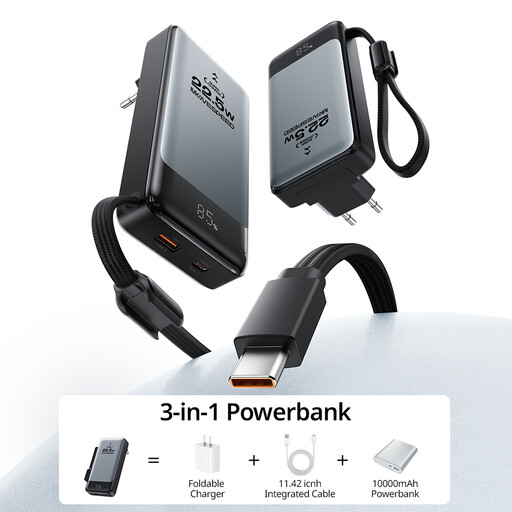
MOVESPEED 3-in-1 Power Bank, 10000mAh, 15W Portable Charge, Integrated Type C Cable and 3 Outputs
Why It Stands Out: This device simplifies your charging setup by integrating a wall charger, a 10,000mAh battery and a built-in Type-C cable into one compact unit. Its GaN technology ensures efficient charging, and it can power up to three devices at once.
Pros:
Who is it for? This is an excellent choice for daily commuters and light travellers who value minimalism and want to carry as few accessories as possible.
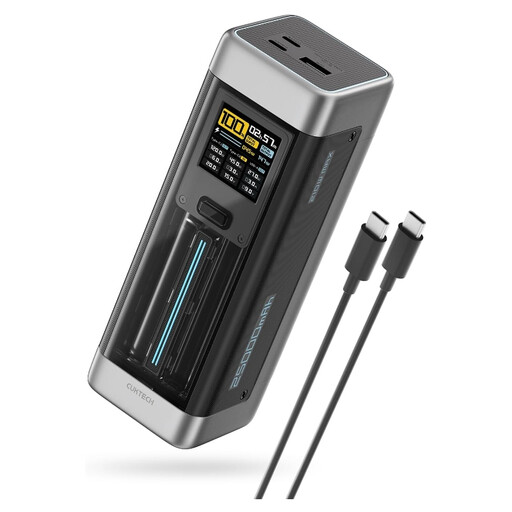
CUKTECH NO.20 Power Bank 25,000mAh, 140W USB C Portable Laptop Charger
Why It Stands Out: With a massive 25,000mAh capacity and a powerful 140W output via its PD3.1 USB-C port, the CUKTECH NO.20 is a true portable laptop charger. It can handle demanding devices like a MacBook Pro while simultaneously charging other gadgets.
Pros:
Who is it for? Mobile professionals, digital nomads and tech enthusiasts who need to power a laptop, tablet and phone on the go will find this high-capacity unit indispensable. Note that for 140W charging, a certified high-wattage cable is required.

Why It Stands Out: This slim power bank is designed for maximum convenience. At only 9.4mm thick, it attaches magnetically to the back of compatible iPhones, providing a cable-free power boost. The integrated kickstand is a thoughtful addition for hands-free viewing.
Pros:
Who is it for? This is ideal for iPhone users who prioritise portability and the convenience of wireless charging. It’s perfect for topping up your battery during the day without the hassle of cables.
If these specific models don't quite match what you're looking for, there is a wider world of charging solutions available. From different capacities to unique form factors, you can find a device that fits your exact lifestyle.
Explore our full range of USB power bank solutions to find your perfect match.
A standard power bank typically offers an output of 5W to 12W. A fast charging USB C power bank provides a higher output, often 18W or more, using protocols like Power Delivery (PD). This allows it to charge compatible devices significantly faster. For example, it might charge a phone to 50% in 30 minutes, whereas a standard charger would take much longer.
Yes, but there are restrictions. Most airlines in the UK and globally follow the 100 Watt-hour (Wh) rule for lithium-ion batteries in carry-on luggage. A 25,000mAh power bank (like the CUKTECH NO.20) is approximately 92.5Wh, placing it safely under this limit. A 10,000mAh power bank is even lower, around 38.5Wh. Always check with your specific airline before flying, but these capacities are generally permitted in your carry-on bag, not in checked luggage.
To get the full benefit of fast charging, especially at very high wattages like 140W, you need a cable that is rated to handle that power. Using a standard, uncertified cable with a powerful charger can result in slower speeds or, in some cases, cause the cable to overheat. Always pair your power bank with a quality cable that matches its output capabilities.