
24/7 Customer Support

Free returns

Same-day & Next-day Delivery

Quality Guaranteed

Unlock Your Welcome Offers: FREE Delivery | Up to 80% OFF | Free 30-day JoyPlus trial
Download the APP
A modern household may need to charge a phone, tablet, laptop, earbuds and smartwatch before leaving the house. Choosing one of the many fast USB-C chargers available online can simplify that routine, but headline wattage alone does not tell you whether a charger suits your devices.
Three common buying traps are worth checking before you order:
Phones commonly require less power than laptops, while some performance laptops can draw 100W or more. A PD fast charger uses USB Power Delivery to negotiate a suitable power level with a compatible device.
For a laptop, check:
A 140W laptop charger can be useful for a high-performance laptop, but it is not automatically necessary for a phone or tablet. Choosing a charger with more capacity than you need can be worthwhile if you expect to add a laptop or another device later.
A multi-port USB-C charger can reduce cable clutter, but port numbers do not show how much power each port supplies. Look for a clear output table covering USB-C and USB-A ports.
For example, the MOVESPEED charger listed below has three USB-C ports and one USB-A port. Its specifications state up to 140W from Type-C1, up to 100W from Type-C2, up to 20W from Type-C3 and up to 22.5W from USB-A, with 140W maximum total output. This is more useful information than simply seeing “four-port fast charging” on a product title.
A GaN charger uses gallium nitride components to support high power in a compact design. However, compact does not mean it can be covered or used in a poorly ventilated space.
Check for:
A charger for a desk may prioritise several ports, while a travel charger should also be compact and compatible with the sockets at your destination. A car charger must be designed for a vehicle’s DC socket rather than a mains outlet.
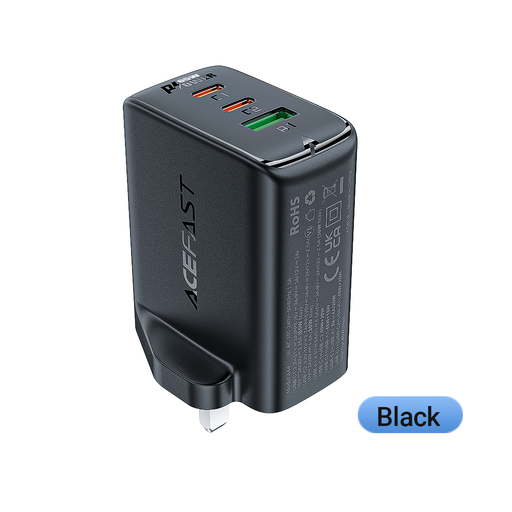
Why This Fits Their Persona: A suitable starting point for UK households moving from separate phone and tablet adaptors to one wall charger with multiple connection options.
The UK plug helps avoid relying on a loose travel adaptor for everyday charging, while the three listed ports provide more flexibility than a single-port adaptor.
65W rated charging, two USB-C ports, one USB-A port and a UK plug format.
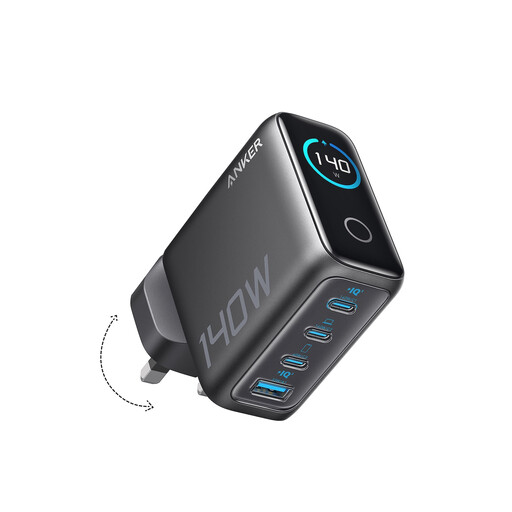
Why This Fits Their Persona: A desk-friendly option for remote workers and tech enthusiasts who want high output, several ports and visible charging information.
Its four-port design and stated 140W USB-C output make it easier to plan around multiple devices instead of buying several single-port adaptors.
Four-device charging, two high-output USB-C ports, GaN construction and a colour display showing charging details.
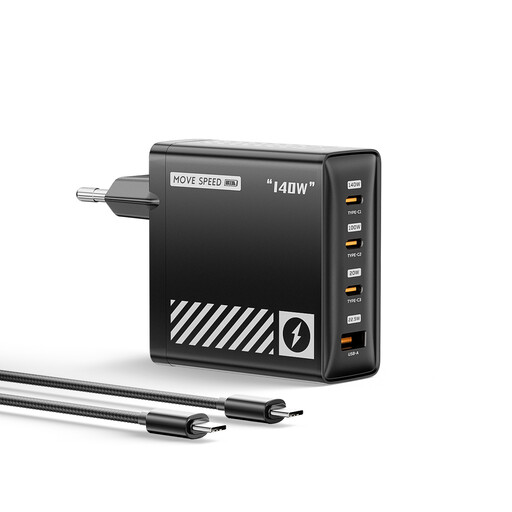
Why This Fits Their Persona: Designed for users carrying a laptop, tablet and phone between home, office and international destinations.
The detailed port allocation helps heavy users distinguish single-port performance from shared charging. As an EU plug model, it should be paired with a suitable UK adaptor when used at home.
Up to 140W through Type-C1, four ports, 100–240V input and stated eight-layer protection.
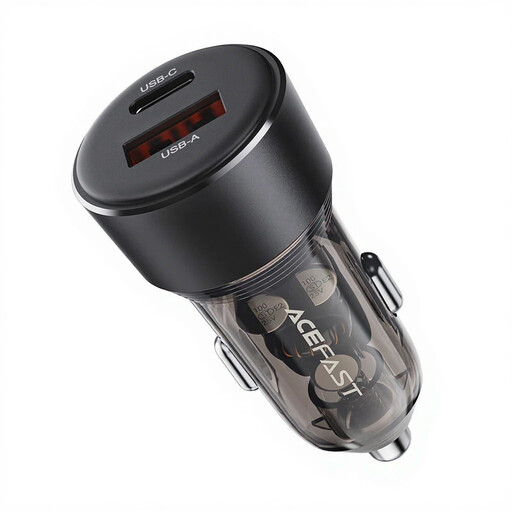
Why This Fits Their Persona: A practical phone and laptop charger alternative for drivers who need to power two smaller devices during a commute.
It is clearly designed for DC 12–24V vehicle sockets, avoiding the mistake of using a mains wall charger in a car. The instructions also advise connecting devices after engine start.
USB-C and USB-A ports, up to 30W per port and support for PD, QC, PPS, FCP, SCP and AFC protocols.
We have compiled a complete, real-time list of products that fully satisfy these strict selection criteria and UK safety regulations.
Yes, provided the charger has adequate output and both devices support USB-C charging. Check the charger’s single-port wattage and its combined output when both devices are connected. A phone may charge normally even if the laptop receives insufficient power, so matching the laptop’s original wattage is important.
The electricity used depends mainly on the power drawn by the connected devices and how long they charge. A higher-rated adaptor does not automatically consume its full capacity. Multi-port models may also reduce the need to leave several separate adaptors plugged in, although standby consumption varies by product.
Lifespan depends on heat, cable quality, socket condition and frequency of use. Keep the charger ventilated, avoid damaged cables, do not cover it and stop using it if you notice unusual heat, odour, casing damage or deformation. A stated warranty, such as the one-year limited warranty supplied with the MOVESPEED model, can also provide useful purchase information.