Private festival groups
If you are feeding several people but do not need a catering case, start with the number of meals and the serving guidance on your chosen tin. Four- and six-tin packs offer defined quantities that you can adjust to your plan.


Choose the tin count from your planned portions and storage space: a 24 × 415g catering case suits repeated service, while four- or six-tin packs give a smaller group less stock to manage. If diners want a particular reduced-sugar or reduced-salt recipe, compare the exact labels rather than assuming that all baked beans have the same ingredients or nutrition. A food stall also needs a plan for allergen information and safe handling after tins are opened.
If you are feeding several people but do not need a catering case, start with the number of meals and the serving guidance on your chosen tin. Four- and six-tin packs offer defined quantities that you can adjust to your plan.
A catering case is relevant when you can store, heat and serve its full quantity. Keep the labels needed for allergen information, and plan how you will handle any opened tins during service.
No-added-sugar and reduced-salt or reduced-sugar recipes are distinct choices. Compare the stated claims with the standard product named on each label, then check the ingredients of the tins you will serve.
Work out portions first, then choose a recipe and a tin size that fit your storage and serving arrangements.
| Priority | What to check | Your needs |
|---|---|---|
| Portions and pack size | Count diners and meal occasions; check servings per tin and the number and weight of tins. Heinz describes its 24 × 415g case as a catering format; Waitrose & Partners lists a Heinz 6 × 415g pack, while ASDA lists a 4 × 415g pack. | I want enough for the planned meals without opening more tins than we can use. |
| Recipe | Compare the exact ingredients and nutrition labels. Waitrose & Partners says Heinz No Added Sugar 6 × 415g has at least 25% less salt than standard Heinz baked beans; its Essential Reduced Salt & Sugar product states 30% less of each than regular Waitrose Essential beans. | Some people in our group prefer a reduced recipe, so I need to know which standard product its claims are compared with. |
| Opened-tin storage | Read the chosen tin’s storage instructions; arrange covered containers and refrigeration for leftovers. The Waitrose Essential listing instructs buyers to transfer opened contents to a non-metallic container, cover, refrigerate and use within two days. | If cold storage is limited, I would rather open tins as needed than plan to keep a large quantity of leftovers. |
| Allergen information | Check the current ingredients on every product used; retain the relevant labels or ingredient records. The Food Standards Agency says retail and catering food businesses must provide allergen information. | For a food stall, I need accurate information about the beans actually served, including any ingredients added to the dish. |
| Food-stall planning | Check whether your activity is a food business and contact the relevant authority. GOV.UK guidance dated 19 August 2026 says food businesses in England, Wales and Northern Ireland must register at least 28 days before trading. | If I am running a stall rather than feeding a private group, I need to allow time to check the requirements that apply where the event takes place. |
A 24 × 415g case, a six-tin pack and individual tins call for different storage space and leftover plans.
Estimate portions across every planned meal, then compare tin count, tin weight and the serving statement on the product you intend to buy.
No-added-sugar and reduced-salt products can have different ingredients, and each reduction claim refers to a specified standard recipe.
Check the current ingredient and nutrition labels, including the stated comparator, before choosing for your group.
Unopened-tin storage directions do not apply once a tin has been opened. Waitrose Essential’s instructions call for transferring leftovers, covering and refrigerating them, and using them within two days.
Open tins progressively and arrange suitable containers and refrigeration if you expect leftovers; follow the instructions on your chosen product.
Ingredients can differ between recipes or change over time. Food businesses must provide allergen information for the food they serve, according to the Food Standards Agency.
Keep the current labels or ingredient records for the tins and any additions used in the finished dish.
These references concern particular baked-bean products and listings, not every recipe sold under each name.
Heinz lists a 24 × 415g Baked Beanz case for catering; UK retailer listings also show four- and six-tin 415g packs.
The cited listings cover individual baked-bean tins, including a Reduced Salt & Sugar recipe, rather than a packaged catering case.
ASDA’s cited listing is for Heinz Baked Beans 4 × 415g, a format to consider for a smaller planned quantity.
The cited Tesco listing identifies a Heinz 415g tin.
These four- and six-tin packs are options for planned group meals; they do not represent the 24-tin catering-case route.
 No image available
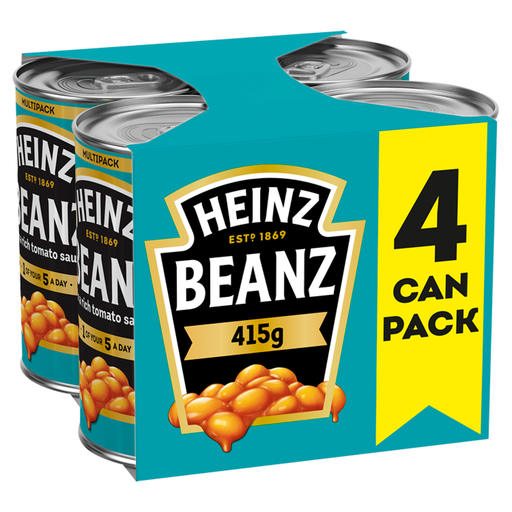
Four 415g tins give a smaller group a defined quantity to include in its meal plan. After opening, transfer unused contents to a non-metallic airtight container, refrigerate and use within two days. For stall service, check the supplied tins’ ingredient and allergen labels.
 No image available
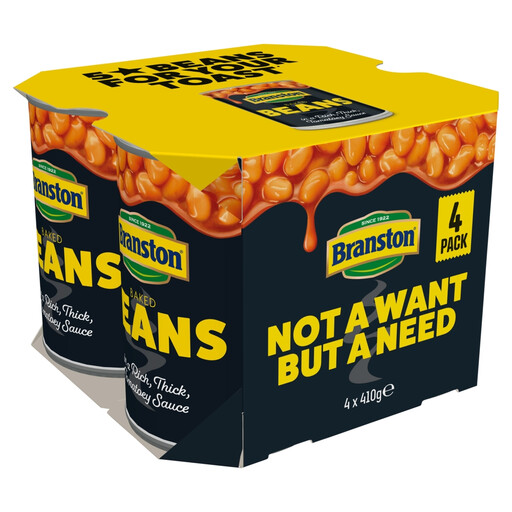
This four-can 410g pack is another quantity for a smaller group to plan around; check its serving guidance rather than treating a 410g can as identical to a 415g tin. Transfer opened leftovers to a container, refrigerate and use within two days. Check current ingredient and allergen details before serving.
 No image available
Six 410g cans offer more individual tins than a four-pack without committing to a catering case. Check the tin’s heating instructions before service. Once opened, transfer unused beans to a covered container, refrigerate and use within two days; check the current label for ingredient and allergen information.
 No image available
This four-can 410g pack is a reduced-sugar-and-salt recipe choice for a smaller planned quantity. Its stated ingredients include steviol glycosides, so check the current label for the people being served, along with the tin’s heating instructions. Transfer leftovers to a covered container, refrigerate and use within two days.
Start with the serving statement on the exact tin, then count diners and the meals at which you will serve beans. Waitrose & Partners describes its cited 420g Essential tin as containing two servings, but that figure should not be applied to every product. Plan for any leftovers you can store according to the chosen label.
Follow your product’s after-opening instructions. The cited Waitrose Essential listing says to transfer unused beans to a non-metallic container, cover, refrigerate and use within two days. If you cannot arrange suitable refrigeration, plan to open only what you expect to serve.
Check the exact beans and the finished dish. Waitrose & Partners labels its cited Heinz six-pack as suitable for vegans, but that statement does not cover other recipes or ingredients added during service.
Food business operators in retail and catering must provide allergen information, according to the Food Standards Agency. Keep ingredient information for the exact tins and any additions used in what you serve, rather than relying on a general description of baked beans.
Check before you plan to trade. GOV.UK guidance dated 19 August 2026 states that food businesses in England, Wales and Northern Ireland must register at least 28 days before trading. Confirm how this applies to your activity with the relevant local authority; seek guidance for Scotland if the event is there.