For stereo or modest multitrack field recordings, start with a compact desktop if your editing software, plug-ins and audio interface support its operating system. A configurable Windows tower or small-form-factor workstation makes more sense when you need Windows-only tools or documented internal expansion. Whichever route you choose, check the exact configuration for storage, connections and shared-office noise rather than assuming that a smaller computer is quieter.
Who this setup suits
Shared-office field-recording editor
You cut, restore, organise and export recordings at a shared desk. Placement, connections for headphones or an audio interface, and storage for active projects matter; ask about noise for the exact computer configuration.
Windows audio-interface user
Your DAW, plug-ins or USB interface depend on Windows software. Check the interface maker's driver and control-software support for the Windows version you intend to use. For a supported ASIO workflow, Focusrite advises selecting the interface's ASIO driver in the DAW.
Editor with a growing project archive
You expect more local recordings, drives or plug-in-heavy projects over time. Lenovo documents PCIe expansion for the ThinkStation P3 Tower, while HP describes accessible memory and storage in the Z2 SFF G1i; check what the particular configuration leaves available.
What to check before buying
Compact macOS desktop
Choose when: Your DAW, essential plug-ins and interface software support the intended macOS version, and desk space is limited.
Trade-off: Plan memory and storage at purchase; a compact case does not establish how quiet the selected configuration will be.
Configurable Windows tower
Choose when: You need Windows-only tools, several internal drives or PCIe expansion; Lenovo documents five open PCIe slots for the ThinkStation P3 Tower.
Trade-off: Allow room for the tower and check acoustic information for its actual processor, graphics and cooling configuration.
Small-form-factor Windows workstation
Choose when: You need a compact workstation with a documented storage-upgrade route; HP describes tool-less memory and storage access for the Z2 SFF G1i.
Trade-off: Check the exact ports and available slots, as well as configuration-specific noise, before relying on its expansion options.
| Concern |
What to check |
Who this matters to |
| Noise and desk space |
Ask about noise for the exact configuration and check its dimensions and cable placement. |
If I edit beside colleagues, I need a computer I can place without disrupting the workspace; around 31% of consumers put noise and space first. |
| Software and interface compatibility |
Check the exact DAW, plug-ins, interface driver and control software against the intended operating-system version. |
An existing interface and editing setup need to work together before other specifications matter. Compatibility is the primary concern for around 31% of consumers. |
| Memory and project storage |
Compare your DAW's requirements with the stated memory, then plan separate capacity for active media and backups. |
With longer recordings or a growing archive, I need enough working memory and room for files beyond the operating system; roughly 25% of consumers prioritise editing resources and storage. |
| Expansion and platform flexibility |
Check available drive slots, PCIe slots and ports in the configuration you would buy. |
Future drives or a required Windows workflow may shape the choice more than a small case. Around 13% of consumers put expansion or platform flexibility first. |
Buying pitfalls
-
Assuming compact means quiet
A smaller case does not establish fan noise under an editing workload. The processor, graphics configuration and cooling arrangement all matter at a shared desk.
Request acoustic information for the exact configuration where available, and consider where the computer will sit relative to colleagues and microphones.
-
Choosing Windows before checking the interface driver
An existing USB interface may depend on a particular driver or control application. Focusrite advises choosing its ASIO driver in a DAW that supports ASIO.
Check your interface model, driver, DAW, plug-ins and intended Windows version together before ordering.
Resolving a driver mismatch can take troubleshooting time or require a different interface.
-
Using the boot SSD as the entire archive plan
Projects, exports and backup copies need capacity beyond the operating system and applications. Adobe's Audition guidance calls for a fast internal SSD for the application and cache, plus additional high-speed storage for media.
Estimate active recordings, exports and backups separately, then check whether the chosen computer can accommodate the storage you plan to use.
A growing archive may require another internal or external drive and separate backup storage.
-
Choosing workstation graphics without a visual-workload requirement
A graphics-card specification alone does not show that field-recording edits will run better. Software requirements vary, particularly when video or other visual applications are involved.
Check the requirements of your actual DAW and companion applications before making dedicated graphics part of the purchase decision.
Brands and product lines to consider
Apple
Mac mini is a compact macOS route if your DAW, plug-ins and audio-interface software support the macOS version you will use.
- Apple lists Mac mini configurations starting with 16GB unified memory and documents Thunderbolt, HDMI and Ethernet connections.
- Plan internal memory and storage choices before purchase, and check acoustic behaviour for the configuration under consideration.
Lenovo
ThinkStation P3 Tower offers a configurable workstation route for editors who need a Windows setup or internal expansion.
- Lenovo documents SSD options, multiple USB connections and five open PCIe slots for the P3 Tower line.
- A tower needs placement space; check the noise characteristics of the exact build rather than treating expansion as evidence of quiet operation.
HP
Z2 SFF G1i is a compact workstation route for buyers who want to plan future memory or storage changes.
- HP describes tool-less memory and storage access and up to three M.2 storage slots for the Z2 SFF G1i line.
- Confirm the processor, graphics, ports, available slots and acoustic information for the specific configuration.
Joybuy desktop choices
These desktops offer compact and tower options for the field-recording workflow. Match the operating system and connections to your software and interface, then check storage plans and noise for the configuration you choose.
 Image unavailable
Apple Mac mini (2026) M6 12-Core CPU, 12-Core GPU, 24GB RAM, 512GB SSD, Silver
A compact macOS choice for a limited desk, provided your DAW, plug-ins and audio-interface software support the intended macOS version.
The listed configuration has 24GB RAM and a 512GB SSD. Plan media and backup storage separately, and check noise information for the configuration.
View on Joybuy
 Image unavailable
Lenovo IdeaCentre Mini PC 01IRH10R, Intel Core 5, 16GB RAM, 512GB SSD, Grey, 91B2000XUK
A compact Windows desktop to consider if your existing audio software and interface driver support the Windows version you plan to use.
The title lists 16GB RAM and a 512GB SSD. Check the available connections, future storage options and configuration-specific noise before buying.
View on Joybuy
 Image unavailable
FIREBAT Mini PC, AMD Ryzen 7 7735HS, Radeon 680M, 16GB RAM, 512GB SSD, Dual M.2, WiFi 6
A mini PC to consider where desk space and a possible future storage change both matter.
The title specifies 16GB RAM, a 512GB SSD and dual M.2 slots. Confirm the operating system, which slots are available in this configuration, software compatibility and acoustic behaviour before relying on it for editing.
View on Joybuy
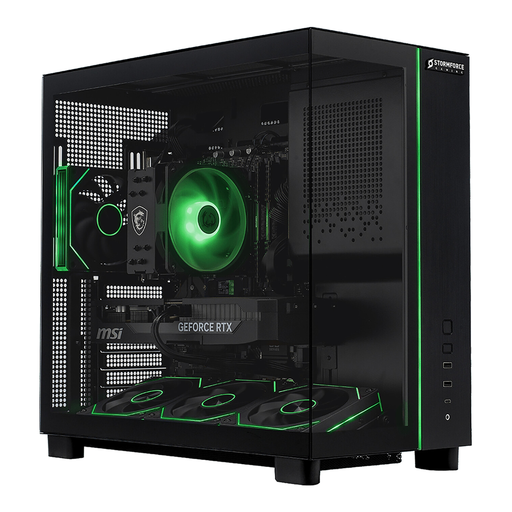 Image unavailable
Stormforce Defiance AMD Ryzen 7, 32GB RAM, 2TB SSD, RTX5070Ti, Win 11
A Windows tower to assess if a larger active-project storage requirement outweighs the need for a small desk footprint.
The title lists 32GB RAM and a 2TB SSD. Confirm space and noise requirements, plus the supplied graphics-card model: the title and description differ on that component.
View on Joybuy
 Image unavailable
HP M02-0005na OmniDesk, AMD Ryzen 5 8500, 8GB RAM, 1TB SSD, Windows 11 Home
A Windows tower to consider if its software compatibility and available working memory fit your particular editing projects.
The title lists 8GB RAM and a 1TB SSD. Adobe's Audition guidance lists 16GB for HD media, so check your software's requirements and memory-upgrade options, along with configuration-specific noise.
View on Joybuy
Common questions
Do I need a dedicated graphics card to edit field recordings?
Not automatically: check the requirements of your DAW and other applications before choosing one. Dedicated graphics may matter if your workflow also includes video or software that explicitly requires a particular GPU.
What should I check before connecting a USB audio interface to a Windows desktop?
Confirm that the interface maker supports your chosen Windows version and provides the driver and control software you need. For a DAW that supports ASIO, Focusrite advises selecting the interface's ASIO driver; plan to use that device for both ASIO input and output.
Is a 256GB SSD enough for field-recording edits?
It depends on your active projects and where you keep media and backups. Adobe's Audition guidance distinguishes a fast internal SSD for the application and cache from additional high-speed storage for media; estimate those files separately before selecting capacity.
What should I do with an old desktop in the UK?
Check an appropriate electrical-waste or reuse route rather than putting the desktop out as ordinary household waste. GOV.UK's guidance describes the UK's Waste Electrical and Electronic Equipment framework; ask your local authority or retailer which route is available to you, and erase personal or work data before handing over the computer.


