Remote field transcribers
People typing up observations during long periods away from mains power need a workable charging plan, enough storage for their files and a transcription workflow they can use without a connection when necessary.


Choose a rugged Android tablet if exposure to rain, dust or gloves and a way to recover from a depleted battery are your priorities; consider a Windows detachable if your transcription depends on desktop software and sustained keyboard use. An iPad can suit an established iPadOS workflow where carry weight matters. For any route, confirm that your exact transcription app works as needed offline, then plan charging around the length of your field session rather than an advertised battery figure.
People typing up observations during long periods away from mains power need a workable charging plan, enough storage for their files and a transcription workflow they can use without a connection when necessary.
People working around rain, dust, dirt or gloves need to check the exact tablet’s protection and touch controls, rather than assuming an ordinary typing setup will suit the conditions.
People who process field notes in Windows desktop software or type for extended periods need to assess the application, keyboard and touchpad together.
For field transcription away from mains power, start with the requirement that could prevent the work altogether: the environment, the required software or the available power.
Consider it when: You must enter notes in exposed conditions or while wearing gloves; Samsung lists IP68 protection, glove-responsive touch and battery replacement without rebooting for the Galaxy Tab Active5 Pro.
Check first: Confirm that your required transcription app and any compatible spare-battery arrangement suit the exact device.
Consider it when: Your field workflow requires Windows desktop software and laptop-style typing; Microsoft offers an optional keyboard and touchpad for Surface Pro.
Check first: The keyboard is separate, and Microsoft says battery life varies with use and settings.
Consider it when: Your transcription workflow already runs on iPadOS and a lighter tablet matters; Apple lists the 11-inch iPad Air Wi-Fi model at 464 g.
Check first: Confirm offline operation and file handling in your app; the compatible keyboard and cellular option are separate choices.
| Concern | What to check | Who this matters to |
|---|---|---|
| Power away from mains | Match the longest session to your intended workload and confirm a compatible charging or spare-battery plan. | If I cannot reach a socket during a long session, I need to keep working when power runs low; around 40% of consumers put power resilience first. |
| Exposure and glove use | Check the exact model’s ingress-rating conditions and whether its touchscreen works with the gloves you use. | When I am transcribing around rain, dirt or dust, I need controls and protection suited to that setting; roughly 30% of consumers make environmental resilience their primary concern. |
| Typing and software fit | Test your app’s offline use and audio import and export, then check keyboard compatibility. | For extended typing or a required desktop application, I need the files and software to work together; about 30% of consumers prioritise the transcription workflow and keyboard. |
Microsoft says Surface battery life varies with usage and settings; its published tests do not establish runtime for your transcription workload.
Test the intended app and peripherals over a representative session, then plan how you will recharge away from mains power.
A compatible power bank or spare battery may add equipment to carry.
A separate keyboard changes how you pack and use the device during sustained transcription. Microsoft’s Surface Pro keyboard and Apple’s Magic Keyboard for iPad Air are optional accessories.
Check the compatible keyboard, case, charger and any connectivity equipment as one working setup.
Ingress ratings have model-specific conditions. For the Galaxy Tab Active5, Samsung describes defined immersion conditions and says water or dust damage is not covered by its warranty; those terms should not be assumed for the different Tab Active5 Pro.
Read the protection conditions and warranty information for the exact model before using it in exposed locations.
Battery life and a keyboard will not resolve a mismatch between your audio files, the transcription service, offline access and the required export format.
Try the intended audio files in the exact app or service, including its offline behaviour, language support and account permissions.
Samsung’s Galaxy Tab Active5 Pro is a relevant model when transcription takes place around dirt, rain or gloves.
Surface Pro is relevant when the required transcription workflow uses Windows software and benefits from laptop-style input.
iPad Air is relevant when the chosen transcription and note-management apps work on iPadOS.
For speech-based field notes where internet access is available, this option focuses on an E Ink voice-to-text tablet.
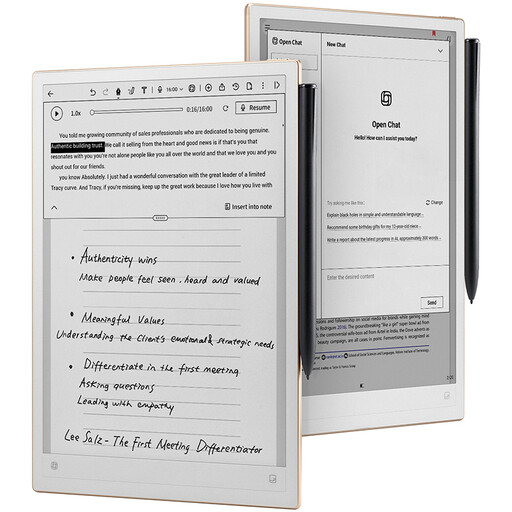 Image unavailable
Consider this tablet for transcribing spoken observations where a reliable internet connection is available. Its listed features include voice-to-text and 16-language transcription; the product name also specifies a 4.2 mm thickness.
Real-time transcription requires an internet connection. Check whether your audio and export workflow is compatible, whether 64 GB meets your storage needs and how long the device runs under your intended workload; storage expansion is listed as unsupported.
It can work if your exact transcription workflow continues without mobile data or you have a reliable hotspot. If recordings must be uploaded or processed online away from Wi-Fi, check the app’s offline behaviour and the connectivity available at your field locations.
Not necessarily: an advertised figure is not a guarantee for transcription in the field. Microsoft says Surface battery life varies with use and settings, so test your intended workload and arrange a suitable charging backup.
A physical keyboard is worth testing for sustained typing, though short corrections may be manageable on screen. Check the keyboard compatible with the exact tablet and whether you can comfortably carry and use the complete setup.
Follow the manufacturer’s instructions and use a power source suitable for the exact device. Mid and West Wales Fire and Rescue Service warns that improperly charged or handled lithium-ion batteries can overheat, so check the condition of the tablet and charging equipment before taking them into the field.