Competitive fighting-game hosts
If local matches depend on precise timing, compare independently measured Game Mode input lag at your intended signal. Check that the console or PC and the selected HDMI input support the refresh mode you plan to use.


For a small-room fighting-game setup, prioritise low input lag in Game Mode at the signal you will use, then check the TV’s supported refresh modes and HDMI ports. Start by measuring the space for a compact screen; consider a larger one only if the furniture and seating positions work for players and spectators. A 144Hz or 165Hz headline does not establish what your console can output.
If local matches depend on precise timing, compare independently measured Game Mode input lag at your intended signal. Check that the console or PC and the selected HDMI input support the refresh mode you plan to use.
A compact screen may be easier to place, but spectators also need a clear view. Compare the TV’s actual width and stand footprint with your furniture and seating arrangement before deciding between a 42-inch and a larger display.
One TV may serve both tournament consoles and a PC, provided the required modes work with each source. Check console support separately from higher-refresh modes advertised for PC connections.
For a small living-room tournament, establish the playable signal and seating layout before comparing headline refresh rates. RTINGS defines input lag as the delay between a source sending a signal and the TV displaying it; judge responsiveness using measurements for the mode you intend to play in.
| Concern | What to check | Who this matters to |
|---|---|---|
| Responsive play and motion | Compare measured Game Mode input lag at the intended resolution and refresh rate. Check that the TV accepts the signal your game and source can provide. | When timing a move in a local match, I want the screen to respond promptly rather than relying on a gaming label. Around 42% of consumers would put responsiveness first. |
| Room fit | Measure the available width and stand space, then check sightlines from the planned seats. For mounting, match the exact TV to the mount’s fitting pattern and load rating. | In a compact lounge, I need players and spectators to see the screen without crowding the furniture. Room fit comes first for around 33% of consumers. |
| Console and PC compatibility | Check the exact model’s supported refresh rates, variable refresh rate (VRR) formats and HDMI port allocation against each connected device. | If I switch between a tournament console and a PC, I need the intended mode to work on the port each device uses. Around 25% of consumers would make compatibility their primary concern. |
Samsung specifies that 4K 165Hz on its 42-inch S90H is available only with PC-connected content; it lists VRR and 4K@120Hz support separately.
Match the exact TV mode to your console or PC and the resolution you will use for matches.
Picture-processing features do not establish input lag in the mode used for play. RTINGS measures input lag as the time between a source sending a signal and its appearance on screen.
Look for independent Game Mode measurements at your intended signal, and assess your preferred picture settings separately.
Sony lists its BRAVIA 5 K-55XR5 at approximately 122.8 cm wide and 18.8 kg with its stand. That footprint needs checking against the planned furniture, wall space and seating.
Confirm the exact model’s dimensions, mounting pattern and compatible mount load rating before ordering.
A different stand or suitable wall mount may be needed if the planned position cannot accommodate the TV.
TV Licensing says its requirements depend on viewing live TV on a TV or streaming service, or using BBC iPlayer, regardless of the device.
If the setup will show broadcasts or use BBC iPlayer, check the official TV Licensing criteria for what you intend to watch.
LG’s 42-inch OLED evo AI C6 is a compact OLED option to assess for a small-room setup.
Samsung’s 42-inch S90H OLED is another compact model for a setup that may alternate between PC and console play.
Sony’s 55-inch BRAVIA 5 K-55XR5 Mini LED is a larger-screen option where the room can accommodate it.
These choices span compact 42- and 43-inch screens, a 48-inch option and larger 55-inch TVs. Compare their physical fit and the input modes needed for your console or PC before choosing one for tournament play.
 Image unavailable
The 42-inch screen is worth considering when the living-room layout calls for a compact TV.
Compare independent Game Mode input-lag measurements at your tournament signal, and check the TV’s width and stand footprint against the planned position.
 Image unavailable
Consider this 55-inch model only if the room has space for a larger shared screen.
Its title names a 165Hz gaming mode; confirm which source and signal can use it, and compare independent input-lag measurements before relying on it for matches. Measure the intended stand space and spectator sightlines too.
 Image unavailable
This 55-inch option suits a layout that can accommodate a larger screen.
Check the actual input resolution and refresh mode for your tournament device rather than treating the title’s Game Accelerator figure as a universal signal mode. Compare Game Mode input-lag measurements and confirm the stand fits your furniture.
 Image unavailable
The 43-inch size offers a compact-screen option for a small living room.
The product title specifies a 120Hz Game Accelerator for FHD; do not assume that means 4K at 120Hz. Confirm the input mode needed by your console or PC, independently measured Game Mode lag and the TV’s physical footprint.
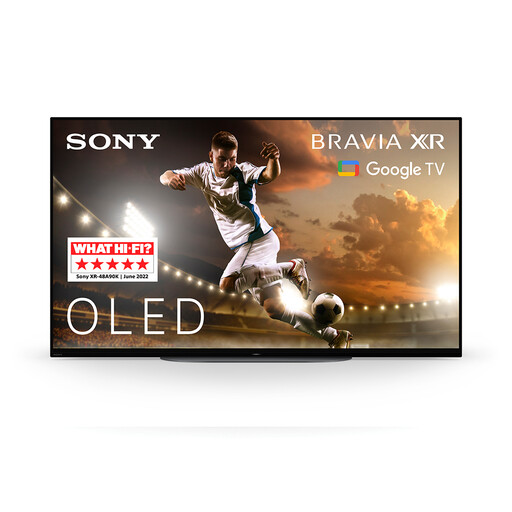 Image unavailable
This 48-inch model falls between the compact 42-inch choices and the larger 55-inch screens.
Check whether its dimensions suit the seating arrangement. If VRR or a particular high-refresh input is essential, confirm support for this exact model and compare independent Game Mode lag at your intended signal.
Enable the TV’s Game Mode and confirm that the console or PC outputs the intended resolution and refresh rate. For responsiveness, compare input-lag measurements at that signal rather than assuming every Game Mode setting performs alike.
VRR can help reduce tearing when the source frame rate varies, but it requires a compatible format on both the TV and the connected device. RTINGS describes VRR as matching display refresh to the source frame rate; it does not replace a check of Game Mode input lag.
Not on every TV: Sony specifies VRR on HDMI ports 3 and 4 of the BRAVIA 5 K-55XR5, although it lists automatic low-latency mode on all four ports. Check the port allocation for the exact TV you choose before connecting several systems.
Gaming on a TV does not by itself determine the licence requirement. TV Licensing says you need to be covered if you watch live TV on a TV or streaming service, or use BBC iPlayer, regardless of the device; check those criteria against what the tournament setup will show.