For regular fighting-game sessions, choose a TV by its Game Mode and the connection modes your consoles or PC can use, rather than by an advertised refresh rate alone. If films are the room’s main use, weigh picture, screen size and sound-system connections alongside gaming support. In either case, check the exact HDMI ports and setup; an OLED screen also calls for care when HUDs or tournament overlays remain fixed for long periods.
Who is this TV for?
Tournament hosts focused on responsiveness
If you host local brackets or regular versus sessions, dependable console connections and the TV’s low-latency gaming settings matter before cinema extras. Check the modes available on the exact HDMI inputs you plan to use.
Home-cinema gamers
If one screen serves films, streaming and matches, consider its size, picture characteristics and connection to your sound system alongside its gaming modes.
PC-and-console players
If you switch between a gaming PC and consoles, check which refresh-rate and variable refresh rate (VRR) modes the exact model offers, and whether enough suitable HDMI inputs remain for your other equipment.
What matters when choosing?
Plan the route from each game source to the TV before settling on picture features or screen size. A stated refresh rate does not establish the input lag of a complete playing setup.
| Concern | What to check | Who this matters to |
|---|
| Responsive play |
Check Game Mode and the exact input’s 4K/120Hz, VRR and automatic low-latency mode (ALLM) support against your console or PC. |
When matches depend on clear timing, I want the intended game and console to work through the TV’s gaming settings. Roughly 36% of consumers might make responsive play their primary concern. |
| Cinema picture |
Compare the screen size, panel type, HDR support and connection to your sound system for the exact model. |
If films are the room’s main use, I want a screen that suits the viewing seats without giving up the gaming connections I need. About 29% of consumers might put cinema presentation first. |
| Multiple sources |
Map consoles, PC and audio equipment to numbered inputs; check which ports provide the required gaming features and audio return. |
When I host players using different systems, I need an equipment layout that leaves the necessary inputs available. For around 21% of consumers, source and audio routing might be the leading concern. |
| Room fit and panel care |
Measure player and spectator positions, and check OLED screen-protection guidance if fixed graphics will stay on screen. |
If sessions run for hours, I need the screen to fit close player seating and a practical plan for persistent HUDs. Roughly 14% of consumers might prioritise these day-to-day considerations. |
Buying pitfalls
-
Treating 144Hz or a response-time claim as a latency test
Panel response time, supported refresh rate and input lag are different measures. A higher advertised rate does not establish how a particular fighting game will feel through the complete console-to-screen path.
Use those specifications to narrow your choices, then check the exact model’s Game Mode, input settings and the output modes of the games and sources you intend to use.
-
Planning the TV port but not the full HDMI path
An AVR, soundbar or cable sits in the signal path if you route a console through it. Sony specifies VRR on HDMI inputs 3 and 4 of its K-65XR8M2, illustrating why port allocation matters.
Draw the intended connections before buying, including any audio-return port, and check that each device in the path supports the modes you need.
For a longer Xbox Series X cable run, Xbox advises using a certified Ultra High Speed HDMI cable.
-
Leaving tournament graphics fixed on an OLED screen
Samsung explains that a fixed image left on screen for a long period can cause visible burn-in, which can be particularly noticeable on OLED TVs.
Use the screen-protection settings, avoid leaving static menus or overlays displayed unnecessarily, and check the terms applying to the exact TV.
-
Choosing screen size for film seats alone
Players may sit much closer to the display than spectators. A size chosen only from the back of the room may not suit the positions used during matches.
Measure both seating positions and the available wall or stand space before settling on a screen size.
Relevant brands to consider
LG
LG’s 48-inch OLED48C56LB is a compact OLED option for a room used for both PC gaming and films.
- LG UK lists G-SYNC compatibility, 144Hz VRR and AMD FreeSync Premium for this model.
- LG’s Intertek-certified 0.1ms panel response-time claim is not a measurement of whole-display input lag. Consider prolonged fixed graphics when planning OLED tournament use.
Samsung
Samsung’s cited 48-inch QE48S90FAEXXU combines an OLED screen with stated high-refresh gaming features for mixed cinema and gaming use.
- Samsung Business UK lists OLED HDR and Motion Xcelerator 144Hz for the cited model.
- Those manufacturer features are not an independent latency comparison. Check the intended source and port arrangement, and account for fixed on-screen graphics during long OLED sessions.
Sony
Sony’s BRAVIA 8 II K-65XR8M2 offers a larger OLED option with detailed HDMI specifications for planning a console and home-cinema installation.
- Sony UK specifies four HDMI inputs, with VRR on inputs 3 and 4 and ALLM on all four.
- Allocate console and audio connections before purchase. Sony’s setup guidance also calls for Enhanced Format on the console’s HDMI input to use 4K at 120Hz.
Joybuy TVs for gaming and cinema use
These Joybuy choices span Mini-LED, QLED and OLED TVs in several sizes. Compare the named gaming features with your actual sources, then check how each screen fits the room and your audio connections.
 No image available
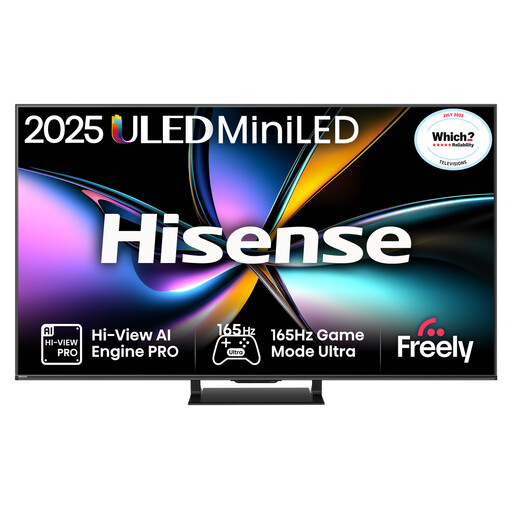
Hisense 65U7QTUK Pro 65-inch Mini-LED 4K TV
Consider this size if the screen must serve cinema seating as well as matches; measure the closer player seats too.
The product name specifies 165Hz Game Mode Ultra and a built-in subwoofer. Check which output modes your games and connected equipment can use.
View on Joybuy
 No image available
Hisense 55U7QTUK Pro 55-inch Mini-LED 4K TV
Consider the 55-inch size where player and spectator positions call for a different screen fit; measure both before choosing.
The product name specifies 165Hz Game Mode Ultra and a built-in subwoofer. Confirm the desired resolution and refresh mode with your source and HDMI path.
View on Joybuy
 No image available
TCL 55P8K-UK 55-inch QLED 4K HDR TV
This 55-inch option combines a QLED screen with gaming and built-in audio features for a shared match-and-film room.
The product name lists 288Hz Game Accelerator and an ONKYO 2.1 sound system. Check the supported input, resolution and source mode rather than treating the accelerator figure as a measured gaming result.
View on Joybuy
 No image available
TCL 75Q6C 75-inch QD-Mini LED 4K HDR TV
Consider this larger screen where spectators sit farther back, but check whether players seated near it will have a comfortable view.
The product name specifies a 144Hz native refresh rate. Confirm the refresh mode and resolution available from the intended console or PC through the chosen input.
View on Joybuy
 No image available
Samsung S90F 55-inch OLED 4K Vision AI TV (2025)
Consider this OLED model if one 55-inch screen will serve both films and fighting-game sessions.
Check the intended console or PC modes and HDMI-port allocation before buying. For extended events, plan how to avoid leaving HUDs and overlays fixed on the OLED screen unnecessarily.
View on Joybuy
Frequently asked questions
Do I need a 120Hz TV for fighting games?
Not for every game: a 120Hz TV does not make a game output more frames than the source supports. Choose 120Hz capability if the console or PC and games you intend to play can use it, or if you also want it for other compatible games. Check Game Mode and the complete connection path rather than using refresh rate alone as a measure of responsiveness.
How should I connect an Xbox Series X for 4K at 120Hz?
Connect it to an input that the exact TV model supports for 4K at 120Hz, then check the Xbox display settings and 4K TV details. Xbox Support says the supplied Series X Ultra High Speed HDMI cable supports HDMI 2.1 features including 4K at 120Hz; for a longer run, it advises a certified Ultra High Speed HDMI cable.
Why might a TV’s 4K/120Hz mode not work after installation?
The selected input may need a particular setting, or another device in the connection path may need to support the same mode. Sony instructs owners to enable Enhanced Format on the HDMI input used for 4K at 120Hz. For Sony’s K-65XR8M2, VRR is specified on HDMI inputs 3 and 4, so check the allocation of your console and audio equipment as well.
Can I use an OLED TV for long sessions with fixed game HUDs?
You can consider OLED, but prolonged fixed graphics deserve a care plan. Samsung explains that leaving a fixed image on screen for a long period can cause visible burn-in. Use the TV’s protection settings, avoid leaving static menus or overlays displayed unnecessarily, and check the terms applying to the model you choose.


