
24/7 Customer Support

Free returns

Same-day & Next-day Delivery

Quality Guaranteed

Unlock Your Welcome Offers: FREE Delivery | Up to 80% OFF | Free 30-day JoyPlus trial
Download the APP
A tidy desk can transform your workday, but finding the right file holder to conquer the paper clutter is often harder than it looks. Whether you're managing invoices in a home office, organising lecture notes or simply trying to keep household mail in check, the wrong choice can lead to more frustration than function. As a Joybuy Product Recommendation Officer, my role is to help you see past the marketing and focus on what truly matters for a practical, long-lasting solution.
Before you add another item to your basket, let’s look at the common pitfalls that many UK shoppers encounter. A little awareness can save you from a purchase you'll regret.
To avoid these issues, focus on a few core parameters. These details separate a reliable home office storage tool from a flimsy gimmick.
The material is the most critical factor. While plastic can be an option, a metal file sorter generally offers superior durability. Look for organisers made from high-quality metal with a powder-coated finish. This coating provides a vital layer of resistance against rust and oxidation, ensuring your organiser maintains its appearance and structural integrity over time. A mesh desk tidy design is also practical, as it allows you to see contents at a glance and prevents dust from accumulating. For desktop models, check for reinforcements like L-shaped supports on the back of each tier, which significantly improve load-bearing capacity.
Consider your available space. A desktop A4 paper tray or magazine holder is convenient for frequently accessed documents, but it must be stable. A key feature to look for is the inclusion of anti-slip rubber or EVA feet. These small additions are non-negotiable, as they protect your desk from scratches and prevent the unit from sliding.
If your desk space is limited, a wall mounted file holder is an excellent alternative. It utilises vertical space, keeping your work surface clear. When choosing this type, ensure it comes with appropriate mounting hardware. You may need to purchase specific wall anchors depending on your wall type (e.g., plasterboard vs. brick) to guarantee a secure installation.
Finally, think about what you need to store. Are you organising thin files, or bulky ring binders? Check the internal width and height of the compartments. A good document organiser will offer enough clearance for standard folders. For those managing multiple projects, a multi-tiered unit with integrated label plates is invaluable. This simple feature transforms a basic letter tray into a systematic filing system, allowing you to find what you need without searching through every slot.
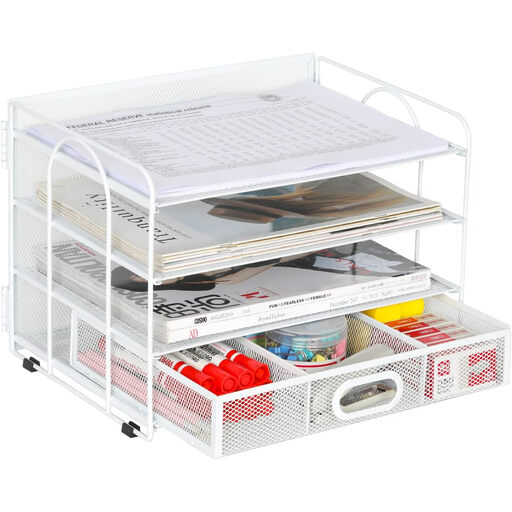
Why This Fits Their Persona: Ideal for those working from a smaller desk in a flat or home study. It combines vertical file storage with a handy drawer for pens and clips, consolidating clutter into one neat unit without sacrificing too much desk space.
Its robust metal construction with L-shaped supports prevents the frame from buckling. It also includes four anti-slip rubber feet, directly addressing the stability shortfall common in lesser models.
The integrated stationery drawer is a significant space-saver. Assembly is straightforward and requires no tools.
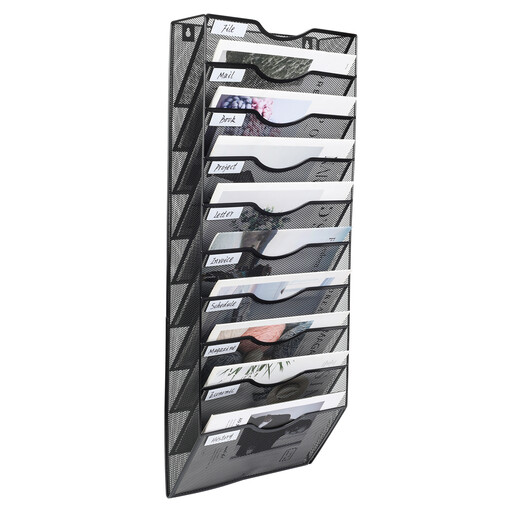
Why This Fits Their Persona: Perfect for administrative staff, students with multiple modules or anyone with a high volume of paperwork. This unit moves organisation off the desk and onto the wall, freeing up the entire work surface for active tasks.
By design, it eliminates desktop stability issues. The inclusion of label plates on each of the 10 tiers directly counters the "impractical design" trap, allowing for a highly organised, systematic approach to filing.
Offers extensive storage capacity in a minimal footprint. The arched pocket design makes retrieving documents quick and easy.
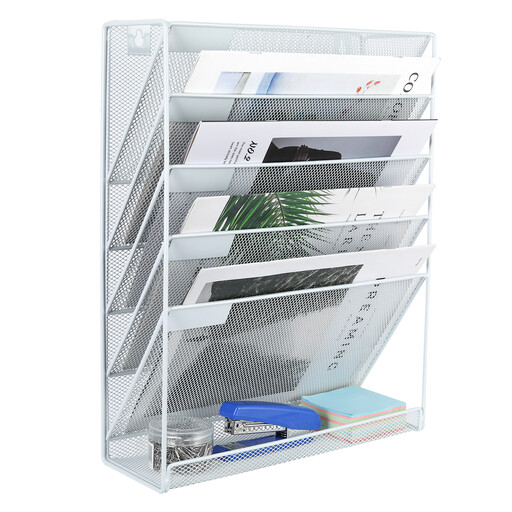
Why This Fits Their Persona: This is for the person who values versatility. It can be used as a freestanding desktop unit or mounted on a wall, making it adaptable to changing needs or different rooms, from the office to the entryway for mail.
The dual-purpose design gives you control over stability. Its durable, powder-coated metal build avoids the flimsy frame trap, and the addition of a bottom tray for small items makes it more practical than basic models.
Unmatched flexibility with its wall-mount or freestanding options. The built-in bottom tray is a thoughtful touch for storing keys or stationery.
We have compiled a complete, real-time list of products that fully satisfy these strict selection criteria and UK safety regulations.
While many organisers come with screws, these are often intended for solid brick or wood. For plasterboard, it is highly recommended to use dedicated plasterboard anchors, such as hollow wall anchors or toggle bolts. These expand behind the board to create a much more secure fixing that can confidently support the weight of the holder and its contents.
This is a valid concern. To prevent damage, always choose a desktop model that explicitly includes anti-slip rubber or EVA feet. These are specifically designed to protect your work surface from scratches while also stopping the organiser from sliding around during use.
This varies by design, but a well-made metal file sorter with features like L-shaped supports on its tiers can comfortably hold several kilograms of paper and files without bending. As a general rule, distribute the weight evenly across the tiers and avoid placing exceptionally heavy items like large, full binders on the top tier.