Coffee drinkers close to bedtime
If caffeine affects your sleep, consider decaf ground coffee rather than choosing a regular blend for its mild flavour. NHS Every Mind Matters notes that caffeine in coffee can make you feel more awake.


If bedtime is near or caffeine affects your sleep, choose decaffeinated ground coffee whose pack names your filter brewer; a mild roast or low intensity score does not establish a lower caffeine content. A regular blend remains an option when caffeine timing is not a concern, but whichever you choose, check the preparation guidance for the exact coffee.
If caffeine affects your sleep, consider decaf ground coffee rather than choosing a regular blend for its mild flavour. NHS Every Mind Matters notes that caffeine in coffee can make you feel more awake.
Choose ground coffee with preparation guidance for the brewer you own. Lavazza lists its Decaf ground coffee for filter and French-press preparation, while its wider range guidance says grinds are calibrated for their intended brewing methods.
Consider the coffee alongside other sources of caffeine. The NHS advises a limit of 200mg of caffeine a day during pregnancy and recommends the same daily limit while breastfeeding.
Start with caffeine timing and brewer compatibility, then use roast and flavour descriptions to choose between suitable coffees.
| Priority | What to check | Your needs |
|---|---|---|
| Caffeine timing | Check whether the exact coffee is labelled decaffeinated. Do not use a mild roast or intensity score as a caffeine measurement; NHS Every Mind Matters notes that caffeine can make you feel more awake. | I may be going to bed soon, so caffeine matters more to me than a mild-sounding flavour description. |
| Brewer fit | Look for preparation guidance naming your filter machine, cafetière or French press. Lavazza lists filter and French press for its Decaf ground coffee; that statement does not cover every ground coffee. | I want to use the brewer I already own, rather than assume any ground-coffee pack will suit it. |
| Roast and flavour | Compare the exact packs’ roast, body and stated flavour notes once their caffeine labelling and brewing method fit. Treat intensity as a flavour cue, not proof of caffeine content. | With supper, I would choose flavour according to my own preference without mistaking a less forceful taste for decaf. |
| Daily caffeine | Account for caffeine from other drinks and foods. The NHS advises no more than 200mg a day during pregnancy and recommends no more than 200mg a day while breastfeeding; caffeine amounts vary by drink and preparation. | If I am pregnant or breastfeeding, I need to consider the whole day’s caffeine, not just the after-supper cup. |
| Brewing format | Check whether the product is ground coffee or instant coffee. Decaf instant can make a quick drink, but it is not used in a filter brewer in the same way as ground coffee. | Sometimes speed matters more to me; otherwise, I want the ground-coffee brewing method I set out to use. |
A mild or low-intensity regular coffee is not thereby decaffeinated. NHS Every Mind Matters notes that caffeine can make you feel more awake.
If caffeine timing is the reason for your choice, check for a decaffeinated label before comparing roast and flavour notes.
Lavazza says its ground blends are calibrated for intended brewing methods, so the word “ground” alone does not identify the right preparation method.
Check that the exact product names your filter machine, cafetière or French press before buying it for that brewer.
Decaf instant coffee is a different format from ground coffee prepared in a filter machine or cafetière.
Choose instant when a quick drink matters more than using your brewer; otherwise, look for decaf ground coffee with suitable preparation guidance.
These product references help distinguish ground decaf coffee from instant alternatives; check the exact pack for your brewing method.
Lavazza UK lists its Decaf ground coffee for moka, filter and French-press preparation.
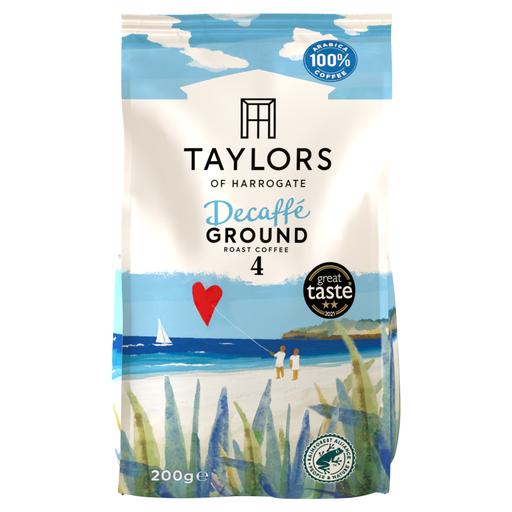
Tesco Groceries and Sainsbury’s list Taylors Decaffé Roast Ground Coffee 200g among their decaf coffees.
Tesco Groceries lists Tesco Finest Decaffeinated Colombian Ground Coffee 227g in its decaf range.
Sainsbury’s decaf range lists own-label Colombian decaf coffee and Italian decaf roast-and-ground coffee.
M&S describes its Decaf Ground Coffee as made from 100% arabica beans.
Sainsbury’s lists Douwe Egberts Pure Decaf Instant Coffee as an alternative format.
These ground coffees cover two different after-supper decisions: checking a coffee’s caffeine labelling when timing matters, or choosing a filter-compatible option when it does not.
 No image available
The product information names filter-machine and cafetière preparation. If caffeine timing matters after supper, check the pack’s caffeine labelling rather than treating “After Dark” as a decaf designation.
 No image available
This is labelled decaf ground coffee for shoppers considering caffeine timing after supper. Check the exact pack’s preparation instructions before buying it for a filter machine or cafetière.
Not when reducing caffeine before bed is your reason for choosing decaf: mild and low-intensity descriptions are flavour cues, not caffeine measurements. NHS Every Mind Matters notes that caffeine in coffee can make you feel more awake, so check for a decaffeinated label when timing matters.
Check the exact product’s preparation directions for your brewer. Lavazza UK explicitly lists filter and French-press preparation for its Decaf ground coffee, but that does not establish compatibility for other ground coffees.
The NHS advises no more than 200mg of caffeine a day during pregnancy and notes that filter coffee can contain more caffeine than its example amount for instant coffee. Consider caffeine from all sources when choosing your drink; the amount in a cup depends on the coffee and preparation.
The NHS recommends no more than 200mg of caffeine a day while breastfeeding. Because caffeine amounts vary by drink and preparation, do not assume that every brewed cup contributes the same amount.