What matters when choosing?
Work out the volume needed for one lunch first, then decide how long coffee must wait before it is served; convenience features come after those choices.
| Concern | What to check | Who this matters to |
|---|
| One-batch capacity |
Compare the stated capacity in litres with your intended mug size and likely refills; check the minimum batch if you also brew for fewer people. |
If I am serving several people together, I want one batch to cover their pours rather than interrupt lunch to brew again. Around 36% of consumers put sufficient batch capacity first. |
| Staggered serving |
Check whether the jug is thermal or uses a hotplate, and compare the exact model’s stated heat-retention or auto-off period with your serving window. |
When guests pour at different times, I need to know how the coffee will be held between servings. For around 29% of consumers, that holding arrangement is the main concern. |
| Filling and cleaning |
Look at tank and filter-holder access, whether a reusable filter is supplied, and the manufacturer’s descaling instructions. |
If I make lunch coffee regularly, awkward filling and clearing grounds would make the routine harder to keep up. Ease of care comes first for around 21% of consumers. |
| Preparation controls |
Check timer and strength settings, whether an integrated grinder accepts pre-ground coffee, and the machine’s stated brewing range. |
I may want to prepare coffee for a planned lunch time or adjust it for different tastes, even if that means more parts to clean. Around 14% of consumers prioritise those controls. |
Joybuy product choices
These two 1.25 L Moccamaster brewers address different shared-lunch serving schedules: the KBG Select has a glass jug and hotplate, while the KBGT has a thermal jug. Check how their stated cup measure translates to your mugs before choosing either.
 No image available
Moccamaster KBG Select Filter Coffee Maker, 1.25 L, Black (53818)
Consider the KBG Select when guests will pour soon after a shared batch is brewed.
- The named variant has a stated 1.25 L capacity; allow for fewer servings if you use large mugs.
- Moccamaster specifies a 40-minute hotplate auto-off for the KBG Select. Check that period against your lunch schedule.
- Confirm the plug and intended UK market with the seller, along with cleaning instructions and replacement-jug options.
View on Joybuy
 No image available
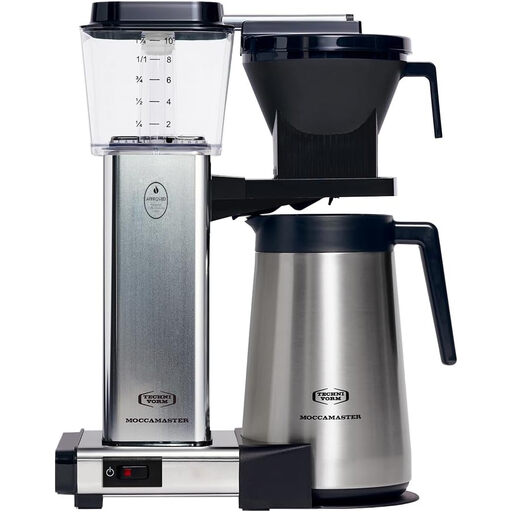
Moccamaster KBGT Filter Coffee Maker with Thermal Jug, 1.25 L, Polished Silver (79411)
Consider the KBGT if lunch guests will pour coffee at different times or the jug will be moved away from the brewer.
- The named variant has a stated 1.25 L capacity and a thermal jug; compare the volume with your intended mug servings.
- Moccamaster claims a full KBGT jug retains 80°C for up to three hours. Check whether its pouring and holding arrangement suits your plans.
- Confirm the plug and intended UK market with the seller, as well as lid care and replacement-jug options.
View on Joybuy
Common questions
What capacity do I need for a shared lunch?
Choose by the litres you expect to serve and the size of your mugs, rather than by cup count alone. Melitta, Moccamaster and Morphy Richards describe particular 1.2–1.25 L brewers as making up to about 10 cups; large mugs or refills may call for a second batch.
Is a thermal jug or a glass jug better for staggered serving?
A thermal jug is the more relevant choice when people will pour in stages or carry the jug away from the brewer; a glass jug with a hotplate can suit coffee served promptly. Compare the exact thermal-retention claim or hotplate auto-off period, as these vary by model.
How much ground coffee should I prepare for a 1.25 L batch?
De’Longhi’s UK guidance gives 75 g of ground coffee for a typical 1.25 L machine, based on 60 g per litre. Treat that as a starting point, adjust to taste and follow your brewer’s instructions where they differ.
How should I clean and descale a filter coffee maker?
Clean removable parts and descale according to your particular machine’s instructions. Morphy Richards advises warm soapy water for removable parts and monthly descaling with an approved solution for its cited model; the appropriate routine can vary with the machine and local water conditions.
What electrical-safety checks matter when buying in the UK?
Buy from a trusted retailer and confirm that the brewer and plug are supplied for your part of the UK before ordering. Great Britain and Northern Ireland have different regulatory contexts, so ask the seller if a listing is unclear; keep the instructions and purchase record, and check current recalls through the Office for Product Safety and Standards.


